
Using the data in the table below, compute Q1 and Q3.
Table of contents
- 1. Intro to Stats and Collecting Data1h 14m
- 2. Describing Data with Tables and Graphs1h 56m
- 3. Describing Data Numerically2h 5m
- 4. Probability2h 16m
- 5. Binomial Distribution & Discrete Random Variables3h 6m
- 6. Normal Distribution and Continuous Random Variables2h 11m
- 7. Sampling Distributions & Confidence Intervals: Mean3h 23m
- Sampling Distribution of the Sample Mean and Central Limit Theorem19m
- Distribution of Sample Mean - ExcelBonus23m
- Introduction to Confidence Intervals15m
- Confidence Intervals for Population Mean1h 18m
- Determining the Minimum Sample Size Required12m
- Finding Probabilities and T Critical Values - ExcelBonus28m
- Confidence Intervals for Population Means - ExcelBonus25m
- 8. Sampling Distributions & Confidence Intervals: Proportion2h 10m
- 9. Hypothesis Testing for One Sample5h 8m
- Steps in Hypothesis Testing1h 6m
- Performing Hypothesis Tests: Means1h 4m
- Hypothesis Testing: Means - ExcelBonus42m
- Performing Hypothesis Tests: Proportions37m
- Hypothesis Testing: Proportions - ExcelBonus27m
- Performing Hypothesis Tests: Variance12m
- Critical Values and Rejection Regions28m
- Link Between Confidence Intervals and Hypothesis Testing12m
- Type I & Type II Errors16m
- 10. Hypothesis Testing for Two Samples5h 37m
- Two Proportions1h 13m
- Two Proportions Hypothesis Test - ExcelBonus28m
- Two Means - Unknown, Unequal Variance1h 3m
- Two Means - Unknown Variances Hypothesis Test - ExcelBonus12m
- Two Means - Unknown, Equal Variance15m
- Two Means - Unknown, Equal Variances Hypothesis Test - ExcelBonus9m
- Two Means - Known Variance12m
- Two Means - Sigma Known Hypothesis Test - ExcelBonus21m
- Two Means - Matched Pairs (Dependent Samples)42m
- Matched Pairs Hypothesis Test - ExcelBonus12m
- Two Variances and F Distribution29m
- Two Variances - Graphing CalculatorBonus16m
- 11. Correlation1h 24m
- 12. Regression3h 33m
- Linear Regression & Least Squares Method26m
- Residuals12m
- Coefficient of Determination12m
- Regression Line Equation and Coefficient of Determination - ExcelBonus8m
- Finding Residuals and Creating Residual Plots - ExcelBonus11m
- Inferences for Slope31m
- Enabling Data Analysis ToolpakBonus1m
- Regression Readout of the Data Analysis Toolpak - ExcelBonus21m
- Prediction Intervals13m
- Prediction Intervals - ExcelBonus19m
- Multiple Regression - ExcelBonus29m
- Quadratic Regression15m
- Quadratic Regression - ExcelBonus10m
- 13. Chi-Square Tests & Goodness of Fit2h 21m
- 14. ANOVA2h 28m
3. Describing Data Numerically
Percentiles & Quartiles
Problem 2.5.11a
Textbook Question
Using and Interpreting Concepts
Using and Interpreting Concepts Finding Quartiles, Interquartile Range, and Outliers In Exercises 11 and 12,
(a) find the quartiles
56 63 51 60 57 60 60 54 63 59 80 63 60 62 65
Verified step by step guidance1
Step 1: Arrange the data set in ascending order. The given data set is: 56, 63, 51, 60, 57, 60, 60, 54, 63, 59, 80, 63, 60, 62, 65. Sorting it will help identify the quartiles.
Step 2: Identify the median (Q2). The median is the middle value of the ordered data set. If the number of data points is odd, the median is the middle value. If even, it is the average of the two middle values.
Step 3: Find the first quartile (Q1). Q1 is the median of the lower half of the data set (values below the overall median).
Step 4: Find the third quartile (Q3). Q3 is the median of the upper half of the data set (values above the overall median).
Step 5: Calculate the interquartile range (IQR) and identify outliers. The IQR is given by IQR = Q3 - Q1. Outliers are values that fall below Q1 - 1.5 * IQR or above Q3 + 1.5 * IQR.
Verified video answer for a similar problem:This video solution was recommended by our tutors as helpful for the problem above
Video duration:
2mPlay a video:
0 Comments
Key Concepts
Here are the essential concepts you must grasp in order to answer the question correctly.
Quartiles
Quartiles are values that divide a dataset into four equal parts, each containing 25% of the data. The first quartile (Q1) is the median of the lower half of the data, the second quartile (Q2) is the overall median, and the third quartile (Q3) is the median of the upper half. These values help summarize the distribution of the data and are essential for understanding its spread.
Recommended video:
Guided course
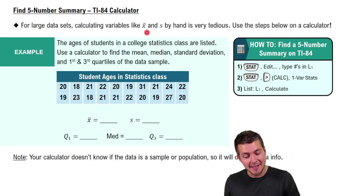
Find 5-Number Summary - TI-84 Calculator
Interquartile Range (IQR)
The interquartile range (IQR) is a measure of statistical dispersion, calculated as the difference between the third quartile (Q3) and the first quartile (Q1). It represents the range within which the central 50% of the data lies, providing insight into the variability of the dataset while being resistant to outliers. A smaller IQR indicates less variability, while a larger IQR suggests more spread in the data.
Recommended video:
Guided course
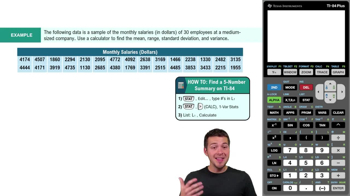
Find 5-Number Summary - TI-84 Calculator Example 1
Outliers
Outliers are data points that significantly differ from the rest of the dataset, often lying outside the range defined by Q1 - 1.5*IQR and Q3 + 1.5*IQR. Identifying outliers is crucial as they can skew the results and affect statistical analyses. Understanding outliers helps in making informed decisions about data cleaning and interpretation.
Recommended video:
Guided course
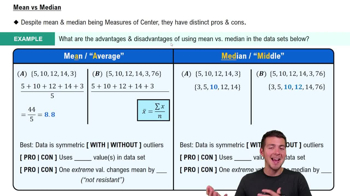
Comparing Mean vs. Median
Related Videos
Related Practice
Multiple Choice
278
views
3
rank
1
comments
