Project Find a real-life data set and use the techniques of Chapter 2, including graphs and numerical quantities, to discuss the center, variation, and shape of the data set. Describe any patterns.
Table of contents
- 1. Intro to Stats and Collecting Data1h 14m
- 2. Describing Data with Tables and Graphs1h 55m
- 3. Describing Data Numerically2h 5m
- 4. Probability2h 16m
- 5. Binomial Distribution & Discrete Random Variables3h 6m
- 6. Normal Distribution and Continuous Random Variables2h 11m
- 7. Sampling Distributions & Confidence Intervals: Mean3h 23m
- Sampling Distribution of the Sample Mean and Central Limit Theorem19m
- Distribution of Sample Mean - Excel23m
- Introduction to Confidence Intervals15m
- Confidence Intervals for Population Mean1h 18m
- Determining the Minimum Sample Size Required12m
- Finding Probabilities and T Critical Values - Excel28m
- Confidence Intervals for Population Means - Excel25m
- 8. Sampling Distributions & Confidence Intervals: Proportion1h 25m
- 9. Hypothesis Testing for One Sample3h 29m
- 10. Hypothesis Testing for Two Samples4h 50m
- Two Proportions1h 13m
- Two Proportions Hypothesis Test - Excel28m
- Two Means - Unknown, Unequal Variance1h 3m
- Two Means - Unknown Variances Hypothesis Test - Excel12m
- Two Means - Unknown, Equal Variance15m
- Two Means - Unknown, Equal Variances Hypothesis Test - Excel9m
- Two Means - Known Variance12m
- Two Means - Sigma Known Hypothesis Test - Excel21m
- Two Means - Matched Pairs (Dependent Samples)42m
- Matched Pairs Hypothesis Test - Excel12m
- 11. Correlation1h 24m
- 12. Regression1h 50m
- 13. Chi-Square Tests & Goodness of Fit2h 21m
- 14. ANOVA1h 57m
3. Describing Data Numerically
Describing Data Numerically Using a Graphing Calculator
Problem 3.T.9
Textbook Question
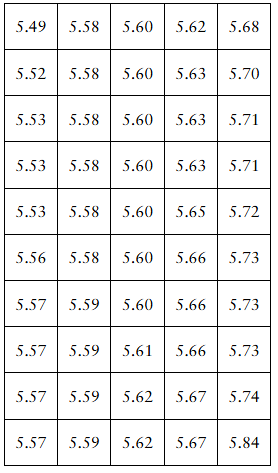
The following data represent the weights (in grams) of 50 randomly selected quarters. Determine and interpret the quartiles. Does the data set contain any outliers?

Verified step by step guidance1
Step 1: Organize the data in ascending order if not already sorted. Here, the data appears sorted from 5.49 to 5.84 grams.
Step 2: Determine the quartiles Q1, Q2 (median), and Q3. Since there are 50 data points, calculate the positions using the formulas: \(Q1 = \frac{1}{4} (n+1)\)-th value, \(Q2 = \frac{1}{2} (n+1)\)-th value, and \(Q3 = \frac{3}{4} (n+1)\)-th value, where \(n=50\).
Step 3: Find the values at these positions or interpolate if necessary to get the exact quartile values.
Step 4: Interpret the quartiles: Q1 is the 25th percentile, meaning 25% of the data is below this value; Q2 is the median, the middle value; Q3 is the 75th percentile, meaning 75% of the data is below this value.
Step 5: To check for outliers, calculate the interquartile range (IQR) as \(IQR = Q3 - Q1\). Then determine the lower bound as \(Q1 - 1.5 \times IQR\) and the upper bound as \(Q3 + 1.5 \times IQR\). Any data points outside these bounds are considered outliers.
Verified video answer for a similar problem:This video solution was recommended by our tutors as helpful for the problem above
Video duration:
6mPlay a video:
Was this helpful?
Key Concepts
Here are the essential concepts you must grasp in order to answer the question correctly.
Quartiles
Quartiles divide a data set into four equal parts after the data is sorted. The first quartile (Q1) is the median of the lower half, the second quartile (Q2) is the overall median, and the third quartile (Q3) is the median of the upper half. Quartiles help summarize the distribution and spread of the data.
Recommended video:
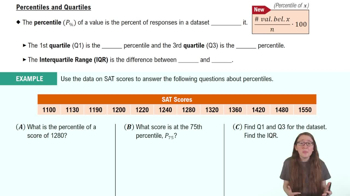
Percentiles and Quartiles
Interquartile Range (IQR)
The interquartile range (IQR) is the difference between the third quartile (Q3) and the first quartile (Q1). It measures the spread of the middle 50% of the data and is used to understand variability and detect outliers by focusing on the central portion of the data.
Recommended video:
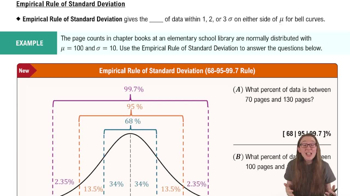
Empirical Rule of Standard Deviation and Range Rule of Thumb
Outlier Detection Using IQR
Outliers are data points that fall significantly outside the typical range. Using the IQR, outliers are identified as values below Q1 - 1.5*IQR or above Q3 + 1.5*IQR. This method helps detect unusual values that may affect analysis or indicate errors.
Recommended video:
Guided course
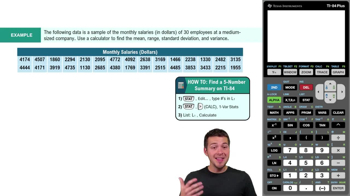
Find 5-Number Summary - TI-84 Calculator Example 1
Watch next
Master Find 5-Number Summary - TI-84 Calculator with a bite sized video explanation from Patrick
Start learningRelated Videos
Related Practice
Textbook Question
47
views