Suppose you simulate 25 games and record the values of the random variable for each game. Which of the following is the correct formula to approximate the mean of based on your simulation results?
Table of contents
- 1. Intro to Stats and Collecting Data1h 14m
- 2. Describing Data with Tables and Graphs1h 55m
- 3. Describing Data Numerically2h 5m
- 4. Probability2h 16m
- 5. Binomial Distribution & Discrete Random Variables3h 6m
- 6. Normal Distribution and Continuous Random Variables2h 11m
- 7. Sampling Distributions & Confidence Intervals: Mean3h 23m
- Sampling Distribution of the Sample Mean and Central Limit Theorem19m
- Distribution of Sample Mean - Excel23m
- Introduction to Confidence Intervals15m
- Confidence Intervals for Population Mean1h 18m
- Determining the Minimum Sample Size Required12m
- Finding Probabilities and T Critical Values - Excel28m
- Confidence Intervals for Population Means - Excel25m
- 8. Sampling Distributions & Confidence Intervals: Proportion1h 25m
- 9. Hypothesis Testing for One Sample3h 29m
- 10. Hypothesis Testing for Two Samples4h 50m
- Two Proportions1h 13m
- Two Proportions Hypothesis Test - Excel28m
- Two Means - Unknown, Unequal Variance1h 3m
- Two Means - Unknown Variances Hypothesis Test - Excel12m
- Two Means - Unknown, Equal Variance15m
- Two Means - Unknown, Equal Variances Hypothesis Test - Excel9m
- Two Means - Known Variance12m
- Two Means - Sigma Known Hypothesis Test - Excel21m
- Two Means - Matched Pairs (Dependent Samples)42m
- Matched Pairs Hypothesis Test - Excel12m
- 11. Correlation1h 24m
- 12. Regression1h 50m
- 13. Chi-Square Tests & Goodness of Fit2h 21m
- 14. ANOVA1h 57m
3. Describing Data Numerically
Mean
Problem 3.1.39
Textbook Question
Geometric Mean The geometric mean is often used in business and economics for finding average rates of change, average rates of growth, or average ratios. To find the geometric mean of n values (all of which are positive), first multiply the values, then find the nth root of the product. For a 6-year period, money deposited in annual certificates of deposit had annual interest rates of 0.58%, 0.29%, 0.13%, 0.14%, 0.15%, and 0.19%. Identify the single percentage growth rate that is the same as the six consecutive growth rates by computing the geometric mean of 1.0058, 1.0029, 1.0013, 1.0014, 1.0015, and 1.0019.
Verified step by step guidance1
Step 1: Understand the problem. The geometric mean is used to find a single growth rate that represents the average of multiple growth rates. The formula for the geometric mean is: \( \text{Geometric Mean} = \sqrt[n]{x_1 \cdot x_2 \cdot x_3 \cdot \ldots \cdot x_n} \), where \( n \) is the number of values and \( x_1, x_2, \ldots, x_n \) are the values.
Step 2: Identify the values to use in the formula. The given growth rates are 1.0058, 1.0029, 1.0013, 1.0014, 1.0015, and 1.0019. These represent the annual growth factors for the 6-year period.
Step 3: Multiply all the growth factors together. This means calculating \( 1.0058 \cdot 1.0029 \cdot 1.0013 \cdot 1.0014 \cdot 1.0015 \cdot 1.0019 \).
Step 4: Take the 6th root of the product obtained in Step 3. The 6th root can be expressed as raising the product to the power of \( \frac{1}{6} \), i.e., \( \text{Geometric Mean} = (\text{Product})^{1/6} \).
Step 5: Subtract 1 from the geometric mean obtained in Step 4 and multiply by 100 to convert it back to a percentage growth rate. This gives the single percentage growth rate equivalent to the six consecutive growth rates.
Verified video answer for a similar problem:This video solution was recommended by our tutors as helpful for the problem above
Video duration:
2mPlay a video:
Was this helpful?
Key Concepts
Here are the essential concepts you must grasp in order to answer the question correctly.
Geometric Mean
The geometric mean is a measure of central tendency that is particularly useful for sets of positive numbers, especially when dealing with rates of change or growth. It is calculated by multiplying all the values together and then taking the nth root of the product, where n is the number of values. This mean is less affected by extreme values compared to the arithmetic mean, making it ideal for financial and economic data.
Recommended video:
Guided course
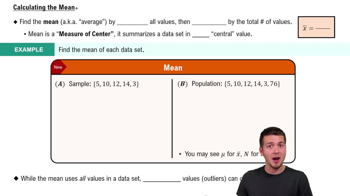
Calculating the Mean
Rates of Change
Rates of change represent how a quantity changes over time, often expressed as a percentage. In finance, they are crucial for understanding growth rates, such as interest rates or investment returns. The geometric mean is particularly suited for calculating average rates of change over multiple periods, as it accounts for compounding effects, providing a more accurate representation of growth.
Recommended video:
Guided course
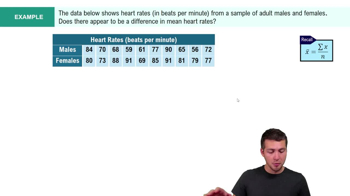
Calculating the Mean Example 1
Compounding
Compounding refers to the process where the value of an investment increases because the earnings on an investment earn interest as time passes. This concept is fundamental in finance, as it affects how growth rates are calculated over time. The geometric mean effectively captures the impact of compounding by averaging growth rates, allowing for a single growth rate that reflects the cumulative effect of multiple periods.
Watch next
Master Calculating the Mean with a bite sized video explanation from Patrick
Start learningRelated Videos
Related Practice
Multiple Choice
14
views
