The sample mean is the point estimator of which population parameter?
Table of contents
- 1. Intro to Stats and Collecting Data1h 14m
- 2. Describing Data with Tables and Graphs1h 55m
- 3. Describing Data Numerically2h 5m
- 4. Probability2h 16m
- 5. Binomial Distribution & Discrete Random Variables3h 6m
- 6. Normal Distribution and Continuous Random Variables2h 11m
- 7. Sampling Distributions & Confidence Intervals: Mean3h 23m
- Sampling Distribution of the Sample Mean and Central Limit Theorem19m
- Distribution of Sample Mean - Excel23m
- Introduction to Confidence Intervals15m
- Confidence Intervals for Population Mean1h 18m
- Determining the Minimum Sample Size Required12m
- Finding Probabilities and T Critical Values - Excel28m
- Confidence Intervals for Population Means - Excel25m
- 8. Sampling Distributions & Confidence Intervals: Proportion1h 25m
- 9. Hypothesis Testing for One Sample3h 29m
- 10. Hypothesis Testing for Two Samples4h 50m
- Two Proportions1h 13m
- Two Proportions Hypothesis Test - Excel28m
- Two Means - Unknown, Unequal Variance1h 3m
- Two Means - Unknown Variances Hypothesis Test - Excel12m
- Two Means - Unknown, Equal Variance15m
- Two Means - Unknown, Equal Variances Hypothesis Test - Excel9m
- Two Means - Known Variance12m
- Two Means - Sigma Known Hypothesis Test - Excel21m
- Two Means - Matched Pairs (Dependent Samples)42m
- Matched Pairs Hypothesis Test - Excel12m
- 11. Correlation1h 24m
- 12. Regression1h 50m
- 13. Chi-Square Tests & Goodness of Fit2h 21m
- 14. ANOVA1h 57m
3. Describing Data Numerically
Mean
Problem 3.1.34
Textbook Question
Weighted Mean A student of the author earned grades of 63, 91, 88, 84, and 79 on her five regular statistics tests. She earned grades of 86 on the final exam and 90 on her class projects. Her combined homework grade was 70. The five regular tests count for 60% of the final grade, the final exam counts for 10%, the project counts for 15%, and homework counts for 15%. What is her weighted mean grade? What letter grade did she earn (A, B, C, D, or F)? Assume that a mean of 90 or above is an A, a mean of 80 to 89 is a B, and so on.
Verified step by step guidance1
Calculate the average grade for the five regular tests. Add the grades together and divide by the number of tests: (63 + 91 + 88 + 84 + 79) / 5.
Multiply the average grade of the regular tests by their weight (60%) to find the contribution to the final grade: \( \text{Average of regular tests} \times 0.60 \).
Multiply the final exam grade by its weight (10%) to find its contribution to the final grade: \( 86 \times 0.10 \).
Multiply the project grade by its weight (15%) to find its contribution to the final grade: \( 90 \times 0.15 \).
Multiply the homework grade by its weight (15%) to find its contribution to the final grade: \( 70 \times 0.15 \).
Verified video answer for a similar problem:This video solution was recommended by our tutors as helpful for the problem above
Video duration:
4mPlay a video:
Was this helpful?
Key Concepts
Here are the essential concepts you must grasp in order to answer the question correctly.
Weighted Mean
The weighted mean is a type of average where each data point contributes to the final average according to its assigned weight. In this context, different components of the student's grade (tests, final exam, project, and homework) have different weights that sum up to 100%. To calculate the weighted mean, multiply each grade by its respective weight, sum these products, and divide by the total weight.
Recommended video:
Guided course
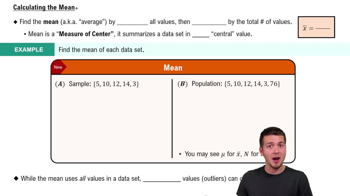
Calculating the Mean
Percentage Weights
Percentage weights are used to express the relative importance of each component in a composite score. In this problem, the weights are given as percentages: 60% for regular tests, 10% for the final exam, 15% for the project, and 15% for homework. These weights determine how much each component influences the overall grade, reflecting their significance in the final assessment.
Recommended video:
Constructing Confidence Intervals for Proportions Example 2
Grading Scale
A grading scale is a system that translates numerical scores into letter grades, providing a qualitative assessment of performance. In this scenario, the scale is defined as follows: a mean of 90 or above is an A, 80 to 89 is a B, 70 to 79 is a C, 60 to 69 is a D, and below 60 is an F. This scale helps in categorizing the student's performance based on the calculated weighted mean.
Recommended video:
Guided course
How to Create Histogram - TI-84 Calculator
Watch next
Master Calculating the Mean with a bite sized video explanation from Patrick
Start learningRelated Videos
Related Practice
Multiple Choice
16
views