According to the U.S. Department of Education, 42.8% of 3-year-olds are enrolled in day care. What is the probability that a randomly selected 3-year-old is enrolled in day care?
Table of contents
- 1. Intro to Stats and Collecting Data1h 14m
- 2. Describing Data with Tables and Graphs1h 55m
- 3. Describing Data Numerically2h 5m
- 4. Probability2h 16m
- 5. Binomial Distribution & Discrete Random Variables3h 6m
- 6. Normal Distribution and Continuous Random Variables2h 11m
- 7. Sampling Distributions & Confidence Intervals: Mean3h 23m
- Sampling Distribution of the Sample Mean and Central Limit Theorem19m
- Distribution of Sample Mean - Excel23m
- Introduction to Confidence Intervals15m
- Confidence Intervals for Population Mean1h 18m
- Determining the Minimum Sample Size Required12m
- Finding Probabilities and T Critical Values - Excel28m
- Confidence Intervals for Population Means - Excel25m
- 8. Sampling Distributions & Confidence Intervals: Proportion1h 25m
- 9. Hypothesis Testing for One Sample3h 29m
- 10. Hypothesis Testing for Two Samples4h 50m
- Two Proportions1h 13m
- Two Proportions Hypothesis Test - Excel28m
- Two Means - Unknown, Unequal Variance1h 3m
- Two Means - Unknown Variances Hypothesis Test - Excel12m
- Two Means - Unknown, Equal Variance15m
- Two Means - Unknown, Equal Variances Hypothesis Test - Excel9m
- Two Means - Known Variance12m
- Two Means - Sigma Known Hypothesis Test - Excel21m
- Two Means - Matched Pairs (Dependent Samples)42m
- Matched Pairs Hypothesis Test - Excel12m
- 11. Correlation1h 24m
- 12. Regression1h 50m
- 13. Chi-Square Tests & Goodness of Fit2h 21m
- 14. ANOVA1h 57m
4. Probability
Basic Concepts of Probability
Problem 5.1.38b
Textbook Question
"[DATA] A Random Process: Green Lights On your drives to school each day you feel like there is a light that is always red when you reach it. You decide to record data to determine the likelihood of arriving at the light while it is red. Open the data set 5_1_38 at www.pearsonhighered.com/sullivanstats, which contains the day number and whether the light was red (1), or not (0), for 120 consecutive days in which you drove to school.
b. What proportion of the days were you stuck by a red light after 15 days?"
Verified step by step guidance1
Identify the variable of interest, which is whether the light was red (coded as 1) or not (coded as 0) for each day.
Focus on the data for the first 15 days from the dataset, specifically the values corresponding to days 1 through 15.
Count the number of days within these 15 days where the light was red (i.e., the number of 1s in the data for these days).
Calculate the proportion of days with a red light by dividing the count of red light days by the total number of days considered (which is 15). This can be expressed as:
\(\text{Proportion} = \frac{\text{Number of days with red light}}{15}\)
Interpret this proportion as the likelihood or probability of encountering a red light on any given day within the first 15 days.
Verified video answer for a similar problem:This video solution was recommended by our tutors as helpful for the problem above
Video duration:
2mPlay a video:
Was this helpful?
Key Concepts
Here are the essential concepts you must grasp in order to answer the question correctly.
Proportion
Proportion is a measure that represents the fraction of times an event occurs relative to the total number of observations. In this context, it is the number of days the light was red divided by the total days observed. Proportions range from 0 to 1 and can be expressed as percentages for easier interpretation.
Recommended video:
Guided course
Difference in Proportions: Hypothesis Tests
Binary Data
Binary data consists of observations with only two possible outcomes, such as red light (1) or not red light (0). This type of data is useful for calculating proportions and probabilities because each trial results in a simple yes/no or success/failure outcome.
Recommended video:
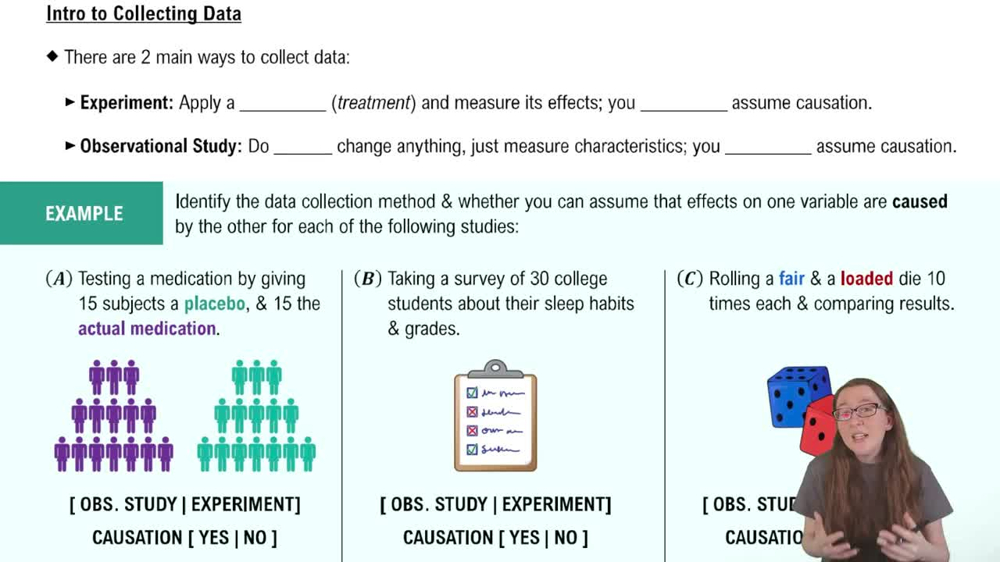
Introduction to Collecting Data
Data Summarization and Interpretation
Data summarization involves organizing and condensing raw data to extract meaningful information, such as calculating the proportion of red light occurrences in the first 15 days. Interpretation means understanding what this proportion tells us about the likelihood of encountering a red light during those days.
Recommended video:
Introduction to Collecting Data
Watch next
Master Introduction to Probability with a bite sized video explanation from Patrick
Start learningRelated Videos
Related Practice
Textbook Question
8
views