
Ch. 10 - Correlation and Regression
Triola - Elementary Statistics 14th Edition
Triola14th EditionElementary StatisticsISBN: 9780137366446Not the one you use?Change textbook
Chapter 10, Problem 10.1.14

Testing for a Linear Correlation
In Exercises 13–28, construct a scatterplot, and find the value of the linear correlation coefficient r. Also find the P-value or the critical values of r from Table A-6. Use a significance level of α = 0.05. Determine whether there is sufficient evidence to support a claim of a linear correlation between the two variables. (Save your work because the same data sets will be used in Section 10-2 exercises.)
Powerball Jackpots and Tickets Sold Listed below are the same data from Table 10-1 in the Chapter Problem, but an additional pair of values has been added from actual Powerball results. Is there sufficient evidence to conclude that there is a linear correlation between lottery jackpots and numbers of tickets sold? Comment on the effect of the added pair of values in the last column. Compare the results to those obtained in Example 4.
Table showing Powerball jackpots and tickets sold with values: 334, 127, 300, 54, 16, 41, etc.

Verified step by step guidance
1
Step 1: Construct a scatterplot. Plot the given data points on a graph where the x-axis represents the jackpot values and the y-axis represents the number of tickets sold. Each pair of values (e.g., (334, 54)) corresponds to a point on the scatterplot.
Step 2: Calculate the linear correlation coefficient (r). Use the formula for r: r = (nΣ(xy) - ΣxΣy) / sqrt([(nΣ(x^2) - (Σx)^2)][(nΣ(y^2) - (Σy)^2)]), where n is the number of data points, Σ(xy) is the sum of the products of paired values, Σx and Σy are the sums of x and y values, and Σ(x^2) and Σ(y^2) are the sums of the squares of x and y values.
Step 3: Determine the critical value of r or the P-value. Use Table A-6 to find the critical value of r for a significance level of α = 0.05 and the appropriate degrees of freedom (df = n - 2). Alternatively, calculate the P-value using statistical software or a calculator.
Step 4: Compare the calculated r value to the critical value or interpret the P-value. If |r| is greater than the critical value or if the P-value is less than α = 0.05, there is sufficient evidence to support the claim of a linear correlation.
Step 5: Analyze the effect of the added pair of values (625, 90). Recalculate the correlation coefficient and compare it to the previous results (e.g., Example 4). Discuss whether the added pair strengthens or weakens the evidence for a linear correlation.

Verified video answer for a similar problem:

This video solution was recommended by our tutors as helpful for the problem above.
Video duration:
5m
Was this helpful?

Key Concepts

Here are the essential concepts you must grasp in order to answer the question correctly.

Linear Correlation Coefficient (r)

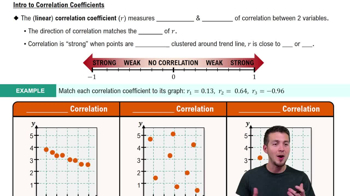
The linear correlation coefficient, denoted as r, quantifies the strength and direction of a linear relationship between two variables. Its value ranges from -1 to 1, where 1 indicates a perfect positive correlation, -1 indicates a perfect negative correlation, and 0 indicates no correlation. Understanding r is crucial for determining whether a linear relationship exists between the jackpot amounts and the number of tickets sold.
Recommended video:
Guided course
05:43
Correlation Coefficient

Scatterplot

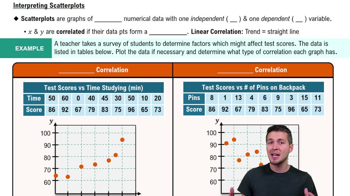
A scatterplot is a graphical representation that displays the relationship between two quantitative variables. Each point on the plot corresponds to an observation in the dataset, with one variable plotted along the x-axis and the other along the y-axis. Creating a scatterplot helps visualize potential correlations and patterns, making it easier to interpret the data before calculating the correlation coefficient.
Recommended video:
Guided course
06:36
Scatterplots & Intro to Correlation

P-value and Significance Level

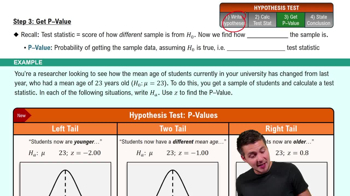
The P-value is a statistical measure that helps determine the significance of the results obtained from a hypothesis test. In this context, it assesses whether the observed correlation is statistically significant at a chosen significance level (α), typically set at 0.05. If the P-value is less than α, it suggests sufficient evidence to reject the null hypothesis, indicating a significant linear correlation between the two variables.
Recommended video:
Guided course
06:50
Step 3: Get P-Value
Related Practice
Textbook Question

Exercises 1–10 are based on the following sample data consisting of costs of dinner (dollars) and the amounts of tips (dollars) left by diners. The data were collected by students of the author.

[IMAGE]

Change in Scale Exercise 1 stated that for the given paired data, r = 0.846. How does that value change if all of the amounts of dinners are left unchanged but all of the tips are expressed in cents instead of dollars?

255
views
Textbook Question

Testing for a Linear Correlation

In Exercises 13–28, construct a scatterplot, and find the value of the linear correlation coefficient r. Also find the P-value or the critical values of r from Table A-6. Use a significance level of α = 0.05. Determine whether there is sufficient evidence to support a claim of a linear correlation between the two variables. (Save your work because the same data sets will be used in Section 10-2 exercises.)

Taxis Using the data from Exercise 15, is there sufficient evidence to support the claim that there is a linear correlation between the distance of the ride and the tip amount? Does it appear that riders base their tips on the distance of the ride?

190
views
Textbook Question

Interpreting a Computer Display

In Exercises 5–8, we want to consider the correlation between heights of fathers and mothers and the heights of their sons. Refer to the StatCrunch display and answer the given questions or identify the indicated items. The display is based on Data Set 10 “Family Heights” in Appendix B. (The response y variable represents heights of sons.)

[IMAGE]


Height of Son Should the multiple regression equation be used for predicting the height of a son based on the height of his father and mother? Why or why not?

169
views
Textbook Question

Notation The author conducted an experiment in which the height of each student was measured in centimeters and those heights were matched with the same students’ scores on the first statistics test. If we find that r = 0, does that indicate that there is no association between those two variables?

269
views
Textbook Question

Variation and Prediction Intervals

In Exercises 17–20, find the (a) explained variation, (b) unexplained variation, and (c) indicated prediction interval. In each case, there is sufficient evidence to support a claim of a linear correlation, so it is reasonable to use the regression equation when making predictions.

Weighing Seals with a Camera The table below lists overhead widths (cm) of seals measured from photographs and the weights (kg) of the seals (based on “Mass Estimation of Weddell Seals Using Techniques of Photogrammetry,” by R. Garrott of Montana State University). For the prediction interval, use a 99% confidence level with an overhead width of 9.0 cm.

108
views
Textbook Question

Exercises 1–10 are based on the following sample data consisting of costs of dinner (dollars) and the amounts of tips (dollars) left by diners. The data were collected by students of the author.

[IMAGE]

Fixed Percentage If a restaurant were to change its tipping policy so that a constant tip of 20% of the bill is added to the cost of the dinner, what would be the value of the linear correlation coefficient for the paired amounts of dinners/tips?

264
views