
Given the following probability distribution for the discrete random variable : What is the expected value of ?
Table of contents
- 1. Intro to Stats and Collecting Data1h 14m
- 2. Describing Data with Tables and Graphs1h 55m
- 3. Describing Data Numerically2h 5m
- 4. Probability2h 16m
- 5. Binomial Distribution & Discrete Random Variables3h 6m
- 6. Normal Distribution and Continuous Random Variables2h 11m
- 7. Sampling Distributions & Confidence Intervals: Mean3h 23m
- Sampling Distribution of the Sample Mean and Central Limit Theorem19m
- Distribution of Sample Mean - Excel23m
- Introduction to Confidence Intervals15m
- Confidence Intervals for Population Mean1h 18m
- Determining the Minimum Sample Size Required12m
- Finding Probabilities and T Critical Values - Excel28m
- Confidence Intervals for Population Means - Excel25m
- 8. Sampling Distributions & Confidence Intervals: Proportion1h 25m
- 9. Hypothesis Testing for One Sample3h 29m
- 10. Hypothesis Testing for Two Samples4h 50m
- Two Proportions1h 13m
- Two Proportions Hypothesis Test - Excel28m
- Two Means - Unknown, Unequal Variance1h 3m
- Two Means - Unknown Variances Hypothesis Test - Excel12m
- Two Means - Unknown, Equal Variance15m
- Two Means - Unknown, Equal Variances Hypothesis Test - Excel9m
- Two Means - Known Variance12m
- Two Means - Sigma Known Hypothesis Test - Excel21m
- Two Means - Matched Pairs (Dependent Samples)42m
- Matched Pairs Hypothesis Test - Excel12m
- 11. Correlation1h 24m
- 12. Regression1h 50m
- 13. Chi-Square Tests & Goodness of Fit2h 21m
- 14. ANOVA1h 57m
5. Binomial Distribution & Discrete Random Variables
Discrete Random Variables
Problem 5.1.5
Textbook Question
Identifying Discrete and Continuous Random Variables. In Exercises 5 and 6, refer to the given values, then identify which of the following is most appropriate: discrete random variable, continuous random variable, or not a random variable.
a. IQ scores of statistics students
b. Exact heights of statistics students
c. Shoe sizes (such as 8 or 8½) of statistics students
d. Majors (such as history) of statistics students
e. The number of rolls of a die required for a statistics student to get the number 4
Verified step by step guidance1
Step 1: Understand the definitions of discrete and continuous random variables. A discrete random variable takes on a countable number of distinct values, such as integers or specific categories. A continuous random variable can take on any value within a given range, often involving measurements like height or weight. If the variable does not involve randomness, it is not a random variable.
Step 2: Analyze part (a): IQ scores of statistics students. IQ scores are numerical values but are typically measured in whole numbers and are not continuous measurements. Determine whether this fits the definition of a discrete random variable or not.
Step 3: Analyze part (b): Exact heights of statistics students. Heights are measured on a continuous scale, meaning they can take on any value within a range (e.g., 5.5 feet, 5.55 feet). Determine whether this fits the definition of a continuous random variable.
Step 4: Analyze part (c): Shoe sizes of statistics students. Shoe sizes are typically discrete values (e.g., 8, 8½) and are countable. Determine whether this fits the definition of a discrete random variable.
Step 5: Analyze parts (d) and (e): Majors of statistics students and the number of rolls of a die required to get a 4. Majors are categorical and not numerical, so they are not random variables. The number of rolls of a die is countable and fits the definition of a discrete random variable.
Verified video answer for a similar problem:This video solution was recommended by our tutors as helpful for the problem above
Video duration:
4mPlay a video:
Was this helpful?
Key Concepts
Here are the essential concepts you must grasp in order to answer the question correctly.
Discrete Random Variables
Discrete random variables are those that can take on a countable number of distinct values. Examples include the number of students in a class or the number of rolls of a die. These variables often represent counts or categories, making them suitable for statistical analysis where specific outcomes can be enumerated.
Recommended video:
Guided course
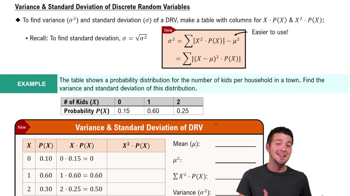
Variance & Standard Deviation of Discrete Random Variables
Continuous Random Variables
Continuous random variables can take on an infinite number of values within a given range. They are typically measurements, such as height or weight, where any value within a range is possible. This type of variable is often represented using intervals and is analyzed using techniques that account for the continuum of possible values.
Recommended video:
Guided course
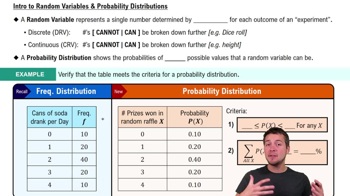
Intro to Random Variables & Probability Distributions
Random Variables
A random variable is a numerical outcome of a random phenomenon, which can be classified as either discrete or continuous. It serves as a bridge between probability and statistics, allowing for the quantification of uncertainty. Understanding random variables is essential for analyzing data and making predictions based on probabilistic models.
Recommended video:
Guided course
Intro to Random Variables & Probability Distributions
Watch next
Master Intro to Random Variables & Probability Distributions with a bite sized video explanation from Patrick
Start learningRelated Videos
Related Practice
Multiple Choice
10
views
