Ch. 7 - Estimating Parameters and Determining Sample Sizes
Triola - Elementary Statistics 14th Edition
Triola14th EditionElementary StatisticsISBN: 9780137366446Not the one you use?Change textbook
Chapter 7, Problem 7.1.20b

Critical Thinking. In Exercises 17–28, use the data and confidence level to construct a confidence interval estimate of p, then address the given question.


OxyContin The drug OxyContin (oxycodone) is used to treat pain, but it is dangerous because it is addictive and can be lethal. In clinical trials, 227 subjects were treated with OxyContin and 52 of them developed nausea (based on data from Purdue Pharma L.P.).


b. Compare the result from part (a) to this 95% confidence interval for 5 subjects who developed nausea among the 45 subjects given a placebo instead of OxyContin: . What do you conclude?

Verified step by step guidance
1
Step 1: Identify the problem type. This problem involves constructing a confidence interval for the proportion (p) of subjects who developed nausea after being treated with OxyContin. Additionally, it requires comparing this confidence interval to another provided interval for subjects given a placebo.
Step 2: Calculate the sample proportion (p̂) for the OxyContin group. Use the formula p̂ = x / n, where x is the number of subjects who developed nausea (52) and n is the total number of subjects treated with OxyContin (227).
Step 3: Determine the standard error (SE) for the proportion. Use the formula SE = sqrt((p̂ * (1 - p̂)) / n), where p̂ is the sample proportion and n is the sample size.
Step 4: Construct the confidence interval for the proportion using the formula: CI = p̂ ± Z * SE, where Z is the critical value corresponding to the 95% confidence level (typically Z = 1.96 for 95%). Substitute the values of p̂ and SE calculated in the previous steps.
Step 5: Compare the confidence interval for the OxyContin group to the provided confidence interval for the placebo group (.). Analyze whether the intervals overlap or are distinct, and interpret what this means in terms of the likelihood of nausea being associated with OxyContin versus the placebo.

Verified video answer for a similar problem:

This video solution was recommended by our tutors as helpful for the problem above.
Video duration:
3m
Was this helpful?

Key Concepts

Here are the essential concepts you must grasp in order to answer the question correctly.

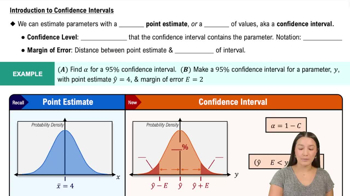
Confidence Interval

A confidence interval is a range of values, derived from sample statistics, that is likely to contain the true population parameter with a specified level of confidence, typically expressed as a percentage. For example, a 95% confidence interval suggests that if we were to take many samples and construct intervals in the same way, approximately 95% of those intervals would contain the true parameter. This concept is crucial for understanding the reliability of estimates in statistics.
Recommended video:
06:33
Introduction to Confidence Intervals

Proportion

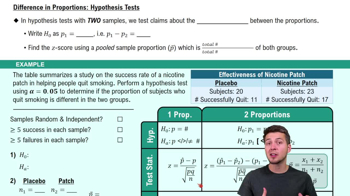
Proportion refers to the fraction of the total that exhibits a certain characteristic, often expressed as a percentage. In the context of the question, it relates to the number of subjects who developed nausea after taking OxyContin compared to the total number of subjects treated. Understanding proportions is essential for comparing outcomes between different groups, such as those receiving OxyContin versus a placebo.
Recommended video:
Guided course
09:27
Difference in Proportions: Hypothesis Tests

Statistical Comparison

Statistical comparison involves evaluating two or more groups to determine if there are significant differences between them. In this case, it requires comparing the proportion of subjects who developed nausea from OxyContin to those who received a placebo. This concept is vital for drawing conclusions about the effectiveness or safety of treatments based on empirical data.
Recommended video:
Guided course
05:53
Parameters vs. Statistics
Related Practice
Textbook Question

Minting Quarters Listed below are weights (grams) of quarters minted after 1964 (based on Data Set 40 “Coin Weights” in Appendix B).


b. Specifications require that the quarters have a weight of 5.670 g. What does the confidence interval suggest about that specification?


91
views
Textbook Question

7. FRESHMAN 15 Here is a sample of amounts of weight change (kg) of college students in their freshman year (from Data Set 13 “Freshman 15” in Appendix B): 11, 3, 0, –2, where –2 represents a loss of 2 kg and positive values represent weight gained. Here are ten bootstrap samples:

{11, 11, 11, 0}, {11, –2, 0, 11}, {11, –2, 3, 0}, {3, –2, 0, 11}, {0, 0, 0, 3}, {3, –2, 3, –2}, {11, 3, –2, 0}, {–2, 3, –2, 3}, {–2, 0, –2, 3}, {3, 11, 11, 11}.

b. Using only the ten given bootstrap samples, construct an 80% confidence interval estimate of the standard deviation of the weight changes for the population.

132
views
Textbook Question

Comparing Waiting Lines


The values listed below are waiting times (in minutes) of customers at the Bank of Providence, where customers may enter any one of three different lines that have formed at three teller windows. Construct a 95% confidence interval for the population standard deviation sigma.

96
views
Textbook Question

Alcohol in Children’s Movies Listed below is a simple random sample of times (seconds) that animated children’s movies showed the use of alcohol (based on Data Set 20 “Alcohol and Tobacco in Movies” in Appendix B).


b. Are the requirements for constructing a 95% confidence interval estimate of the population standard deviation satisfied? If so, construct that confidence interval.


106
views
Textbook Question

Mean Pulse Rate of Males Data Set 1 “Body Data” in Appendix B includes pulse rates of 153 randomly selected adult males, and those pulse rates vary from a low of 40 bpm to a high of 104 bpm. Find the minimum sample size required to estimate the mean pulse rate of adult males. Assume that we want 99% confidence that the sample mean is within 2 bpm of the population mean.


b. Assume that sigma=11.3 bpm, based on the value of s=11.3 bpm for the sample of 153 male pulse rates.


110
views
Textbook Question

Astrology A sociologist plans to conduct a survey to estimate the percentage of adults who believe in astrology. How many people must be surveyed if we want a confidence level of 99% and a margin of error of four percentage points?


b. Use the information from a previous Harris survey in which 26% of respondents said that they believed in astrology.

94
views