
Ch. 7 - Estimating Parameters and Determining Sample Sizes
Triola - Elementary Statistics 14th Edition
Triola14th EditionElementary StatisticsISBN: 9780137366446Not the one you use?Change textbook
Chapter 7, Problem 7.1.24a

Critical Thinking. In Exercises 17–28, use the data and confidence level to construct a confidence interval estimate of p, then address the given question.


Job Interviews In a Harris poll of 514 human resource professionals, 90% said that the appearance of a job applicant is most important for a good first impression.


a. Among the 514 human resource professionals who were surveyed, how many of them said that the appearance of a job applicant is most important for a good first impression?

Verified step by step guidance
1
Step 1: Identify the given information. The total number of human resource professionals surveyed is 514, and the proportion (p̂) of those who said appearance is most important is 90%, or 0.90.
Step 2: To find the number of professionals who said appearance is most important, use the formula: \( \text{Number} = p̂ \times \text{Total Surveyed} \).
Step 3: Substitute the given values into the formula: \( \text{Number} = 0.90 \times 514 \).
Step 4: Perform the multiplication to calculate the number of professionals. This will give you the total count of those who prioritized appearance.
Step 5: Verify the result to ensure it is a whole number, as the number of people cannot be fractional. If necessary, round to the nearest whole number.

Verified video answer for a similar problem:

This video solution was recommended by our tutors as helpful for the problem above.
Video duration:
1m
Was this helpful?

Key Concepts

Here are the essential concepts you must grasp in order to answer the question correctly.

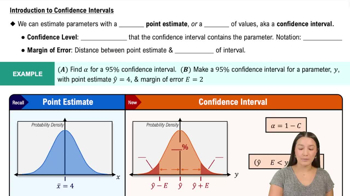
Confidence Interval

A confidence interval is a range of values, derived from sample statistics, that is likely to contain the true population parameter with a specified level of confidence. For example, if a 95% confidence interval for a population proportion is calculated, it means that if we were to take many samples and build intervals in this way, approximately 95% of those intervals would contain the true proportion.
Recommended video:
06:33
Introduction to Confidence Intervals

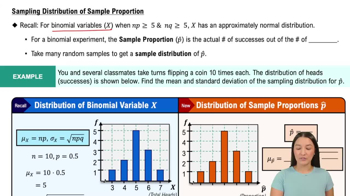
Sample Proportion

The sample proportion is the ratio of the number of successes in a sample to the total number of observations in that sample. In the context of the question, it refers to the percentage of surveyed human resource professionals who believe that appearance is crucial for a good first impression, which is 90% in this case.
Recommended video:
05:11
Sampling Distribution of Sample Proportion

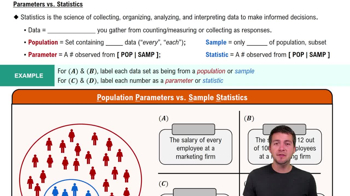
Population Parameter

A population parameter is a numerical value that summarizes a characteristic of an entire population, such as the true proportion of all human resource professionals who prioritize appearance. In this scenario, while the sample provides an estimate, the actual population parameter remains unknown and is what the confidence interval aims to estimate.
Recommended video:
Guided course
05:53
Parameters vs. Statistics
Related Practice
Textbook Question

Analysis of Last Digits Weights of respondents were recorded as part of the California Health Interview Survey. The last digits of weights from 50 randomly selected respondents are listed below.


a. Use the bootstrap method with 1000 bootstrap samples to find a 95% confidence interval estimate of .

122
views
Textbook Question

Critical Thinking. In Exercises 17–28, use the data and confidence level to construct a confidence interval estimate of p, then address the given question.


Tennis Challenges In a recent U. S. Open tennis tournament, women playing singles matches used challenges on 137 calls made by the line judges. Among those challenges, 33 were found to be successful with the call overturned.


a. Construct a 99% confidence interval for the percentage of successful challenges.

139
views
Textbook Question

Large Data Sets from Appendix B. In Exercises 21 and 22, use the data set in Appendix B. Assume that each sample is a simple random sample obtained from a population with a normal distribution.


Birth Weights Refer to Data Set 6 “Births” in Appendix B.


a. Use the 205 birth weights of girls to construct a 95% confidence interval estimate of the standard deviation of the population from which the sample was obtained.


154
views
Textbook Question

Freshman 15 Here is a sample of amounts of weight change (kg) of college students in their freshman year (from Data Set 13 “Freshman 15” in Appendix B): 11, 3, 0, , where represents a loss of 2 kg and positive values represent weight gained. Here are ten bootstrap samples:

[Image]


a. Using only the ten given bootstrap samples, construct an 80% confidence interval estimate of the mean weight change for the population.


159
views
Textbook Question

No Failures According to the Rule of Three, when we have a sample size n with x=0 successes, we have 95% confidence that the true population proportion has an upper bound of 3/n. (See “A Look at the Rule of Three,” by Jovanovic and Levy, American Statistician, Vol. 51, No. 2.)


a. If n independent trials result in no successes, why can’t we find confidence interval limits by using the methods described in this section?

384
views
Textbook Question

15. HEIGHTS OF FEMALE SOCCER PLAYERS Listed below are the heights (in.) of players on the U.S. Women’s National Soccer Team (at the time of this writing). Use those heights as a sample of the heights of all professional women soccer players.

a. Use 1000 bootstrap samples to construct a 95% confidence interval estimate of σ.

104
views