
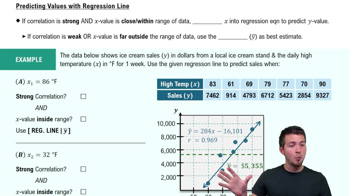
5. To predict y-values using the equation of a regression line, what must be true about the correlation coefficient of the variables?
Table of contents
- 1. Intro to Stats and Collecting Data1h 14m
- 2. Describing Data with Tables and Graphs1h 55m
- 3. Describing Data Numerically2h 5m
- 4. Probability2h 16m
- 5. Binomial Distribution & Discrete Random Variables3h 6m
- 6. Normal Distribution and Continuous Random Variables2h 11m
- 7. Sampling Distributions & Confidence Intervals: Mean3h 23m
- Sampling Distribution of the Sample Mean and Central Limit Theorem19m
- Distribution of Sample Mean - Excel23m
- Introduction to Confidence Intervals15m
- Confidence Intervals for Population Mean1h 18m
- Determining the Minimum Sample Size Required12m
- Finding Probabilities and T Critical Values - Excel28m
- Confidence Intervals for Population Means - Excel25m
- 8. Sampling Distributions & Confidence Intervals: Proportion2h 10m
- 9. Hypothesis Testing for One Sample5h 8m
- Steps in Hypothesis Testing1h 6m
- Performing Hypothesis Tests: Means1h 4m
- Hypothesis Testing: Means - Excel42m
- Performing Hypothesis Tests: Proportions37m
- Hypothesis Testing: Proportions - Excel27m
- Performing Hypothesis Tests: Variance12m
- Critical Values and Rejection Regions28m
- Link Between Confidence Intervals and Hypothesis Testing12m
- Type I & Type II Errors16m
- 10. Hypothesis Testing for Two Samples5h 37m
- Two Proportions1h 13m
- Two Proportions Hypothesis Test - Excel28m
- Two Means - Unknown, Unequal Variance1h 3m
- Two Means - Unknown Variances Hypothesis Test - Excel12m
- Two Means - Unknown, Equal Variance15m
- Two Means - Unknown, Equal Variances Hypothesis Test - Excel9m
- Two Means - Known Variance12m
- Two Means - Sigma Known Hypothesis Test - Excel21m
- Two Means - Matched Pairs (Dependent Samples)42m
- Matched Pairs Hypothesis Test - Excel12m
- Two Variances and F Distribution29m
- Two Variances - Graphing Calculator16m
- 11. Correlation1h 24m
- 12. Regression3h 33m
- Linear Regression & Least Squares Method26m
- Residuals12m
- Coefficient of Determination12m
- Regression Line Equation and Coefficient of Determination - Excel8m
- Finding Residuals and Creating Residual Plots - Excel11m
- Inferences for Slope31m
- Enabling Data Analysis Toolpak1m
- Regression Readout of the Data Analysis Toolpak - Excel21m
- Prediction Intervals13m
- Prediction Intervals - Excel19m
- Multiple Regression - Excel29m
- Quadratic Regression15m
- Quadratic Regression - Excel10m
- 13. Chi-Square Tests & Goodness of Fit2h 21m
- 14. ANOVA2h 28m
12. Regression
Linear Regression & Least Squares Method
Problem 9.2.3
Textbook Question
3. Explain how to predict y-values using the equation of a regression line.
Verified step by step guidance1
Understand that the equation of a regression line is typically written as , where is the y-intercept and is the slope of the line.
Identify the value of for which you want to predict the corresponding -value. This is the independent variable or predictor.
Substitute the chosen -value into the regression equation in place of .
Perform the arithmetic operations: multiply the slope by the -value, then add the y-intercept to this product.
The result of this calculation gives the predicted -value, which is the estimated value of the dependent variable based on the regression model.
Verified video answer for a similar problem:This video solution was recommended by our tutors as helpful for the problem above
Video duration:
1mPlay a video:
0 Comments
Key Concepts
Here are the essential concepts you must grasp in order to answer the question correctly.
Regression Line Equation
The regression line equation is typically written as y = mx + b, where y is the predicted value, x is the independent variable, m is the slope, and b is the y-intercept. This equation models the relationship between variables and is used to estimate y for given x values.
Recommended video:
Guided course
Using Regression Lines to Predict Values
Slope and Intercept Interpretation
The slope (m) indicates the rate of change in y for each unit increase in x, showing the strength and direction of the relationship. The intercept (b) represents the predicted value of y when x is zero, providing a starting point for predictions.
Recommended video:
Empirical Rule of Standard Deviation and Range Rule of Thumb
Using the Equation for Prediction
To predict y-values, substitute the given x-value into the regression equation and solve for y. This process allows estimation of the dependent variable based on the independent variable, assuming the linear relationship holds.
Recommended video:
Guided course
Prediction Intervals
Watch next
Master Intro to Least Squares Regression with a bite sized video explanation from Patrick
Start learningRelated Videos
Related Practice
Textbook Question
54
views
