Ch. 5 - Discrete Probability Distributions
Triola - Elementary Statistics 14th Edition
Triola14th EditionElementary StatisticsISBN: 9780137366446Not the one you use?Change textbook
Chapter 5, Problem 5.1.20b

Using Probabilities for Significant Events


b. Find the probability of getting 1 or fewer matches.

Verified step by step guidance
1
Step 1: Identify the type of probability distribution involved in the problem. If the problem involves matches (e.g., successes in trials), it is likely a binomial distribution. Confirm the number of trials (n) and the probability of success (p) for each trial.
Step 2: Define the event of interest. In this case, the event is 'getting 1 or fewer matches,' which means calculating the cumulative probability for 0 matches and 1 match.
Step 3: Use the probability mass function (PMF) of the binomial distribution to calculate the probabilities for 0 matches and 1 match. The PMF is given by: P(X=k)=n!k!(n-k)!pk(1-p)n-k, where k is the number of matches.
Step 4: Add the probabilities for 0 matches and 1 match to find the cumulative probability. This is expressed as: P(X1)=P(X=0)+P(X=1).
Step 5: Use a calculator or statistical software to compute the individual probabilities and their sum. Alternatively, if a cumulative distribution function (CDF) is available, use it directly to find P(X1).

Verified video answer for a similar problem:

This video solution was recommended by our tutors as helpful for the problem above.
Video duration:
1m
Was this helpful?

Key Concepts

Here are the essential concepts you must grasp in order to answer the question correctly.

Probability

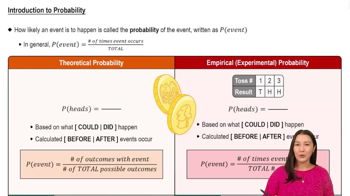
Probability is a measure of the likelihood that a particular event will occur, expressed as a number between 0 and 1. A probability of 0 indicates that the event cannot happen, while a probability of 1 indicates certainty. In the context of significant events, understanding how to calculate probabilities helps in assessing the chances of various outcomes.
Recommended video:
5:37
Introduction to Probability

Binomial Distribution

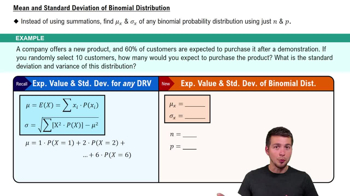
The binomial distribution is a statistical distribution that models the number of successes in a fixed number of independent Bernoulli trials, each with the same probability of success. It is particularly useful for scenarios where there are two possible outcomes, such as success or failure. In this case, finding the probability of getting 1 or fewer matches can be calculated using the binomial formula.
Recommended video:
Guided course
03:28
Mean & Standard Deviation of Binomial Distribution

Cumulative Probability

Cumulative probability refers to the probability that a random variable takes on a value less than or equal to a specific value. It is calculated by summing the probabilities of all outcomes up to that value. For the question at hand, determining the cumulative probability of getting 1 or fewer matches involves adding the probabilities of getting 0 matches and 1 match.
Recommended video:
5:37
Introduction to Probability
Related Practice
Textbook Question

Binomial Probability Formula. In Exercises 13 and 14, answer the questions designed to help understand the rationale for the binomial probability formula.


Guessing Answers Standard tests, such as the SAT, ACT, or Medical College Admission Test (MCAT), typically use multiple choice questions, each with five possible answers (a, b, c, d, e), one of which is correct. Assume that you guess the answers to the first three questions.


b. Beginning with WWC, make a complete list of the different possible arrangements of two wrong answers and one correct answer, and then find the probability for each entry in the list.

292
views
Textbook Question

In Exercises 9–16, use the Poisson distribution to find the indicated probabilities.


Births In a recent year (365 days), NYU-Langone Medical Center had 5942 births.


b. Find the probability that in a single day, there are 16 births.

143
views
Textbook Question

Politics The County Clerk in Essex, New Jersey, was accused of cheating by not using randomness in assigning the order in which candidates’ names appeared on voting ballots. Among 41 different ballots, Democrats were assigned the desirable first line 40 times. Assume that Democrats and Republicans are assigned the first line using a method of random selection so that they are equally likely to get that first line.


b. Find the probability of exactly 40 first lines for Democrats.

102
views
Textbook Question

Lottery. In Exercises 15–20, refer to the accompanying table, which describes probabilities for the California Daily 4 lottery. The player selects four digits with repetition allowed, and the random variable x is the number of digits that match those in the same order that they are drawn (for a “straight” bet).


Using Probabilities for Significant Events


b. Find the probability of getting 3 or more matches.

129
views
Textbook Question

In Exercises 25–28, find the probabilities and answer the questions.


Too Young to Tat Based on a Harris poll, among adults who regret getting tattoos, 20% say that they were too young when they got their tattoos. Assume that five adults who regret getting tattoos are randomly selected, and find the indicated probability.


b. Find the probability that exactly one of the selected adults says that he or she was too young to get tattoos.


116
views
Textbook Question

 In Exercises 5–8, assume that the Poisson distribution applies; assume that the mean number of Atlantic hurricanes in the United States is 5.5 per year, as in Example 1; and proceed to find the indicated probability.


Hurricanes


b. In a 118-year period, how many years are expected to have 7 hurricanes?

100
views