c. Determine the critical values for a two-tailed test of a population mean at the α = 0.01 level of significance based on a sample size of n = 33.
Table of contents
- 1. Intro to Stats and Collecting Data1h 14m
- 2. Describing Data with Tables and Graphs1h 55m
- 3. Describing Data Numerically2h 5m
- 4. Probability2h 16m
- 5. Binomial Distribution & Discrete Random Variables3h 6m
- 6. Normal Distribution and Continuous Random Variables2h 11m
- 7. Sampling Distributions & Confidence Intervals: Mean3h 23m
- Sampling Distribution of the Sample Mean and Central Limit Theorem19m
- Distribution of Sample Mean - Excel23m
- Introduction to Confidence Intervals15m
- Confidence Intervals for Population Mean1h 18m
- Determining the Minimum Sample Size Required12m
- Finding Probabilities and T Critical Values - Excel28m
- Confidence Intervals for Population Means - Excel25m
- 8. Sampling Distributions & Confidence Intervals: Proportion1h 25m
- 9. Hypothesis Testing for One Sample3h 29m
- 10. Hypothesis Testing for Two Samples4h 50m
- Two Proportions1h 13m
- Two Proportions Hypothesis Test - Excel28m
- Two Means - Unknown, Unequal Variance1h 3m
- Two Means - Unknown Variances Hypothesis Test - Excel12m
- Two Means - Unknown, Equal Variance15m
- Two Means - Unknown, Equal Variances Hypothesis Test - Excel9m
- Two Means - Known Variance12m
- Two Means - Sigma Known Hypothesis Test - Excel21m
- Two Means - Matched Pairs (Dependent Samples)42m
- Matched Pairs Hypothesis Test - Excel12m
- 11. Correlation1h 24m
- 12. Regression1h 50m
- 13. Chi-Square Tests & Goodness of Fit2h 21m
- 14. ANOVA1h 57m
9. Hypothesis Testing for One Sample
Steps in Hypothesis Testing
Problem 12.2.13g
Textbook Question
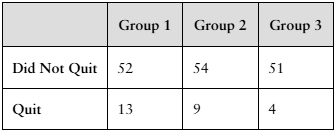
Efficacy of e-Cigs Do electronic cigarettes assist in helping individuals quit smoking? Researchers found 300 current smokers to volunteer for a study in which each was randomly assigned to one of three treatment groups. Group 1 received an electronic cigarette (e-cig) in which each cartridge contained 7.2 mg of nicotine, Group 2 received an e-cig that contained 5.4 mg of nicotine, and Group 3 received an e-cig that contained no nicotine. The subjects did not know which group they were assigned. During the course of the 52-week intervention, subjects dropped out of the study. At the end of the study 65 subjects remained in Group 1, 63 in Group 2, and 55 in Group 3. After 52 weeks, it was determined via questionnaire whether the subject quit smoking entirely. Results of the study are presented in the following table.

g. Write a conclusion for this hypothesis test.
Verified step by step guidance1
Step 1: Define the hypotheses. The null hypothesis (H0) states that the proportion of individuals who quit smoking is the same across all three groups. The alternative hypothesis (Ha) states that at least one group has a different quitting proportion.
Step 2: Calculate the sample proportions of quitting for each group. For each group, divide the number of individuals who quit by the total number of individuals remaining in that group (e.g., for Group 1, calculate \(\hat{p}_1 = \frac{13}{65}\)).
Step 3: Use a chi-square test for homogeneity to compare the quitting rates across the three groups. Construct a contingency table with the observed counts (Quit and Did Not Quit for each group) and calculate the expected counts under the null hypothesis.
Step 4: Compute the chi-square test statistic using the formula \(\chi^2 = \sum \frac{(O - E)^2}{E}\), where \(O\) is the observed count and \(E\) is the expected count for each cell in the contingency table.
Step 5: Determine the degrees of freedom for the test, which is \((\text{number of rows} - 1) \times (\text{number of columns} - 1)\), and compare the test statistic to the critical value from the chi-square distribution or calculate the p-value. Based on this, decide whether to reject or fail to reject the null hypothesis and write a conclusion about whether the nicotine content in e-cigarettes affects quitting rates.
Verified video answer for a similar problem:This video solution was recommended by our tutors as helpful for the problem above
Video duration:
2mPlay a video:
Was this helpful?
Key Concepts
Here are the essential concepts you must grasp in order to answer the question correctly.
Hypothesis Testing
Hypothesis testing is a statistical method used to decide whether there is enough evidence to reject a null hypothesis. It involves formulating a null and alternative hypothesis, calculating a test statistic, and comparing it to a critical value or p-value to draw conclusions about the population.
Recommended video:
Performing Hypothesis Tests: Proportions
Chi-Square Test for Independence
The chi-square test for independence assesses whether two categorical variables are related. In this context, it tests if quitting smoking is independent of the treatment group. It compares observed frequencies with expected frequencies under the assumption of independence.
Recommended video:
Guided course
Independence Test
Random Assignment and Blinding
Random assignment ensures each participant has an equal chance of being in any group, reducing bias and confounding variables. Blinding means subjects do not know their group, preventing placebo effects and bias in reporting outcomes, which strengthens the validity of the study results.
Recommended video:
Guided course
Intro to Random Variables & Probability Distributions
Watch next
Master Step 1: Write Hypotheses with a bite sized video explanation from Patrick
Start learningRelated Videos
Related Practice
Textbook Question
21
views