
Ch. 3 - Probability
Larson - Elementary Statistics: Picturing the World 8th Edition
Larson8th EditionElementary Statistics: Picturing the WorldISBN: 9780137493470Not the one you use?Change textbook
Chapter 3, Problem 3.3.3

"True or False? In Exercises 3-6, determine whether the statement is true or false. If it is false,
explain why.
3. When two events are mutually exclusive, they have no outcomes in common."

Verified step by step guidance
1
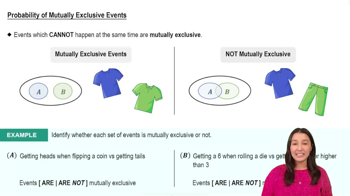
Understand the concept of mutually exclusive events: Two events are mutually exclusive if they cannot occur at the same time. This means that the occurrence of one event excludes the possibility of the other event occurring.
Consider the definition of mutually exclusive events in terms of their intersection: Mathematically, two events A and B are mutually exclusive if their intersection is empty, i.e., A ∩ B = ∅. This means there are no outcomes that belong to both events.
Analyze the statement: The statement claims that mutually exclusive events have no outcomes in common. Based on the definition of mutually exclusive events, this is true because their intersection is empty.
If the statement were false, we would need to provide a counterexample. However, since the definition of mutually exclusive events inherently means no shared outcomes, the statement aligns with the definition.
Conclude that the statement is true, as it directly reflects the definition of mutually exclusive events having no outcomes in common.

Verified video answer for a similar problem:

This video solution was recommended by our tutors as helpful for the problem above.
Video duration:
2m
Was this helpful?

Key Concepts

Here are the essential concepts you must grasp in order to answer the question correctly.

Mutually Exclusive Events

Mutually exclusive events are those that cannot occur at the same time. If one event happens, the other cannot. For example, when flipping a coin, the outcomes 'heads' and 'tails' are mutually exclusive because both cannot occur simultaneously.
Recommended video:
5:14
Probability of Mutually Exclusive Events

Sample Space

The sample space is the set of all possible outcomes of a random experiment. Understanding the sample space is crucial for determining whether events are mutually exclusive, as it helps identify if there are any common outcomes between the events in question.
Recommended video:
05:11
Sampling Distribution of Sample Proportion

Probability

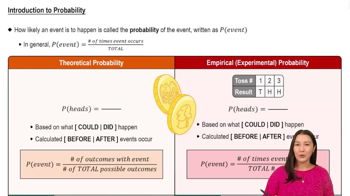
Probability is a measure of the likelihood that an event will occur, expressed as a number between 0 and 1. In the context of mutually exclusive events, the probability of either event occurring is the sum of their individual probabilities, reinforcing the concept that they cannot happen at the same time.
Recommended video:
5:37
Introduction to Probability