
Ch. 3 - Probability
Larson - Elementary Statistics: Picturing the World 8th Edition
Larson8th EditionElementary Statistics: Picturing the WorldISBN: 9780137493470Not the one you use?Change textbook
Chapter 3, Problem 3.1.32

Identifying the Sample Space of a Probability Experiment In Exercises 25-32, identify the sample space of the probability experiment and determine the number of outcomes in the sample space. Draw a tree diagram when appropriate.
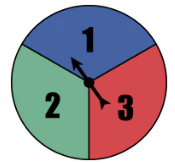
32. Rolling a six-sided die, tossing two coins, and spinning the fair spinner shown

Verified step by step guidance
1
Step 1: Understand the components of the probability experiment. The experiment involves rolling a six-sided die, tossing two coins, and spinning a fair spinner with three sections labeled 1, 2, and 3.
Step 2: Identify the sample space for each individual component. For the six-sided die, the sample space is {1, 2, 3, 4, 5, 6}. For the two coins, each coin has two possible outcomes: {Heads, Tails}, resulting in a combined sample space of {HH, HT, TH, TT}. For the spinner, the sample space is {1, 2, 3}.
Step 3: Combine the sample spaces of all components to form the overall sample space. Since the outcomes of the die, coins, and spinner are independent, the total sample space is the Cartesian product of the individual sample spaces.
Step 4: Calculate the total number of outcomes in the sample space. Multiply the number of outcomes for each component: 6 outcomes for the die × 4 outcomes for the coins × 3 outcomes for the spinner = 72 total outcomes.
Step 5: Draw a tree diagram to visually represent the sample space. Start with the outcomes of the die, branch out to the outcomes of the coins, and then branch further to the outcomes of the spinner. This will help illustrate all possible combinations of outcomes.

Verified video answer for a similar problem:

This video solution was recommended by our tutors as helpful for the problem above.
Video duration:
2m
Was this helpful?

Key Concepts

Here are the essential concepts you must grasp in order to answer the question correctly.

Sample Space

The sample space of a probability experiment is the set of all possible outcomes. For the given experiment of rolling a die, tossing two coins, and spinning a spinner, the sample space includes every combination of results from these actions. Understanding the sample space is crucial for calculating probabilities and analyzing the experiment.
Recommended video:
05:11
Sampling Distribution of Sample Proportion

Probability

Probability is a measure of the likelihood of an event occurring, expressed as a number between 0 and 1. In this context, it can be calculated by dividing the number of favorable outcomes by the total number of outcomes in the sample space. Knowing how to compute probabilities helps in making informed predictions about the results of the experiment.
Recommended video:
5:37
Introduction to Probability

Tree Diagram

A tree diagram is a visual representation used to illustrate all possible outcomes of a probability experiment. Each branch of the tree represents a possible outcome from one action, leading to further branches for subsequent actions. This tool is particularly useful for organizing complex experiments, such as the one described, making it easier to identify the sample space and calculate probabilities.
Recommended video:
5:14
Probability of Mutually Exclusive Events
Related Practice
Textbook Question

Odds The chances of winning are often written in terms of odds rather than probabilities. The odds of winning is the ratio of the number of successful outcomes to the number of unsuccessful outcomes. The odds of losing is the ratio of the number of unsuccessful outcomes to the number of successful outcomes. For example, when the number of successful outcomes is 2 and the number of unsuccessful outcomes is 3, the odds of winning are 2 : 3 (read "2 to 3"). In Exercises 91-96, use this information about odds.

94. A card is picked at random from a standard deck of 52 playing cards. Find the odds that it is a spade.

242
views
Textbook Question

Using the Fundamental Counting Principle In Exercises 37-40, use the Fundamental Counting Principle.

37. Menu A restaurant offers a \$15 dinner special that lets you choose from 6 appetizers, 12 entrées, and 8 desserts. How many different meals are available when you select an appetizer, an entrée, and a dessert?

224
views
Textbook Question

Identifying the Sample Space of a Probability Experiment In Exercises 25-32, identify the sample space of the probability experiment and determine the number of outcomes in the sample space. Draw a tree diagram when appropriate.

31. Rolling a pair of six-sided dice

107
views
Textbook Question

3. Explain why the statement is incorrect: The probability of rain is 150%.

156
views
Textbook Question

In Exercises 7-14, perform the indicated calculation.

9.8C3

136
views
Textbook Question

"Classifying Events as Independent or Dependent In Exercises 9-14, determine whether the events are independent or dependent. Explain your reasoning.

10. A father having hazel eyes and a daughter having hazel eyes"

69
views