Ch. 5 - Normal Probability Distributions
Larson - Elementary Statistics: Picturing the World 8th Edition
Larson8th EditionElementary Statistics: Picturing the WorldISBN: 9780137493470Not the one you use?Change textbook
Chapter 5, Problem 5.R.61

In Exercises 61 and 62, a binomial experiment is given. Determine whether you can use a normal distribution to approximate the binomial distribution. If you can, find the mean and standard deviation. If you cannot, explain why.


A survey of U.S. adults ages 33 to 40 earning more than \$150,000 per year found that 94% are content with how their lives have turned out so far. You randomly select 20 U.S. adults ages 33 to 40 earning more than \$150,000 and ask if they are content with their lives so far.

Verified step by step guidance
1
Step 1: Identify the parameters of the binomial distribution. In this problem, the number of trials (n) is 20, and the probability of success (p) is 0.94 (since 94% of the population is content).
Step 2: Check if the normal approximation to the binomial distribution can be used. The rule of thumb is that both np and n(1-p) must be greater than or equal to 5. Calculate np = 20 * 0.94 and n(1-p) = 20 * (1 - 0.94).
Step 3: If the conditions in Step 2 are satisfied, proceed to calculate the mean (μ) of the binomial distribution. The formula for the mean is μ = n * p.
Step 4: Calculate the standard deviation (σ) of the binomial distribution. The formula for the standard deviation is σ = sqrt(n * p * (1 - p)).
Step 5: If the conditions for normal approximation are not satisfied, explain that the binomial distribution cannot be approximated by a normal distribution in this case and provide reasoning based on the calculations in Step 2.

Verified video answer for a similar problem:

This video solution was recommended by our tutors as helpful for the problem above.
Video duration:
2m
Was this helpful?

Key Concepts

Here are the essential concepts you must grasp in order to answer the question correctly.

Binomial Distribution

A binomial distribution models the number of successes in a fixed number of independent Bernoulli trials, each with the same probability of success. It is characterized by two parameters: the number of trials (n) and the probability of success (p). In this context, the success could be defined as an adult being content with their life.
Recommended video:
Guided course
03:28
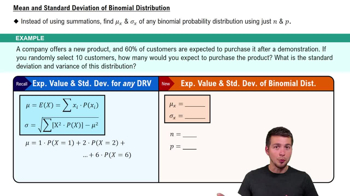
Mean & Standard Deviation of Binomial Distribution

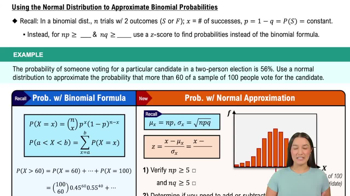
Normal Approximation to the Binomial

The normal approximation to the binomial distribution can be used when certain conditions are met, specifically when both np and n(1-p) are greater than or equal to 5. This allows for the use of the normal distribution to estimate probabilities and calculate the mean and standard deviation of the binomial distribution, simplifying analysis.
Recommended video:
06:23
Using the Normal Distribution to Approximate Binomial Probabilities

Mean and Standard Deviation of a Binomial Distribution

The mean (μ) of a binomial distribution is calculated as μ = np, while the standard deviation (σ) is given by σ = √(np(1-p)). These formulas provide essential measures of central tendency and variability, helping to understand the distribution of successes in the context of the experiment.
Recommended video:
Guided course
03:28
Mean & Standard Deviation of Binomial Distribution
Related Practice
Textbook Question

In Exercises 55–60, find the indicated probabilities and interpret the results.


The mean MCAT total score in a recent year is 500.9. A random sample of 32 MCAT total scores is selected. What is the probability that the mean score for the sample is (b) more than 502? Assume sigma=10.6.

69
views
Textbook Question

In Exercises 51 and 52, a population and sample size are given. (b) List all samples (with replacement) of the given size from the population and find the mean of each. (c) Find the mean and standard deviation of the sampling distribution of sample means and compare them with the mean and standard deviation of the population.


The goals scored in a season by the four starting defenders on a soccer team are 1, 2, 0, and 3. Use a sample size of 2.

117
views
Textbook Question

In Exercises 53 and 54, find the mean and standard deviation of the indicated sampling distribution of sample means. Then sketch a graph of the sampling distribution.


The population densities in people per square mile in the 50 U.S. states have a mean of 199.6 and a standard deviation of 265.4. Random samples of size 35 are drawn from this population, and the mean of each sample is determined.

53
views
Textbook Question

In Exercises 69 and 70, determine whether you can use a normal distribution to approximate the binomial distribution. If you can, use the normal distribution to approximate the indicated probabilities and sketch their graphs. If you cannot, explain why and use a binomial distribution to find the indicated probabilities.


A survey of U.S. adults found that 72% used a mobile device to manage their bank account at least once in the previous month. You randomly select 70 U.S. adults and ask whether they used a mobile device to manage their bank account at least once in the previous month. Find the probability that the number who have done so is (a) at most 40.

124
views
Textbook Question

In Exercises 55–60, find the indicated probabilities and interpret the results.


The mean annual salary for physical therapists in the United States is about \$87,000. A random sample of 50 physical therapists is selected. What is the probability that the mean annual salary of the sample is (b) more than \(85,000? Assume sigma = \)10,500.

67
views
Textbook Question

In Exercises 69 and 70, determine whether you can use a normal distribution to approximate the binomial distribution. If you can, use the normal distribution to approximate the indicated probabilities and sketch their graphs. If you cannot, explain why and use a binomial distribution to find the indicated probabilities.


A survey of U.S. adults found that 72% used a mobile device to manage their bank account at least once in the previous month. You randomly select 70 U.S. adults and ask whether they used a mobile device to manage their bank account at least once in the previous month. Find the probability that the number who have done so is (b) exactly 50.

163
views