The random variable x is normally distributed with the given parameters. Find each probability.
c. μ = 5.5, σ ≈ 0.08, P(5.36 < x < 5.64)
Verified step by step guidance
1
Step 1: Understand the problem. The random variable x follows a normal distribution with mean (μ) = 5.5 and standard deviation (σ) ≈ 0.08. We are tasked with finding the probability that x lies between 5.36 and 5.64, i.e., P(5.36 < x < 5.64).
Step 2: Standardize the values of x to convert them into z-scores using the formula: z = (x - μ) / σ. For the lower bound (x = 5.36), calculate z₁ = (5.36 - 5.5) / 0.08. For the upper bound (x = 5.64), calculate z₂ = (5.64 - 5.5) / 0.08.
Step 3: Use the standard normal distribution table (or a calculator) to find the cumulative probabilities corresponding to z₁ and z₂. Let Φ(z) represent the cumulative probability for a given z-score. Find Φ(z₁) and Φ(z₂).
Step 4: Compute the probability P(5.36 < x < 5.64) by subtracting the cumulative probability at z₁ from the cumulative probability at z₂. This can be expressed as: P(5.36 < x < 5.64) = Φ(z₂) - Φ(z₁).
Step 5: Interpret the result. The value obtained represents the probability that the random variable x falls within the range 5.36 to 5.64 under the given normal distribution.
Verified video answer for a similar problem:
This video solution was recommended by our tutors as helpful for the problem above
Video duration:
5m
Play a video:
0 Comments
Key Concepts
Here are the essential concepts you must grasp in order to answer the question correctly.
Normal Distribution
The normal distribution is a continuous probability distribution characterized by its bell-shaped curve, defined by its mean (μ) and standard deviation (σ). It is symmetric around the mean, meaning that approximately 68% of the data falls within one standard deviation from the mean, and about 95% falls within two standard deviations. This distribution is fundamental in statistics as many real-world phenomena tend to follow this pattern.
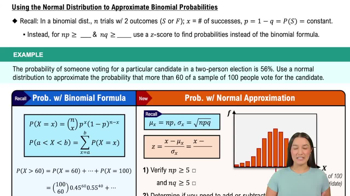
Using the Normal Distribution to Approximate Binomial Probabilities
Standard Normal Distribution
The standard normal distribution is a special case of the normal distribution where the mean is 0 and the standard deviation is 1. To find probabilities for any normal distribution, we often convert the values to the standard normal distribution using the z-score formula: z = (x - μ) / σ. This transformation allows us to use standard normal distribution tables or software to find probabilities associated with specific ranges of values.
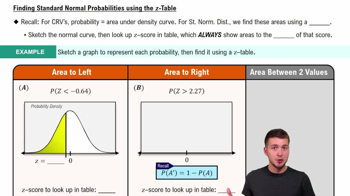
Finding Standard Normal Probabilities using z-Table
Probability Calculation
Calculating probabilities for a normal distribution involves finding the area under the curve between two points. For the given parameters, P(5.36 < x < 5.64) can be determined by calculating the z-scores for both values and then using the standard normal distribution to find the corresponding probabilities. The difference between these probabilities gives the desired probability for the range specified.