The arrival times of the bus Alex takes to work follow a normal distribution, with after the scheduled arrival rime & . If the bus is scheduled to arrive at Alex's work 10 min before opening, what is the probability that Alex arrives on time (i.e. the bus is less than 10 min late)?
Table of contents
- 1. Intro to Stats and Collecting Data1h 14m
- 2. Describing Data with Tables and Graphs1h 55m
- 3. Describing Data Numerically2h 5m
- 4. Probability2h 16m
- 5. Binomial Distribution & Discrete Random Variables3h 6m
- 6. Normal Distribution and Continuous Random Variables2h 11m
- 7. Sampling Distributions & Confidence Intervals: Mean3h 23m
- Sampling Distribution of the Sample Mean and Central Limit Theorem19m
- Distribution of Sample Mean - Excel23m
- Introduction to Confidence Intervals15m
- Confidence Intervals for Population Mean1h 18m
- Determining the Minimum Sample Size Required12m
- Finding Probabilities and T Critical Values - Excel28m
- Confidence Intervals for Population Means - Excel25m
- 8. Sampling Distributions & Confidence Intervals: Proportion1h 25m
- 9. Hypothesis Testing for One Sample3h 29m
- 10. Hypothesis Testing for Two Samples4h 50m
- Two Proportions1h 13m
- Two Proportions Hypothesis Test - Excel28m
- Two Means - Unknown, Unequal Variance1h 3m
- Two Means - Unknown Variances Hypothesis Test - Excel12m
- Two Means - Unknown, Equal Variance15m
- Two Means - Unknown, Equal Variances Hypothesis Test - Excel9m
- Two Means - Known Variance12m
- Two Means - Sigma Known Hypothesis Test - Excel21m
- Two Means - Matched Pairs (Dependent Samples)42m
- Matched Pairs Hypothesis Test - Excel12m
- 11. Correlation1h 24m
- 12. Regression1h 50m
- 13. Chi-Square Tests & Goodness of Fit2h 21m
- 14. ANOVA1h 57m
6. Normal Distribution and Continuous Random Variables
Non-Standard Normal Distribution
Problem 7.T.8
Textbook Question
Suppose the scores earned on Professor McArthur’s third statistics exam are normally distributed with mean 64 and standard deviation 8. Professor McArthur wants to curve the exam scores as follows: The top 6% get an A, the next 14% get a B, the middle 60% get a C, the bottom 6% fail, and the rest earn a D. Any student who can determine these cut-offs earns five bonus points. Determine the cut-offs for Professor McArthur.
Verified step by step guidance1
Identify the given information: the exam scores are normally distributed with mean \(\mu = 64\) and standard deviation \(\sigma = 8\).
Understand the grading cut-offs in terms of percentiles: top 6% get an A, next 14% get a B, middle 60% get a C, bottom 6% fail, and the remaining 14% get a D. These percentages correspond to cumulative probabilities that define the boundaries between grades.
Convert the cumulative percentages into cumulative probabilities starting from the lowest score: bottom 6% fail corresponds to the 6th percentile, next 14% (fail to D) corresponds to the 20th percentile (6% + 14%), middle 60% (D to C) corresponds to the 80th percentile (20% + 60%), next 14% (C to B) corresponds to the 94th percentile (80% + 14%), and top 6% (B to A) corresponds to the 100th percentile.
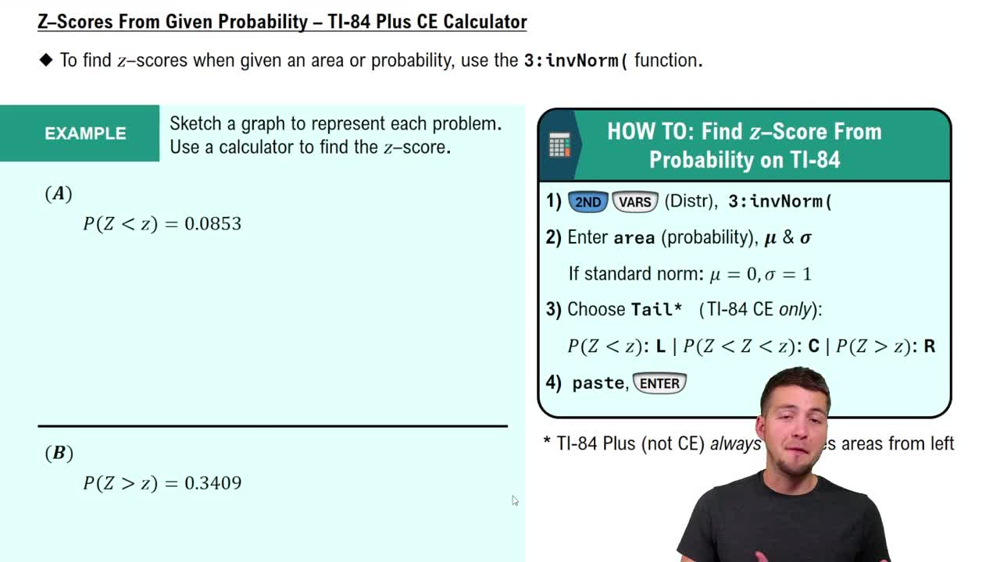
Use the standard normal distribution table or a calculator to find the z-scores corresponding to these cumulative probabilities: find \(z\) such that \(P(Z \leq z) = 0.06\), \$0.20\(, \)0.80\(, and \)0.94$.
Convert each z-score to the actual exam score cut-off using the formula \(X = \mu + z \times \sigma\), where \(\mu = 64\) and \(\sigma = 8\). These values will give the score boundaries between the grades.
Verified video answer for a similar problem:This video solution was recommended by our tutors as helpful for the problem above
Video duration:
10mPlay a video:
Was this helpful?
Key Concepts
Here are the essential concepts you must grasp in order to answer the question correctly.
Normal Distribution
The normal distribution is a continuous probability distribution characterized by a symmetric, bell-shaped curve defined by its mean and standard deviation. It models many natural phenomena, including exam scores, and allows us to calculate probabilities and percentiles for given values.
Recommended video:
Guided course
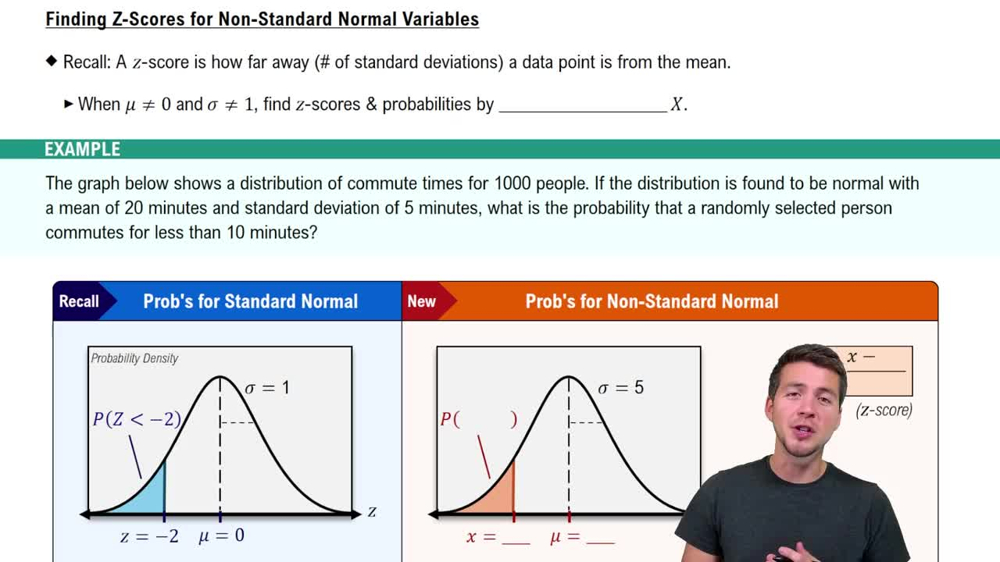
Finding Z-Scores for Non-Standard Normal Variables
Z-Scores and Standardization
A z-score represents how many standard deviations a data point is from the mean. Standardizing values using z-scores allows comparison across different normal distributions and helps find corresponding percentiles or probabilities using standard normal tables.
Recommended video:
Guided course
Z-Scores From Given Probability - TI-84 (CE) Calculator
Percentiles and Cut-Off Scores
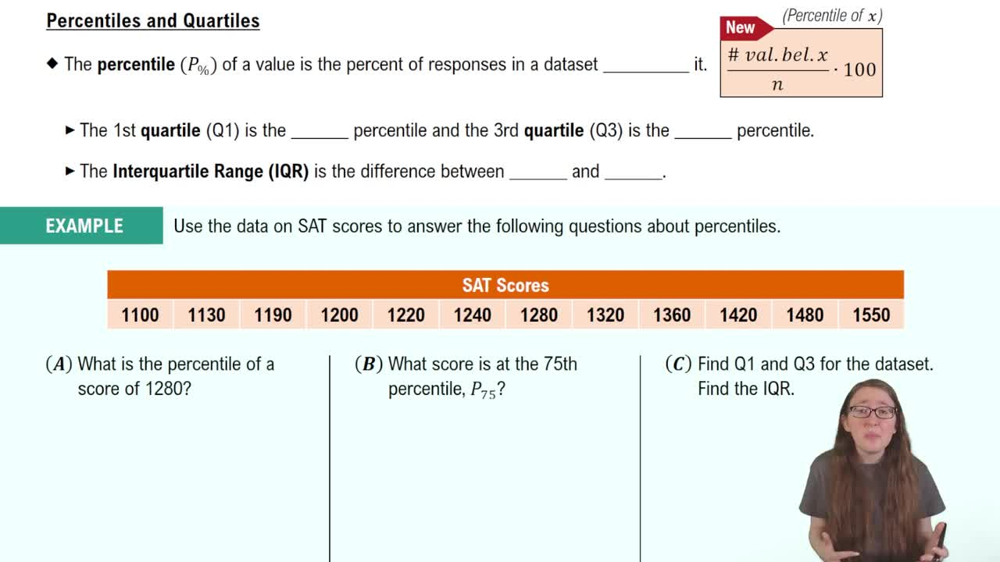
Percentiles divide data into 100 equal parts, indicating the relative standing of a score within a distribution. Determining cut-off scores involves finding the exam scores that correspond to specific cumulative percentages, which can be done by converting percentiles to z-scores and then back to raw scores.
Recommended video:
Percentiles and Quartiles
Watch next
Master Finding Z-Scores for Non-Standard Normal Variables with a bite sized video explanation from Patrick
Start learningRelated Videos
Related Practice
Multiple Choice
99
views
2
rank