Exam Scores After giving a statistics exam, Professor Dang determined the following five-number summary for her class results: 60 68 77 89 98. Use this information to draw a boxplot of the exam scores.
Table of contents
- 1. Intro to Stats and Collecting Data1h 14m
- 2. Describing Data with Tables and Graphs1h 55m
- 3. Describing Data Numerically2h 5m
- 4. Probability2h 16m
- 5. Binomial Distribution & Discrete Random Variables3h 6m
- 6. Normal Distribution and Continuous Random Variables2h 11m
- 7. Sampling Distributions & Confidence Intervals: Mean3h 23m
- Sampling Distribution of the Sample Mean and Central Limit Theorem19m
- Distribution of Sample Mean - Excel23m
- Introduction to Confidence Intervals15m
- Confidence Intervals for Population Mean1h 18m
- Determining the Minimum Sample Size Required12m
- Finding Probabilities and T Critical Values - Excel28m
- Confidence Intervals for Population Means - Excel25m
- 8. Sampling Distributions & Confidence Intervals: Proportion1h 25m
- 9. Hypothesis Testing for One Sample3h 29m
- 10. Hypothesis Testing for Two Samples4h 50m
- Two Proportions1h 13m
- Two Proportions Hypothesis Test - Excel28m
- Two Means - Unknown, Unequal Variance1h 3m
- Two Means - Unknown Variances Hypothesis Test - Excel12m
- Two Means - Unknown, Equal Variance15m
- Two Means - Unknown, Equal Variances Hypothesis Test - Excel9m
- Two Means - Known Variance12m
- Two Means - Sigma Known Hypothesis Test - Excel21m
- Two Means - Matched Pairs (Dependent Samples)42m
- Matched Pairs Hypothesis Test - Excel12m
- 11. Correlation1h 24m
- 12. Regression1h 50m
- 13. Chi-Square Tests & Goodness of Fit2h 21m
- 14. ANOVA1h 57m
3. Describing Data Numerically
Boxplots
Problem 3.5.18f
Textbook Question
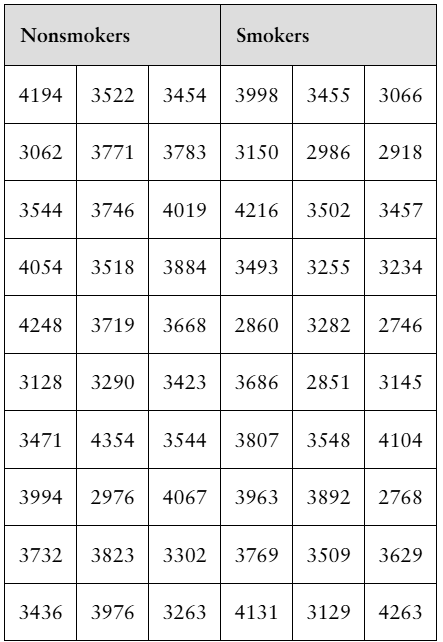
"[DATA] Putting It Together: Paternal Smoking It is well-documented that active maternal smoking during pregnancy is associated with lower-birth-weight babies. Researchers wanted to determine if there is a relationship between paternal smoking habits and birth weight. The researchers administered a questionnaire to each parent of newborn infants. One question asked whether the individual smoked regularly. Because the survey was administered within 15 days of birth, it was assumed that any regular smokers were also regular smokers during pregnancy. Birth weights for the babies (in grams) of nonsmoking mothers were obtained and divided into two groups, nonsmoking fathers and smoking fathers. The given data are representative of the data collected by the researchers. The researchers concluded that the birth weight of babies whose father smoked was less than the birth weight of babies whose father did not smoke.
f. Interpret the first quartile for both the nonsmoker and smoker group."

Verified step by step guidance1
Step 1: Understand what the first quartile (Q1) represents. The first quartile is the value below which 25% of the data fall. It is a measure of the lower spread of the data and helps to understand the distribution of birth weights in each group.
Step 2: Organize the birth weight data for each group (Nonsmokers and Smokers) in ascending order. This is necessary to accurately find the position of the first quartile in the sorted data set.
Step 3: Determine the position of the first quartile in each sorted data set using the formula: \(Q1 = \frac{1}{4} (n + 1)\), where \(n\) is the number of data points in the group. This gives the rank or position of the first quartile value.
Step 4: Locate the first quartile value in each sorted list by finding the data point at the position calculated in Step 3. If the position is not an integer, interpolate between the two closest data points.
Step 5: Interpret the first quartile values for both groups by explaining what these values mean in the context of birth weights. For example, the first quartile for nonsmokers indicates that 25% of babies born to nonsmoking fathers have birth weights below this value, and similarly for the smoker group.
Verified video answer for a similar problem:This video solution was recommended by our tutors as helpful for the problem above
Video duration:
2mPlay a video:
Was this helpful?
Key Concepts
Here are the essential concepts you must grasp in order to answer the question correctly.
Quartiles and the First Quartile (Q1)
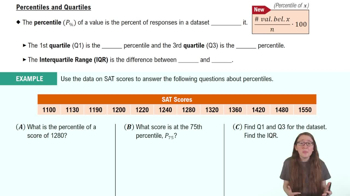
Quartiles divide a data set into four equal parts after sorting the data. The first quartile (Q1) is the value below which 25% of the data fall. It helps describe the lower spread of the data and is useful for understanding the distribution and identifying potential outliers.
Recommended video:
Percentiles and Quartiles
Comparing Distributions Between Groups
When comparing two groups, such as nonsmoking and smoking fathers, analyzing quartiles helps understand differences in data spread and central tendency. Comparing Q1 values shows how the lower 25% of birth weights differ between groups, indicating potential effects of paternal smoking.
Recommended video:
Guided course
Probabilities Between Two Values
Interpreting Birth Weight Data in Context
Birth weight data reflect newborn health and can be influenced by parental factors. Interpreting quartiles in this context means understanding what a specific quartile value implies about the baby's weight relative to others, helping assess the impact of paternal smoking on infant health outcomes.
Recommended video:
Empirical Rule of Standard Deviation and Range Rule of Thumb
Watch next
Master Boxplots ("Box and Whisker Plots") with a bite sized video explanation from Patrick
Start learningRelated Videos
Related Practice
Textbook Question
15
views