
A software development company created a new app for fitness, and they want to determine if using the app can lead to weight loss and increased strength in customers. Should they run an observational study or experiment?
Table of contents
- 1. Intro to Stats and Collecting Data1h 14m
- 2. Describing Data with Tables and Graphs1h 55m
- 3. Describing Data Numerically2h 5m
- 4. Probability2h 16m
- 5. Binomial Distribution & Discrete Random Variables3h 6m
- 6. Normal Distribution and Continuous Random Variables2h 11m
- 7. Sampling Distributions & Confidence Intervals: Mean3h 23m
- Sampling Distribution of the Sample Mean and Central Limit Theorem19m
- Distribution of Sample Mean - Excel23m
- Introduction to Confidence Intervals15m
- Confidence Intervals for Population Mean1h 18m
- Determining the Minimum Sample Size Required12m
- Finding Probabilities and T Critical Values - Excel28m
- Confidence Intervals for Population Means - Excel25m
- 8. Sampling Distributions & Confidence Intervals: Proportion1h 25m
- 9. Hypothesis Testing for One Sample3h 29m
- 10. Hypothesis Testing for Two Samples4h 50m
- Two Proportions1h 13m
- Two Proportions Hypothesis Test - Excel28m
- Two Means - Unknown, Unequal Variance1h 3m
- Two Means - Unknown Variances Hypothesis Test - Excel12m
- Two Means - Unknown, Equal Variance15m
- Two Means - Unknown, Equal Variances Hypothesis Test - Excel9m
- Two Means - Known Variance12m
- Two Means - Sigma Known Hypothesis Test - Excel21m
- Two Means - Matched Pairs (Dependent Samples)42m
- Matched Pairs Hypothesis Test - Excel12m
- 11. Correlation1h 24m
- 12. Regression1h 50m
- 13. Chi-Square Tests & Goodness of Fit2h 21m
- 14. ANOVA1h 57m
1. Intro to Stats and Collecting Data
Intro to Collecting Data
Problem 1.1.27
Textbook Question
"Identify the population and the sample. Describe the sample data set.
A survey of 1500 U.S. adults found that 59% have never had a vaccine reaction. (Source: SingleCare)"
Verified step by step guidance1
Step 1: Understand the definitions of population and sample. The population refers to the entire group of individuals or objects that we want to study, while the sample is a subset of the population that is actually observed or surveyed.
Step 2: Identify the population in the problem. The population is all U.S. adults, as the survey aims to understand vaccine reactions among this group.
Step 3: Identify the sample in the problem. The sample consists of the 1500 U.S. adults who were surveyed. This is the subset of the population used to gather data.
Step 4: Describe the sample data set. The sample data set includes information about the 1500 surveyed U.S. adults, specifically the proportion (59%) who reported never having a vaccine reaction.
Step 5: Note the source of the data. The data was collected from SingleCare, which provides context and credibility to the survey results.
Verified video answer for a similar problem:This video solution was recommended by our tutors as helpful for the problem above
Video duration:
3mPlay a video:
Was this helpful?
Key Concepts
Here are the essential concepts you must grasp in order to answer the question correctly.
Population
In statistics, the population refers to the entire group of individuals or instances about whom we want to draw conclusions. In this context, the population consists of all U.S. adults, as the survey aims to understand their experiences with vaccine reactions.
Recommended video:
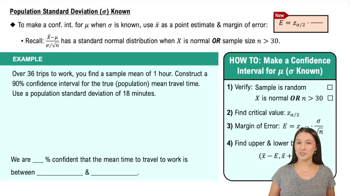
Population Standard Deviation Known
Sample
A sample is a subset of the population selected for analysis. In this case, the sample comprises 1,500 U.S. adults surveyed to gather data on vaccine reactions. The sample should ideally represent the population to ensure the findings are generalizable.
Recommended video:
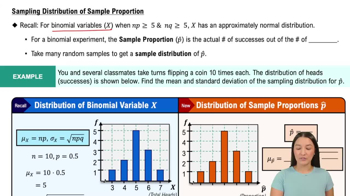
Sampling Distribution of Sample Proportion
Sample Data Set
The sample data set includes the specific responses collected from the surveyed individuals. Here, it indicates that 59% of the 1,500 adults reported never having a vaccine reaction, providing insight into the broader population's experiences and perceptions regarding vaccines.
Recommended video:
Sampling Distribution of Sample Proportion
Watch next
Master Introduction to Collecting Data with a bite sized video explanation from Patrick
Start learningRelated Videos
Related Practice
Multiple Choice
423
views
9
rank
