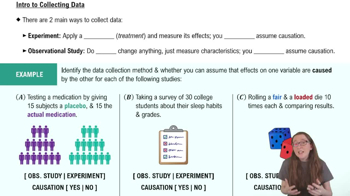
A regional store manager wants to test whether increasing store hours increases profits, so they randomly select half of their locations to stay open an extra hour later in the evenings and compare profits between stores at the end of the month. They notice that stores open later saw higher profits on average. Is this an experiment or an observational study? Can they determine the extra hours caused the increase in sales?
Table of contents
- 1. Intro to Stats and Collecting Data1h 14m
- 2. Describing Data with Tables and Graphs1h 55m
- 3. Describing Data Numerically2h 5m
- 4. Probability2h 16m
- 5. Binomial Distribution & Discrete Random Variables3h 6m
- 6. Normal Distribution and Continuous Random Variables2h 11m
- 7. Sampling Distributions & Confidence Intervals: Mean3h 23m
- Sampling Distribution of the Sample Mean and Central Limit Theorem19m
- Distribution of Sample Mean - Excel23m
- Introduction to Confidence Intervals15m
- Confidence Intervals for Population Mean1h 18m
- Determining the Minimum Sample Size Required12m
- Finding Probabilities and T Critical Values - Excel28m
- Confidence Intervals for Population Means - Excel25m
- 8. Sampling Distributions & Confidence Intervals: Proportion1h 25m
- 9. Hypothesis Testing for One Sample3h 29m
- 10. Hypothesis Testing for Two Samples4h 50m
- Two Proportions1h 13m
- Two Proportions Hypothesis Test - Excel28m
- Two Means - Unknown, Unequal Variance1h 3m
- Two Means - Unknown Variances Hypothesis Test - Excel12m
- Two Means - Unknown, Equal Variance15m
- Two Means - Unknown, Equal Variances Hypothesis Test - Excel9m
- Two Means - Known Variance12m
- Two Means - Sigma Known Hypothesis Test - Excel21m
- Two Means - Matched Pairs (Dependent Samples)42m
- Matched Pairs Hypothesis Test - Excel12m
- 11. Correlation1h 24m
- 12. Regression1h 50m
- 13. Chi-Square Tests & Goodness of Fit2h 21m
- 14. ANOVA1h 57m
1. Intro to Stats and Collecting Data
Intro to Collecting Data
Problem 1.1.7
Textbook Question
"Determine whether the statement is true or false. If it is false, rewrite it as a true statement.
It is impossible to obtain all the census data about the U.S. population."
Verified step by step guidance1
Understand the statement: The statement claims that it is impossible to obtain all the census data about the U.S. population. Consider what 'census data' means and the challenges associated with collecting it.
Recall the definition of a census: A census is a complete enumeration of a population, where data is collected from every individual in the population.
Consider practical challenges: While a census aims to collect data from everyone, practical issues such as non-responses, inaccessible populations, and data entry errors can make it difficult to achieve 100% accuracy.
Evaluate the truth of the statement: Based on the challenges mentioned, it is generally true that obtaining all census data perfectly is impossible. However, the census can still provide a very close approximation of the population data.
Rewrite the statement if false: If the statement is deemed false, a true version could be: 'It is extremely difficult to obtain all the census data about the U.S. population due to practical challenges, but efforts are made to collect as much accurate data as possible.'
Verified video answer for a similar problem:This video solution was recommended by our tutors as helpful for the problem above
Video duration:
1mPlay a video:
Was this helpful?
Key Concepts
Here are the essential concepts you must grasp in order to answer the question correctly.
Census Data
Census data refers to the comprehensive collection of demographic information about a population, typically conducted at regular intervals by a government. In the U.S., the Census Bureau collects data on various aspects such as age, race, income, and housing. This data is crucial for policy-making, resource allocation, and understanding population trends.
Recommended video:
Introduction to Collecting Data
Sampling and Estimation
Sampling and estimation are statistical techniques used to infer characteristics of a larger population based on a smaller subset. While a complete census aims to gather data from every individual, practical limitations often necessitate sampling methods to estimate population parameters. Understanding these concepts helps clarify the feasibility of obtaining complete census data.
Recommended video:
Sampling Distribution of Sample Proportion
Data Collection Challenges
Data collection challenges encompass the various obstacles faced when gathering information from a population. These can include logistical issues, non-response bias, and the dynamic nature of populations. Recognizing these challenges is essential to understanding why complete census data may be difficult to achieve, even if it is not entirely impossible.
Recommended video:
Introduction to Collecting Data
Watch next
Master Introduction to Collecting Data with a bite sized video explanation from Patrick
Start learningRelated Videos
Related Practice
Multiple Choice
462
views
12
rank