An office manager wants to determine how employees feel about their personal growth and professional achievement in the last quarter. Should they run an observational study or experiment?
Table of contents
- 1. Intro to Stats and Collecting Data1h 14m
- 2. Describing Data with Tables and Graphs1h 55m
- 3. Describing Data Numerically2h 5m
- 4. Probability2h 16m
- 5. Binomial Distribution & Discrete Random Variables3h 6m
- 6. Normal Distribution and Continuous Random Variables2h 11m
- 7. Sampling Distributions & Confidence Intervals: Mean3h 23m
- Sampling Distribution of the Sample Mean and Central Limit Theorem19m
- Distribution of Sample Mean - Excel23m
- Introduction to Confidence Intervals15m
- Confidence Intervals for Population Mean1h 18m
- Determining the Minimum Sample Size Required12m
- Finding Probabilities and T Critical Values - Excel28m
- Confidence Intervals for Population Means - Excel25m
- 8. Sampling Distributions & Confidence Intervals: Proportion1h 25m
- 9. Hypothesis Testing for One Sample3h 29m
- 10. Hypothesis Testing for Two Samples4h 50m
- Two Proportions1h 13m
- Two Proportions Hypothesis Test - Excel28m
- Two Means - Unknown, Unequal Variance1h 3m
- Two Means - Unknown Variances Hypothesis Test - Excel12m
- Two Means - Unknown, Equal Variance15m
- Two Means - Unknown, Equal Variances Hypothesis Test - Excel9m
- Two Means - Known Variance12m
- Two Means - Sigma Known Hypothesis Test - Excel21m
- Two Means - Matched Pairs (Dependent Samples)42m
- Matched Pairs Hypothesis Test - Excel12m
- 11. Correlation1h 24m
- 12. Regression1h 50m
- 13. Chi-Square Tests & Goodness of Fit2h 21m
- 14. ANOVA1h 57m
1. Intro to Stats and Collecting Data
Intro to Collecting Data
Problem 1.1.13
Textbook Question
"Determine whether the data set is a population or a sample. Explain your reasoning.
A survey of 250 members from an organized union of over 20,000 members"
Verified step by step guidance1
Step 1: Understand the definitions of population and sample. A population refers to the entire group of individuals or items that you want to study, while a sample is a subset of the population selected for analysis.
Step 2: Identify the total size of the group being studied. In this case, the organized union consists of over 20,000 members, which represents the population.
Step 3: Examine the size of the group surveyed. The problem states that only 250 members were surveyed, which is a subset of the total population.
Step 4: Compare the surveyed group to the population. Since the surveyed group (250 members) is smaller than the total population (20,000 members), it is considered a sample.
Step 5: Conclude that the data set is a sample because it represents only a portion of the entire population, and explain that samples are often used to make inferences about the population when studying the entire population is impractical.
Verified video answer for a similar problem:This video solution was recommended by our tutors as helpful for the problem above
Video duration:
3mPlay a video:
Was this helpful?
Key Concepts
Here are the essential concepts you must grasp in order to answer the question correctly.
Population
In statistics, a population refers to the entire group of individuals or items that we are interested in studying. It encompasses all members of a defined group, such as all employees in a company or all voters in an election. Understanding whether a data set represents a population is crucial for determining the scope and applicability of statistical analyses.
Recommended video:
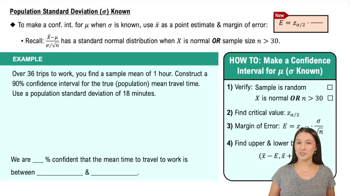
Population Standard Deviation Known
Sample
A sample is a subset of a population that is selected for analysis. It is used to make inferences about the larger population without needing to collect data from every member. The quality of a sample can significantly affect the validity of conclusions drawn, making it essential to ensure that the sample is representative of the population.
Recommended video:
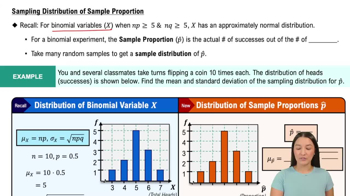
Sampling Distribution of Sample Proportion
Sampling Method
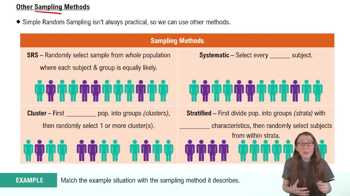
The sampling method refers to the technique used to select individuals from a population to form a sample. Common methods include random sampling, stratified sampling, and convenience sampling. The choice of sampling method impacts the reliability of the results and the extent to which they can be generalized to the population.
Recommended video:
Sampling Methods
Watch next
Master Introduction to Collecting Data with a bite sized video explanation from Patrick
Start learningRelated Videos
Related Practice
Multiple Choice
418
views
5
rank