Ch. 5 - Discrete Probability Distributions
Triola - Elementary Statistics 14th Edition
Triola14th EditionElementary StatisticsISBN: 9780137366446Not the one you use?Change textbook
Chapter 5, Problem 5.2.7

In Exercises 5–12, determine whether the given procedure results in a binomial distribution or a distribution that can be treated as binomial (by applying the 5% guideline for cumbersome calculations). For those that are not binomial and cannot be treated as binomial, identify at least one requirement that is not satisfied.


LOL In a U.S. Cellular survey of 500 smartphone users, subjects are asked if they find abbreviations (such as LOL or BFF) annoying, and each response was recorded as “yes,” “no,” or “not sure.”

Verified step by step guidance
1
Step 1: Recall the four requirements for a binomial distribution: (1) The procedure must have a fixed number of trials, (2) each trial must have only two possible outcomes (success or failure), (3) the trials must be independent, and (4) the probability of success must remain constant for all trials.
Step 2: Analyze the given problem. The survey involves 500 smartphone users, which represents a fixed number of trials. This satisfies the first requirement.
Step 3: Examine the possible outcomes for each trial. The responses are recorded as 'yes,' 'no,' or 'not sure,' which means there are three possible outcomes. This violates the second requirement, as a binomial distribution requires only two outcomes (e.g., success or failure).
Step 4: Since the second requirement is not satisfied, the procedure does not result in a binomial distribution. Additionally, the problem does not specify whether the trials are independent or whether the probability of success remains constant, but these are secondary considerations since the second requirement is already violated.
Step 5: Conclude that the given procedure does not result in a binomial distribution, and the primary reason is that there are more than two possible outcomes for each trial.

Verified video answer for a similar problem:

This video solution was recommended by our tutors as helpful for the problem above.
Video duration:
4m
Was this helpful?

Key Concepts

Here are the essential concepts you must grasp in order to answer the question correctly.

Binomial Distribution

A binomial distribution models the number of successes in a fixed number of independent trials, each with the same probability of success. It requires two outcomes (success or failure), a fixed number of trials, and constant probability across trials. For example, flipping a coin multiple times and counting the number of heads is a classic binomial scenario.
Recommended video:
Guided course
03:28
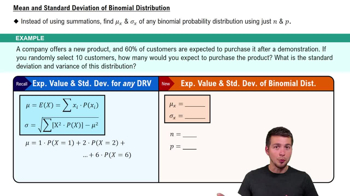
Mean & Standard Deviation of Binomial Distribution

5% Guideline

The 5% guideline is a rule of thumb used to determine if a distribution can be treated as binomial when the sample size is large. It states that if the probability of success is less than 5% and the sample size is large, the trials can be considered independent, allowing for a binomial approximation. This is particularly useful in simplifying calculations for large datasets.

Requirements for Binomial Distribution

For a distribution to be classified as binomial, it must meet specific criteria: a fixed number of trials, only two possible outcomes per trial, independence of trials, and a constant probability of success. If any of these conditions are not met, the distribution may not be binomial. In the given survey, the presence of three response options (yes, no, not sure) violates the binary outcome requirement.
Recommended video:
Guided course
03:28
Mean & Standard Deviation of Binomial Distribution
Related Practice
Textbook Question

If we sample from a small finite population without replacement, the binomial distribution should not be used because the events are not independent. If sampling is done without replacement and the outcomes belong to one of two types, we can use the hypergeometric distribution. If a population has A objects of one type (such as lottery numbers you selected), while the remaining B objects are of the other type (such as lottery numbers you didn’t select), and if n objects are sampled without replacement (such as six drawn lottery numbers), then the probability of getting x objects of type A and objects of type B is

In New Jersey’s Pick 6 lottery game, a bettor selects six numbers from 1 to 49 (without repetition), and a winning six-number combination is later randomly selected. Find the probability of getting exactly four winning numbers with one ticket.

101
views
Textbook Question

In Exercises 25–28, find the probabilities and answer the questions.


Whitus v. Georgia In the classic legal case of Whitus v. Georgia, a jury pool of 90 people was supposed to be randomly selected from a population in which 27% were minorities. Among the 90 people selected, 7 were minorities. Find the probability of getting 7 or fewer minorities if the jury pool was randomly selected. Is the result of 7 minorities significantly low? What does the result suggest about the jury selection process?

165
views
Textbook Question

Identifying Probability Distributions. In Exercises 7–14, determine whether a probability distribution is given. If a probability distribution is given, find its mean and standard deviation. If a probability distribution is not given, identify the requirements that are not satisfied.

Online Courses College students are randomly selected and arranged in groups of three. The random variable x is the number in the group who say that they take one or more online courses (based on data from Sallie Mae).

253
views
Textbook Question

Texting and Driving. In Exercises 21–26, refer to the accompanying table, which describes probabilities for groups of five drivers. The random variable x is the number of drivers in a group who say that they text while driving (based on data from an Arity survey of drivers).

Range Rule of Thumb for Significant Events Use the range rule of thumb to determine whether 4 is a significantly high number of drivers who say that they text while driving.

131
views
Textbook Question

In Exercises 9–16, use the Poisson distribution to find the indicated probabilities.


Murders In a recent year (365 days), there were 650 murders in Chicago. Find the mean number of murders per day, then use that result to find the probability that in a single day, there are no murders. Would 0 murders in a single day be a significantly low number of murders?

12
views
Textbook Question

Random Variable The accompanying table lists probabilities for the corresponding numbers of unlicensed software packages when four software packages are randomly selected in China. What is the random variable, what are its possible values, and are its values numerical?


" style="" width="330">

146
views