Why do we use a pooled estimate of the population proportion when testing a hypothesis about two proportions? Why do we not use a pooled estimate of the population proportion when constructing a confidence interval for the difference of two proportions?
Table of contents
- 1. Intro to Stats and Collecting Data1h 14m
- 2. Describing Data with Tables and Graphs1h 55m
- 3. Describing Data Numerically2h 5m
- 4. Probability2h 16m
- 5. Binomial Distribution & Discrete Random Variables3h 6m
- 6. Normal Distribution and Continuous Random Variables2h 11m
- 7. Sampling Distributions & Confidence Intervals: Mean3h 23m
- Sampling Distribution of the Sample Mean and Central Limit Theorem19m
- Distribution of Sample Mean - Excel23m
- Introduction to Confidence Intervals15m
- Confidence Intervals for Population Mean1h 18m
- Determining the Minimum Sample Size Required12m
- Finding Probabilities and T Critical Values - Excel28m
- Confidence Intervals for Population Means - Excel25m
- 8. Sampling Distributions & Confidence Intervals: Proportion1h 25m
- 9. Hypothesis Testing for One Sample3h 29m
- 10. Hypothesis Testing for Two Samples4h 50m
- Two Proportions1h 13m
- Two Proportions Hypothesis Test - Excel28m
- Two Means - Unknown, Unequal Variance1h 3m
- Two Means - Unknown Variances Hypothesis Test - Excel12m
- Two Means - Unknown, Equal Variance15m
- Two Means - Unknown, Equal Variances Hypothesis Test - Excel9m
- Two Means - Known Variance12m
- Two Means - Sigma Known Hypothesis Test - Excel21m
- Two Means - Matched Pairs (Dependent Samples)42m
- Matched Pairs Hypothesis Test - Excel12m
- 11. Correlation1h 24m
- 12. Regression1h 50m
- 13. Chi-Square Tests & Goodness of Fit2h 21m
- 14. ANOVA1h 57m
10. Hypothesis Testing for Two Samples
Two Proportions
Problem 11.1.33b
Textbook Question
"[NW] Determining Sample Size A physical therapist wants to determine the difference in the proportion of men and women who participate in regular, sustained physical activity. What sample size should be obtained if she wishes the estimate to be within 3 percentage points with 95% confidence, assuming that
b. she does not use any prior estimates?"
Verified step by step guidance1
Identify the confidence level and margin of error. Here, the confidence level is 95%, and the margin of error (E) is 3 percentage points, which should be expressed as a decimal: \(E = 0.03\).
Since no prior estimates of the population proportions are available, use the most conservative estimate for the proportion, which is \(p = 0.5\). This maximizes the product \(p(1-p)\) and thus the required sample size.
Find the critical value \(z\) corresponding to the 95% confidence level. This value comes from the standard normal distribution and is typically \(z = 1.96\) for 95% confidence.
Use the formula for the sample size needed to estimate a population proportion within a specified margin of error:
\( n = \left( \frac{z}{E} \right)^2 \times p(1-p) \)
Substitute the values \(z = 1.96\), \(E = 0.03\), and \(p = 0.5\) into the formula to calculate the required sample size \(n\). Remember to round up to the next whole number since sample size must be an integer.
Verified video answer for a similar problem:This video solution was recommended by our tutors as helpful for the problem above
Video duration:
4mPlay a video:
Was this helpful?
Key Concepts
Here are the essential concepts you must grasp in order to answer the question correctly.
Sample Size Determination for Proportions
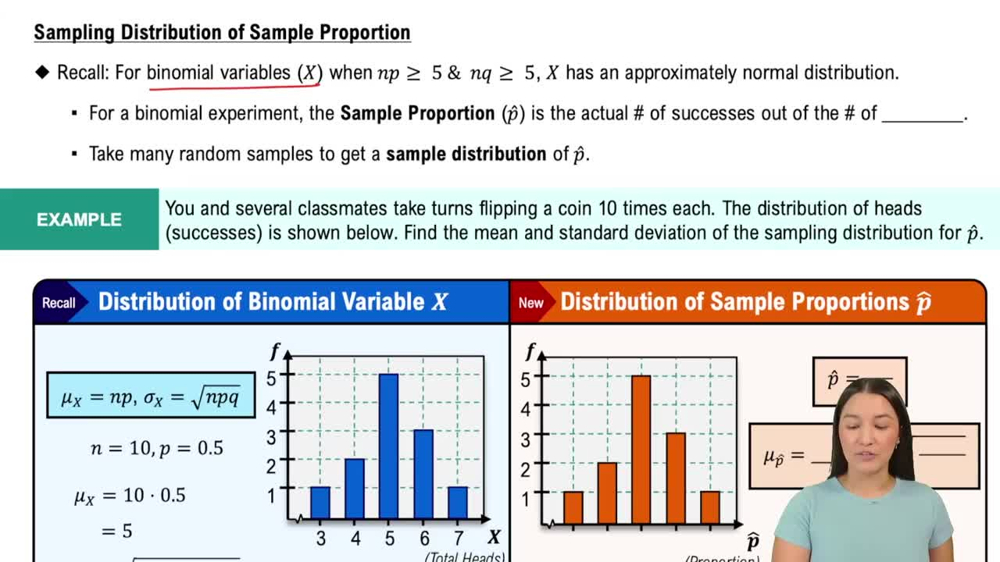
Sample size determination involves calculating the number of observations needed to estimate a population parameter with a desired level of precision and confidence. For proportions, the sample size depends on the margin of error, confidence level, and variability in the population. Larger sample sizes reduce the margin of error, improving estimate accuracy.
Recommended video:
Sampling Distribution of Sample Proportion
Margin of Error and Confidence Interval
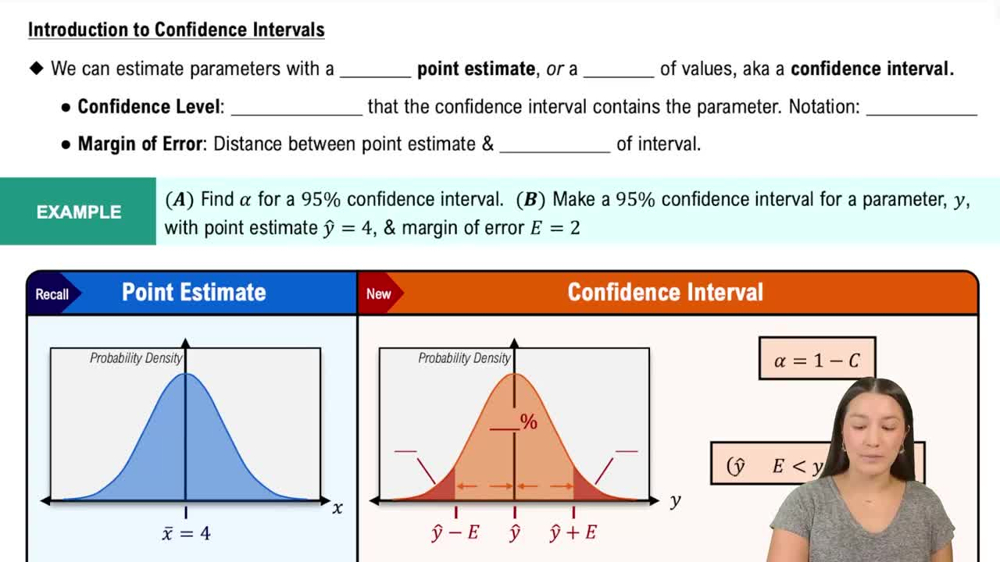
The margin of error defines the range within which the true population parameter is expected to lie with a certain confidence level, such as 95%. It reflects the maximum allowable difference between the sample estimate and the true proportion. Confidence intervals provide a range of plausible values for the parameter based on the sample data.
Recommended video:
Introduction to Confidence Intervals
Using Conservative Estimates Without Prior Information
When no prior estimate of the population proportion is available, a conservative approach assumes the maximum variability at p = 0.5. This maximizes the product p(1-p), leading to the largest required sample size to ensure the desired precision. This approach safeguards against underestimating the needed sample size.
Recommended video:
Guided course
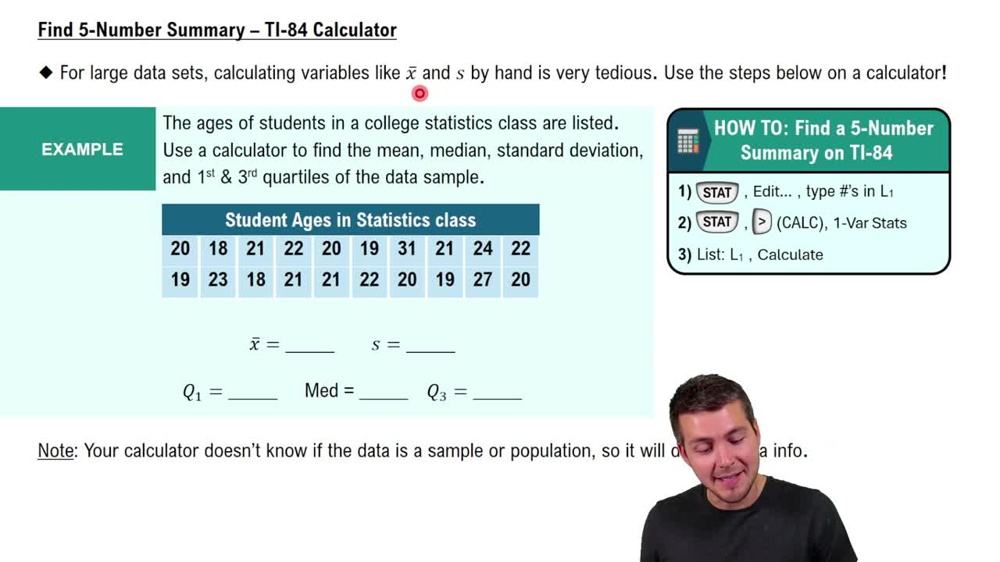
Find 5-Number Summary - TI-84 Calculator
Watch next
Master Difference in Proportions: Hypothesis Tests with a bite sized video explanation from Patrick
Start learningRelated Videos
Related Practice
Textbook Question
2
views