Sample Size Dr. Paul Oswiecmiski wants to estimate the mean serum HDL cholesterol of all 20- to 29-year-old males. How many subjects are needed to estimate the mean serum HDL cholesterol of all 20- to 29-year-old males within 1.5 points with 90% confidence, assuming that s = 12.5 based on earlier studies? Suppose that Dr. Oswiecmiski would prefer 95% confidence. How does the increase in confidence affect the sample size required?
Table of contents
- 1. Intro to Stats and Collecting Data1h 14m
- 2. Describing Data with Tables and Graphs1h 56m
- 3. Describing Data Numerically2h 5m
- 4. Probability2h 17m
- 5. Binomial Distribution & Discrete Random Variables3h 6m
- 6. Normal Distribution and Continuous Random Variables2h 11m
- 7. Sampling Distributions & Confidence Intervals: Mean3h 23m
- Sampling Distribution of the Sample Mean and Central Limit Theorem19m
- Distribution of Sample Mean - ExcelBonus23m
- Introduction to Confidence Intervals15m
- Confidence Intervals for Population Mean1h 18m
- Determining the Minimum Sample Size Required12m
- Finding Probabilities and T Critical Values - ExcelBonus28m
- Confidence Intervals for Population Means - ExcelBonus25m
- 8. Sampling Distributions & Confidence Intervals: Proportion2h 10m
- 9. Hypothesis Testing for One Sample5h 8m
- Steps in Hypothesis Testing1h 6m
- Performing Hypothesis Tests: Means1h 4m
- Hypothesis Testing: Means - ExcelBonus42m
- Performing Hypothesis Tests: Proportions37m
- Hypothesis Testing: Proportions - ExcelBonus27m
- Performing Hypothesis Tests: Variance12m
- Critical Values and Rejection Regions28m
- Link Between Confidence Intervals and Hypothesis Testing12m
- Type I & Type II Errors16m
- 10. Hypothesis Testing for Two Samples5h 37m
- Two Proportions1h 13m
- Two Proportions Hypothesis Test - ExcelBonus28m
- Two Means - Unknown, Unequal Variance1h 3m
- Two Means - Unknown Variances Hypothesis Test - ExcelBonus12m
- Two Means - Unknown, Equal Variance15m
- Two Means - Unknown, Equal Variances Hypothesis Test - ExcelBonus9m
- Two Means - Known Variance12m
- Two Means - Sigma Known Hypothesis Test - ExcelBonus21m
- Two Means - Matched Pairs (Dependent Samples)42m
- Matched Pairs Hypothesis Test - ExcelBonus12m
- Two Variances and F Distribution29m
- Two Variances - Graphing CalculatorBonus16m
- 11. Correlation1h 24m
- 12. Regression3h 33m
- Linear Regression & Least Squares Method26m
- Residuals12m
- Coefficient of Determination12m
- Regression Line Equation and Coefficient of Determination - ExcelBonus8m
- Finding Residuals and Creating Residual Plots - ExcelBonus11m
- Inferences for Slope31m
- Enabling Data Analysis ToolpakBonus1m
- Regression Readout of the Data Analysis Toolpak - ExcelBonus21m
- Prediction Intervals13m
- Prediction Intervals - ExcelBonus19m
- Multiple Regression - ExcelBonus29m
- Quadratic Regression15m
- Quadratic Regression - ExcelBonus10m
- 13. Chi-Square Tests & Goodness of Fit2h 21m
- 14. ANOVA2h 29m
7. Sampling Distributions & Confidence Intervals: Mean
Confidence Intervals for Population Mean
Problem 9.2.45
Textbook Question
"Simulation: Normal Distribution IQ scores based on the Wechsler Intelligence Scale for Children (WISC) are known to be approximately normally distributed with μ = 100 and σ = 15.
a. Use StatCrunch, Minitab, or some other statistical software to simulate obtaining 100 simple random samples of size n = 5 from this population.
b. Obtain the sample mean and sample standard deviation for each of the 100 samples.
c. Construct 95% t-intervals for each of the 100 samples.
d. How many of the intervals do you expect to include the population mean? How many of the intervals actually include the population mean?"
Verified step by step guidance1
Understand the problem context: IQ scores follow a normal distribution with mean \(\mu = 100\) and standard deviation \(\sigma = 15\). We want to simulate sampling from this population and analyze the sample statistics and confidence intervals.
Step a: Use statistical software (like StatCrunch or Minitab) to generate 100 simple random samples, each of size \(n = 5\), from the normal distribution \(N(100, 15^2)\). This means each sample consists of 5 IQ scores drawn from this distribution.
Step b: For each of the 100 samples, calculate the sample mean \(\bar{x}\) and the sample standard deviation \(s\). The sample mean is calculated as \(\bar{x} = \frac{1}{n} \sum_{i=1}^n x_i\), and the sample standard deviation is \(s = \sqrt{\frac{1}{n-1} \sum_{i=1}^n (x_i - \bar{x})^2}\).
Step c: Construct a 95% confidence interval for the population mean for each sample using the t-distribution. The formula for the confidence interval is:
\(\left( \bar{x} - t_{\alpha/2, n-1} \times \frac{s}{\sqrt{n}}, \quad \bar{x} + t_{\alpha/2, n-1} \times \frac{s}{\sqrt{n}} \right)\)
where \(t_{\alpha/2, n-1}\) is the critical t-value with \(n-1\) degrees of freedom corresponding to a 95% confidence level.
Step d: Since the confidence level is 95%, theoretically about 95 out of the 100 intervals should contain the true population mean \(\mu = 100\). Count how many of the constructed intervals actually include 100 by checking if 100 lies between the lower and upper bounds of each interval.
Verified video answer for a similar problem:This video solution was recommended by our tutors as helpful for the problem above
Video duration:
4mPlay a video:
0 Comments
Key Concepts
Here are the essential concepts you must grasp in order to answer the question correctly.
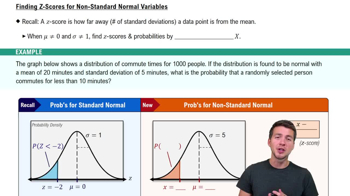
Normal Distribution
The normal distribution is a continuous probability distribution characterized by its symmetric, bell-shaped curve defined by the mean (μ) and standard deviation (σ). Many natural phenomena, like IQ scores, approximate this distribution, allowing us to model and simulate data effectively. Understanding its properties helps in interpreting sample data and applying inferential statistics.
Recommended video:
Guided course
Finding Z-Scores for Non-Standard Normal Variables
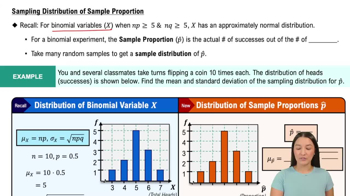
Sampling and Sample Statistics
Sampling involves selecting a subset of individuals from a population to estimate population parameters. Sample mean and sample standard deviation summarize the data from each sample, providing estimates of the population mean and variability. Recognizing the variability among samples is key to understanding sampling distributions and the reliability of estimates.
Recommended video:
Sampling Distribution of Sample Proportion
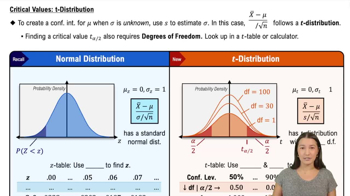
Confidence Intervals and the t-Distribution
A confidence interval estimates a population parameter by providing a range likely to contain it, with a specified confidence level (e.g., 95%). When the population standard deviation is unknown and sample sizes are small, the t-distribution is used instead of the normal distribution to account for extra uncertainty. Constructing t-intervals helps assess how often these intervals capture the true mean.
Recommended video:
Critical Values: t-Distribution
Related Videos
Related Practice
Textbook Question