Age of Death-Row InmatesIn 2002, the mean age of an inmate on death row was 40.7 years, according to data from the U.S. Department of Justice. A sociologist wondered whether the mean age of a death-row inmate has changed since then. She randomly selects 32 death-row inmates and finds that their mean age is 38.9, with a standard deviation of 9.6. Construct a 95% confidence interval about the mean age. What does the interval imply?
Verified step by step guidance
1
Identify the sample statistics and parameters given: sample size \(n = 32\), sample mean \(\bar{x} = 38.9\), sample standard deviation \(s = 9.6\), and the confidence level is 95%.
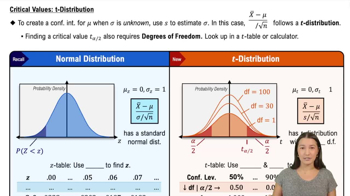
Since the population standard deviation is unknown and the sample size is less than 30, use the t-distribution to construct the confidence interval. The degrees of freedom (df) will be \(n - 1 = 31\).
Find the critical t-value \(t^*\) corresponding to a 95% confidence level and 31 degrees of freedom. This value can be found using a t-table or statistical software.
Calculate the standard error of the mean (SEM) using the formula:
\(\text{SEM} = \frac{s}{\sqrt{n}} = \frac{9.6}{\sqrt{32}}\)
Construct the confidence interval using the formula:
\(\bar{x} \pm t^* \times \text{SEM}\)
This interval estimates the range in which the true mean age of death-row inmates lies with 95% confidence. Interpret the interval by explaining whether it suggests a change from the 2002 mean age of 40.7 years.
Verified video answer for a similar problem:
This video solution was recommended by our tutors as helpful for the problem above
Video duration:
10m
Play a video:
Was this helpful?
Key Concepts
Here are the essential concepts you must grasp in order to answer the question correctly.
Confidence Interval
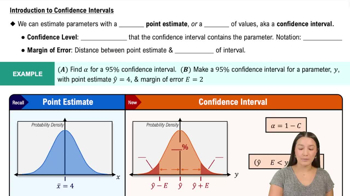
A confidence interval estimates a range of values within which the true population parameter, such as the mean, is likely to fall. It is calculated from sample data and provides a measure of uncertainty. For example, a 95% confidence interval means we are 95% confident the true mean lies within this range.
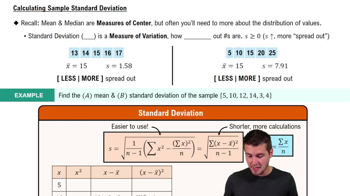
The sample mean is the average value calculated from the sample data, representing an estimate of the population mean. The standard deviation measures the variability or spread of the sample data. Both are essential for constructing confidence intervals and understanding the data's distribution.
When the population standard deviation is unknown and the sample size is small, the t-distribution is used instead of the normal distribution to construct confidence intervals. The shape depends on degrees of freedom, calculated as sample size minus one, which affects the critical value for the interval.