
Suppose a survey records whether students prefer coffee or tea (, ) and whether they are undergraduate or graduate students (, ). Which two-way table correctly displays this data?
Table of contents
- 1. Intro to Stats and Collecting Data1h 14m
- 2. Describing Data with Tables and Graphs1h 55m
- 3. Describing Data Numerically2h 5m
- 4. Probability2h 16m
- 5. Binomial Distribution & Discrete Random Variables3h 6m
- 6. Normal Distribution and Continuous Random Variables2h 11m
- 7. Sampling Distributions & Confidence Intervals: Mean3h 23m
- Sampling Distribution of the Sample Mean and Central Limit Theorem19m
- Distribution of Sample Mean - Excel23m
- Introduction to Confidence Intervals15m
- Confidence Intervals for Population Mean1h 18m
- Determining the Minimum Sample Size Required12m
- Finding Probabilities and T Critical Values - Excel28m
- Confidence Intervals for Population Means - Excel25m
- 8. Sampling Distributions & Confidence Intervals: Proportion1h 25m
- 9. Hypothesis Testing for One Sample3h 29m
- 10. Hypothesis Testing for Two Samples4h 50m
- Two Proportions1h 13m
- Two Proportions Hypothesis Test - Excel28m
- Two Means - Unknown, Unequal Variance1h 3m
- Two Means - Unknown Variances Hypothesis Test - Excel12m
- Two Means - Unknown, Equal Variance15m
- Two Means - Unknown, Equal Variances Hypothesis Test - Excel9m
- Two Means - Known Variance12m
- Two Means - Sigma Known Hypothesis Test - Excel21m
- Two Means - Matched Pairs (Dependent Samples)42m
- Matched Pairs Hypothesis Test - Excel12m
- 11. Correlation1h 24m
- 12. Regression1h 50m
- 13. Chi-Square Tests & Goodness of Fit2h 21m
- 14. ANOVA1h 57m
13. Chi-Square Tests & Goodness of Fit
Contingency Tables
Problem 10.2.11
Textbook Question
Finding Expected Frequencies
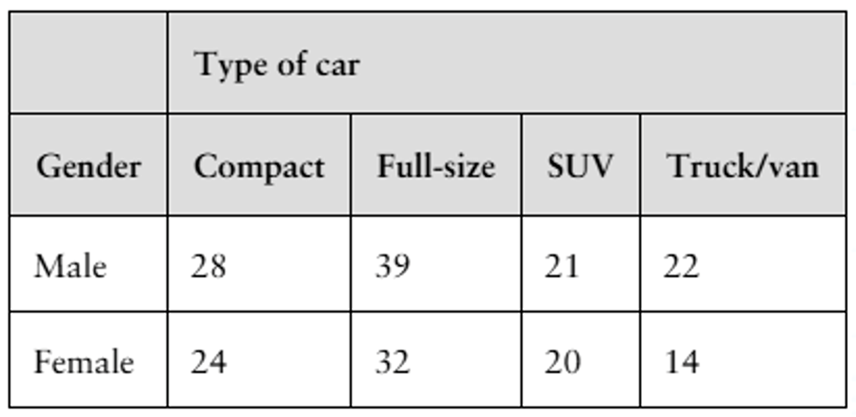
In Exercises 7–12, (a) calculate the marginal frequencies and (b) find the expected frequency for each cell in the contingency table. Assume that the variables are independent.

Verified step by step guidance1
Step 1: Calculate the marginal frequencies for each row and column. Marginal frequencies are the totals for each row and column in the contingency table. Add the values across each row to find the row totals, and add the values down each column to find the column totals.
Step 2: Compute the grand total by summing all the values in the table. This represents the total number of observations in the dataset.
Step 3: Use the formula for expected frequency to calculate the expected frequency for each cell in the table. The formula is: , where E is the expected frequency.
Step 4: Apply the formula to each cell in the table. For example, for the cell corresponding to 'Male' and 'Compact', use the row total for 'Male', the column total for 'Compact', and the grand total to calculate the expected frequency.
Step 5: Repeat the calculation for all cells in the table to find the expected frequencies for each cell. Ensure that the expected frequencies are rounded appropriately if needed.
Verified video answer for a similar problem:This video solution was recommended by our tutors as helpful for the problem above
Video duration:
5mPlay a video:
Was this helpful?
Key Concepts
Here are the essential concepts you must grasp in order to answer the question correctly.
Marginal Frequencies
Marginal frequencies are the totals of the rows and columns in a contingency table. They provide a summary of the data by showing the total counts for each category, allowing for a quick overview of the distribution of responses. For example, in the given table, the marginal frequency for males would be the sum of all car types chosen by males.
Recommended video:
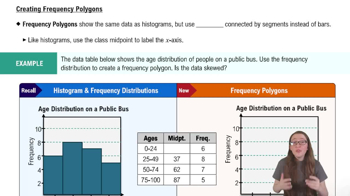
Creating Frequency Polygons
Expected Frequencies
Expected frequencies are the theoretical counts that would occur in each cell of a contingency table if the variables were independent. They are calculated by multiplying the marginal totals of the corresponding row and column, then dividing by the total number of observations. This concept is crucial for conducting chi-square tests to determine if there is a significant association between the variables.
Recommended video:
Guided course
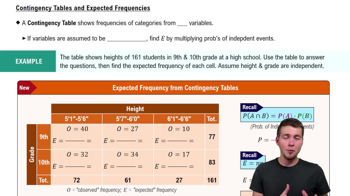
Contingency Tables & Expected Frequencies
Independence of Variables
The independence of variables means that the occurrence of one variable does not affect the occurrence of another. In the context of a contingency table, if the variables (like gender and car type) are independent, the expected frequencies can be calculated using the marginal totals. This assumption is essential for accurately interpreting the results of statistical tests, such as the chi-square test.
Recommended video:
Guided course
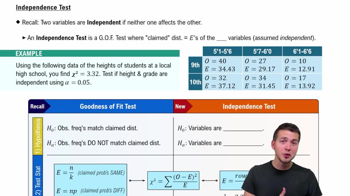
Independence Test
Watch next
Master Contingency Tables & Expected Frequencies with a bite sized video explanation from Patrick
Start learningRelated Videos
Related Practice
Multiple Choice
14
views
