Obligations to Vote and Serve In the General Social Survey, individuals were asked whether civic duty included voting and whether it included serving on a jury. The results of the survey are shown in the table. Is there a difference in the proportion of individuals who feel jury duty is a civic duty and the proportion of individuals who feel voting is a civic duty? Use the α = 0.05 level of significance.
Table of contents
- 1. Intro to Stats and Collecting Data1h 14m
- 2. Describing Data with Tables and Graphs1h 56m
- 3. Describing Data Numerically2h 5m
- 4. Probability2h 16m
- 5. Binomial Distribution & Discrete Random Variables3h 6m
- 6. Normal Distribution and Continuous Random Variables2h 11m
- 7. Sampling Distributions & Confidence Intervals: Mean3h 23m
- Sampling Distribution of the Sample Mean and Central Limit Theorem19m
- Distribution of Sample Mean - ExcelBonus23m
- Introduction to Confidence Intervals15m
- Confidence Intervals for Population Mean1h 18m
- Determining the Minimum Sample Size Required12m
- Finding Probabilities and T Critical Values - ExcelBonus28m
- Confidence Intervals for Population Means - ExcelBonus25m
- 8. Sampling Distributions & Confidence Intervals: Proportion2h 10m
- 9. Hypothesis Testing for One Sample5h 8m
- Steps in Hypothesis Testing1h 6m
- Performing Hypothesis Tests: Means1h 4m
- Hypothesis Testing: Means - ExcelBonus42m
- Performing Hypothesis Tests: Proportions37m
- Hypothesis Testing: Proportions - ExcelBonus27m
- Performing Hypothesis Tests: Variance12m
- Critical Values and Rejection Regions28m
- Link Between Confidence Intervals and Hypothesis Testing12m
- Type I & Type II Errors16m
- 10. Hypothesis Testing for Two Samples5h 37m
- Two Proportions1h 13m
- Two Proportions Hypothesis Test - ExcelBonus28m
- Two Means - Unknown, Unequal Variance1h 3m
- Two Means - Unknown Variances Hypothesis Test - ExcelBonus12m
- Two Means - Unknown, Equal Variance15m
- Two Means - Unknown, Equal Variances Hypothesis Test - ExcelBonus9m
- Two Means - Known Variance12m
- Two Means - Sigma Known Hypothesis Test - ExcelBonus21m
- Two Means - Matched Pairs (Dependent Samples)42m
- Matched Pairs Hypothesis Test - ExcelBonus12m
- Two Variances and F Distribution29m
- Two Variances - Graphing CalculatorBonus16m
- 11. Correlation1h 24m
- 12. Regression3h 33m
- Linear Regression & Least Squares Method26m
- Residuals12m
- Coefficient of Determination12m
- Regression Line Equation and Coefficient of Determination - ExcelBonus8m
- Finding Residuals and Creating Residual Plots - ExcelBonus11m
- Inferences for Slope31m
- Enabling Data Analysis ToolpakBonus1m
- Regression Readout of the Data Analysis Toolpak - ExcelBonus21m
- Prediction Intervals13m
- Prediction Intervals - ExcelBonus19m
- Multiple Regression - ExcelBonus29m
- Quadratic Regression15m
- Quadratic Regression - ExcelBonus10m
- 13. Chi-Square Tests & Goodness of Fit2h 21m
- 14. ANOVA2h 28m
13. Chi-Square Tests & Goodness of Fit
Contingency Tables
Multiple Choice
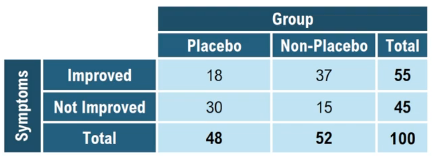
The table below shows the results from a drug trial for a new ADHD medication. Find the frequencies that we would expect if improvement of symptoms was independent of whether a participant received the placebo.

A
E1,1 = 25.0; E2,1 = 25.0; E1,2 = 25.0; E2,2 = 25.0
B
E1,1 = 28.6; E2,1 = 26.4; E1,2 = 23.4; E2,2 = 21.6
C
E1,1 = 26.4; E2,1 = 21.6; E1,2 = 28.6; E2,2 = 23.4
D
E1,1 = 18; E2,1 = 30; E1,2 = 37; E2,2 = 15
0 Comments
Verified step by step guidance1
Step 1: Understand the problem. We are tasked with finding the expected frequencies under the assumption that improvement of symptoms is independent of whether a participant received the placebo. This involves using the formula for expected frequency in a contingency table: E = (row total × column total) / grand total.
Step 2: Identify the totals from the table. The row totals are: Improved = 55, Not Improved = 45. The column totals are: Placebo = 48, Non-Placebo = 52. The grand total is 100.
Step 3: Calculate the expected frequency for each cell using the formula E = (row total × column total) / grand total. For example, for the 'Improved and Placebo' cell: E1,1 = (55 × 48) / 100.
Step 4: Repeat the calculation for the other cells: 'Improved and Non-Placebo' (E1,2), 'Not Improved and Placebo' (E2,1), and 'Not Improved and Non-Placebo' (E2,2). Use the same formula for each cell.
Step 5: Verify that the sum of the expected frequencies for each row and column matches the respective row and column totals. This ensures the calculations are consistent with the independence assumption.
Related Videos
Related Practice
Textbook Question
20
views

