Construct a frequency distribution and a frequency histogram for the data set using the indicated number of classes. Describe any patterns. Reaction Times Number of classes: 8 Data set: Reaction times (in milliseconds) of 30 adult females to an auditory stimulus 507 389 305 291 336 310 514 442 373 428 387 454 323 441 388 426 411 382 320 450 309 416 359 388 307 337 469 351 422 413
Verified step by step guidance
1
Step 1: Determine the range of the data set. To do this, subtract the smallest value in the data set from the largest value. The smallest value is 291, and the largest value is 514. Compute the range as Range = Largest Value - Smallest Value.
Step 2: Calculate the class width. Divide the range by the number of classes (8 in this case) and round up to the nearest whole number. Use the formula: Class Width = ⌈Range / Number of Classes⌉.
Step 3: Create the class intervals. Start with the smallest value in the data set as the lower limit of the first class. Add the class width to determine the upper limit of the first class. Continue this process to create all 8 classes, ensuring there is no overlap between intervals.
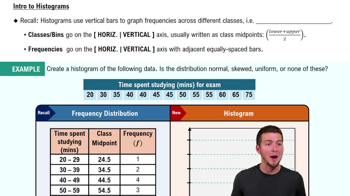
Step 4: Tally the data into the class intervals to construct the frequency distribution. Count how many data points fall into each class interval and record these frequencies.
Step 5: Construct the frequency histogram. On the x-axis, represent the class intervals, and on the y-axis, represent the frequencies. Draw bars for each class interval with heights corresponding to their frequencies. Analyze the histogram for any patterns, such as skewness, peaks, or uniformity.
Verified video answer for a similar problem:
This video solution was recommended by our tutors as helpful for the problem above
Video duration:
3m
Play a video:
0 Comments
Key Concepts
Here are the essential concepts you must grasp in order to answer the question correctly.
Frequency Distribution
A frequency distribution is a summary of how often each value occurs in a dataset. It organizes data into classes or intervals, showing the number of observations (frequency) that fall within each class. This helps in understanding the distribution of data points and identifying patterns, such as skewness or modality.
A histogram is a graphical representation of a frequency distribution, where the data is divided into intervals (bins) and the frequency of data points in each interval is represented by bars. The height of each bar corresponds to the frequency of observations in that interval, allowing for visual analysis of the data's distribution, trends, and potential outliers.
Classes refer to the intervals into which data is grouped for analysis, while bin width is the range of values each class covers. Choosing the right number of classes and appropriate bin width is crucial, as it affects the clarity and interpretability of the histogram. Too few classes can oversimplify the data, while too many can obscure important patterns.

 3:49 minutes
 Verified step by step guidance
 06:38
06:38