
Ch. 2 - Descriptive Statistics
Larson - Elementary Statistics: Picturing the World 8th Edition
Larson8th EditionElementary Statistics: Picturing the WorldISBN: 9780137493470Not the one you use?Change textbook
Chapter 2, Problem 2.1.41

Construct a cumulative frequency distribution and an ogive for the data set using six classes. Then describe the location of the greatest increase in frequency.
Retirement Ages
Data set: Retirement ages of 35 English professors 72 62 55 61 53 62 65 66 69 55 66 63 67 69 55 65 67 57 67 68 73 75 65 54 71 57 52 58 58 71 72 67 63 65 61

Verified step by step guidance
1
Organize the data set in ascending order. This will make it easier to group the data into classes and calculate frequencies.
Determine the range of the data by subtracting the smallest value from the largest value. Then, divide the range by the number of classes (6 in this case) to calculate the class width. Round up to the nearest whole number if necessary.
Create six classes by starting with the smallest value and adding the class width to define the upper limit of each class. Ensure that the classes do not overlap and cover the entire range of the data.
Count the number of data points (frequencies) that fall into each class. Then, calculate the cumulative frequency for each class by adding the frequency of the current class to the cumulative frequency of the previous class.
Plot the ogive by graphing the cumulative frequencies on the y-axis and the upper class boundaries on the x-axis. To describe the location of the greatest increase in frequency, identify the steepest segment of the ogive, which corresponds to the class with the largest frequency increase.

Verified video answer for a similar problem:

This video solution was recommended by our tutors as helpful for the problem above.
Video duration:
3m
Was this helpful?

Key Concepts

Here are the essential concepts you must grasp in order to answer the question correctly.

Cumulative Frequency Distribution

A cumulative frequency distribution is a statistical tool that summarizes the number of observations that fall below a particular value in a dataset. It is constructed by adding the frequency of each class interval to the sum of the frequencies of all preceding intervals. This allows for an understanding of the distribution of data points across different ranges, making it easier to identify trends and patterns.
Recommended video:
Guided course
06:38
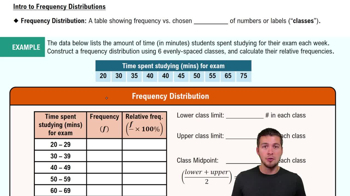
Intro to Frequency Distributions

Ogive

An ogive is a graphical representation of a cumulative frequency distribution. It is plotted with the cumulative frequency on the y-axis and the upper boundaries of the class intervals on the x-axis. The resulting curve helps visualize how many data points fall below a certain value, allowing for quick assessments of data distribution and comparisons between different datasets.

Class Intervals

Class intervals are the ranges into which data points are grouped for frequency distribution analysis. In this context, the data set is divided into six classes, which helps in organizing the data for cumulative frequency and ogive construction. Choosing appropriate class intervals is crucial, as it affects the clarity and interpretability of the distribution, highlighting areas of significant frequency changes.
Recommended video:
Guided course
09:00
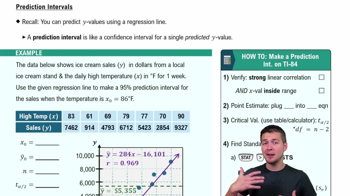
Prediction Intervals
Related Practice
Textbook Question

Identifying the Shape of a Distribution In Exercises 53–56, construct a frequency distribution and a frequency histogram for the data set using the indicated number of classes. Describe the shape of the histogram as symmetric, uniform, negatively skewed, positively skewed, or none of these.


Heights of Males

Number of classes: 5

Data set: The heights (to the nearest inch) of 30 males

67 76 69 68 72 68 65 63 75 69

66 72 67 66 69 73 64 62 71 73

68 72 71 65 69 66 74 72 68 69

265
views
Textbook Question

Constructing Data Sets In Exercises 5– 8, construct the described data set. The entries in the data set cannot all be the same.


Mean and median are the same and the data is bimodal.

128
views
Textbook Question

Construct a frequency distribution for the data set using the indicated number of classes. In the table, include the midpoints, relative frequencies, and cumulative frequencies. Which class has the greatest class frequency and which has the least class frequency.

Textbook Spending

Number of classes: 6

Data set: Amounts (in dollars) spent on textbooks for a semester 91 472 279 249 530 376 188 341 266 199 142 273 189 130 489 266 248 101 375 486 190 398 188 269 43 30 127 354 84 319

232
views
Textbook Question

Interpreting Percentiles In Exercises 29–32, use the ogive, which represents the cumulative frequency distribution for quantitative reasoning scores on the Graduate Record Examination in a recent range of years. (Adapted from Educational Testing Service)

What percentile is a score of 170? How should you interpret this?

266
views
Textbook Question

Extending Concepts


Midquartile Another measure of position is called the midquartile. You can find the midquartile of a data set by using the formula below.

Midquartile = (Q₁ + Q₃) / 2

In Exercises 55 and 56, find the midquartile of the data set.


5 7 1 2 3 10 8 7 5 3

121
views
Textbook Question

Graphing Data Sets In Exercises 17–32, organize the data using the indicated type of graph. Describe any patterns.


Engineering Degrees Use a time series chart to display the data shown in the table. The data represent the number of bachelor’s degrees in engineering (in thousands) conferred in the U.S. (Source: U.S. Deapartment of Education)


121
views