Explain why it is not feasible to insert the entire human insulin gene into E. coli and anticipate the production of insulin.
Table of contents
- 1. Introduction to Genetics51m
- 2. Mendel's Laws of Inheritance3h 37m
- 3. Extensions to Mendelian Inheritance2h 41m
- 4. Genetic Mapping and Linkage2h 28m
- 5. Genetics of Bacteria and Viruses1h 21m
- 6. Chromosomal Variation1h 48m
- 7. DNA and Chromosome Structure56m
- 8. DNA Replication1h 10m
- 9. Mitosis and Meiosis1h 34m
- 10. Transcription1h 0m
- 11. Translation58m
- 12. Gene Regulation in Prokaryotes1h 19m
- 13. Gene Regulation in Eukaryotes44m
- 14. Genetic Control of Development44m
- 15. Genomes and Genomics1h 50m
- 16. Transposable Elements47m
- 17. Mutation, Repair, and Recombination1h 6m
- 18. Molecular Genetic Tools19m
- 19. Cancer Genetics29m
- 20. Quantitative Genetics1h 26m
- 21. Population Genetics50m
- 22. Evolutionary Genetics29m
11. Translation
The Genetic Code
Problem 29e
Textbook Question
Shown here are the amino acid sequences of the wild-type and three mutant forms of a short protein.
___________________________________________________
Wild-type: Met-Trp-Tyr-Arg-Gly-Ser-Pro-Thr
Mutant 1: Met-Trp
Mutant 2: Met-Trp-His-Arg-Gly-Ser-Pro-Thr
Mutant 3: Met -Cys-Ile-Val-Val-Val-Gln-His
___________________________________________________
Use this information to answer the following questions:
Another mutation (mutant 4) is isolated. Its amino acid sequence is unchanged from the wild type, but the mutant cells produce abnormally low amounts of the wild-type proteins. As specifically as you can, predict where this mutation exists in the gene.
Verified step by step guidance1
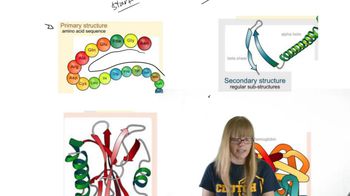
Understand that the amino acid sequence of mutant 4 is identical to the wild-type protein, indicating that the mutation does not change the protein's primary structure.
Since the protein sequence is unchanged but the amount of protein produced is abnormally low, consider mutations that affect gene expression rather than protein coding, such as mutations in regulatory regions.
Identify key regulatory regions in the gene that control transcription and translation, including the promoter, enhancer, and possibly the 5' untranslated region (5' UTR) or sequences affecting mRNA stability.
Predict that the mutation likely exists in the promoter or other regulatory elements upstream of the coding sequence, which would reduce transcription efficiency and thus lower protein production without altering the amino acid sequence.
Conclude that the mutation is not in the coding region but in a regulatory region of the gene that controls the amount of protein synthesized.
Verified video answer for a similar problem:This video solution was recommended by our tutors as helpful for the problem above
Video duration:
2mPlay a video:
Was this helpful?
Key Concepts
Here are the essential concepts you must grasp in order to answer the question correctly.
Gene Expression and Protein Synthesis
Gene expression involves transcribing DNA into mRNA and translating mRNA into a protein sequence. Mutations can affect protein quantity or quality by altering transcription, mRNA stability, or translation efficiency, even if the amino acid sequence remains unchanged.
Recommended video:
Guided course
Proteins
Types of Mutations Affecting Protein Levels
Mutations outside the coding region, such as in promoters, enhancers, or regulatory sequences, can reduce protein production without changing the amino acid sequence. These regulatory mutations impact transcription initiation or mRNA processing, leading to lower protein amounts.
Recommended video:
Guided course
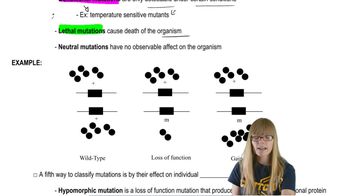
Mutations and Phenotypes
Relationship Between DNA Sequence and Protein Sequence
The amino acid sequence is determined by the coding DNA sequence, but mutations in non-coding regions or synonymous codons can affect gene expression levels. Thus, unchanged protein sequences can still result from mutations that alter gene regulation rather than protein structure.
Recommended video:
Guided course
Sequencing Overview
Related Videos
Related Practice
Textbook Question
384
views
