A research scientist is interested in producing human insulin in the bacterial species E. coli. Will the genetic code allow the production of human proteins from bacterial cells? Explain why or why not.
Table of contents
- 1. Introduction to Genetics51m
- 2. Mendel's Laws of Inheritance3h 37m
- 3. Extensions to Mendelian Inheritance2h 41m
- 4. Genetic Mapping and Linkage2h 28m
- 5. Genetics of Bacteria and Viruses1h 21m
- 6. Chromosomal Variation1h 48m
- 7. DNA and Chromosome Structure56m
- 8. DNA Replication1h 10m
- 9. Mitosis and Meiosis1h 34m
- 10. Transcription1h 0m
- 11. Translation58m
- 12. Gene Regulation in Prokaryotes1h 19m
- 13. Gene Regulation in Eukaryotes44m
- 14. Genetic Control of Development44m
- 15. Genomes and Genomics1h 50m
- 16. Transposable Elements47m
- 17. Mutation, Repair, and Recombination1h 6m
- 18. Molecular Genetic Tools19m
- 19. Cancer Genetics29m
- 20. Quantitative Genetics1h 26m
- 21. Population Genetics50m
- 22. Evolutionary Genetics29m
11. Translation
The Genetic Code
Problem 29d
Textbook Question
Shown here are the amino acid sequences of the wild-type and three mutant forms of a short protein.
___________________________________________________
Wild-type: Met-Trp-Tyr-Arg-Gly-Ser-Pro-Thr
Mutant 1: Met-Trp
Mutant 2: Met-Trp-His-Arg-Gly-Ser-Pro-Thr
Mutant 3: Met-Cys-Ile-Val-Val-Val-Gln-Hi
___________________________________________________
Use this information to answer the following questions:
Of the first eight wild-type triplets, which, if any, can you determine specifically from an analysis of the mutant proteins? In each case, explain why or why not.
Verified step by step guidance1
Step 1: Understand that each amino acid in the wild-type protein corresponds to a specific codon (triplet of nucleotides) in the DNA sequence. Since the wild-type sequence has eight amino acids, there are eight corresponding codons to consider.
Step 2: Compare the mutant protein sequences to the wild-type sequence to identify which amino acids are preserved, missing, or changed. This comparison helps infer which codons might be unchanged or altered in the mutants.
Step 3: For Mutant 1, which only has 'Met-Trp', note that the sequence is truncated after the second amino acid. This suggests a mutation causing an early stop codon or deletion after the second codon, so the first two codons (Met and Trp) are likely unchanged and can be determined specifically.
Step 4: For Mutant 2, which has 'Met-Trp-His-Arg-Gly-Ser-Pro-Thr', observe that the sequence is longer than the wild-type and includes a His instead of Tyr at the third position. This indicates a mutation in the third codon, changing Tyr to His, so the first two codons (Met and Trp) are likely unchanged, but the third codon is altered and cannot be determined as wild-type.
Step 5: For Mutant 3, which has a completely different sequence starting with 'Met-Cys-Ile-Val-Val-Val-Gln-Hi', note that the first amino acid Met is the same, but the rest differ. This suggests the first codon is likely unchanged, but the subsequent codons are mutated, so only the first codon can be determined specifically from this mutant.
Verified video answer for a similar problem:This video solution was recommended by our tutors as helpful for the problem above
Video duration:
29sPlay a video:
Was this helpful?
Key Concepts
Here are the essential concepts you must grasp in order to answer the question correctly.
Genetic Code and Codon-Amino Acid Relationship
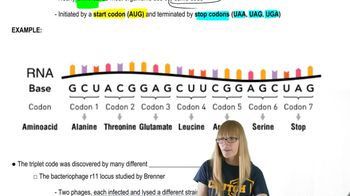
The genetic code consists of triplet codons in mRNA, each specifying a particular amino acid. Understanding which codons correspond to which amino acids is essential for interpreting how mutations affect protein sequences. This concept helps link changes in DNA or mRNA to alterations in the amino acid sequence of proteins.
Recommended video:
Guided course
The Genetic Code
Types of Mutations and Their Effects on Protein Sequence
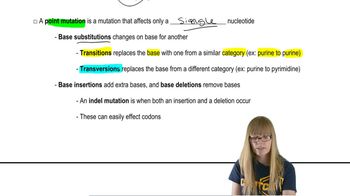
Mutations such as deletions, insertions, or substitutions can alter the amino acid sequence of a protein. Frameshift mutations change the reading frame, potentially altering all downstream amino acids, while point mutations may change a single amino acid. Recognizing mutation types helps determine which original codons can be inferred from mutant sequences.
Recommended video:
Guided course
Point Mutations
Protein Translation and Reading Frame
Protein translation reads mRNA codons sequentially in groups of three nucleotides, starting from a fixed start codon. Maintaining the correct reading frame is crucial; shifts can drastically change the resulting amino acid sequence. Analyzing mutant proteins requires understanding how changes affect the reading frame and which original codons remain identifiable.
Recommended video:
Guided course
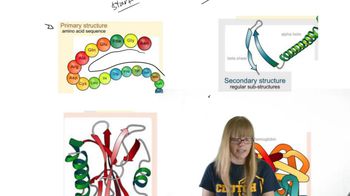
Proteins
Related Videos
Related Practice
Textbook Question
578
views
