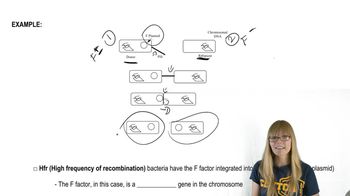
The flow diagram identifies relationships between bacterial strains in various F factor states. For each of the four arrows in the diagram, provide a description of the events involved in the transition.
Table of contents
- 1. Introduction to Genetics51m
- 2. Mendel's Laws of Inheritance3h 37m
- 3. Extensions to Mendelian Inheritance2h 41m
- 4. Genetic Mapping and Linkage2h 28m
- 5. Genetics of Bacteria and Viruses1h 21m
- 6. Chromosomal Variation1h 48m
- 7. DNA and Chromosome Structure56m
- 8. DNA Replication1h 10m
- 9. Mitosis and Meiosis1h 34m
- 10. Transcription1h 0m
- 11. Translation58m
- 12. Gene Regulation in Prokaryotes1h 19m
- 13. Gene Regulation in Eukaryotes44m
- 14. Genetic Control of Development44m
- 15. Genomes and Genomics1h 50m
- 16. Transposable Elements47m
- 17. Mutation, Repair, and Recombination1h 6m
- 18. Molecular Genetic Tools19m
- 19. Cancer Genetics29m
- 20. Quantitative Genetics1h 26m
- 21. Population Genetics50m
- 22. Evolutionary Genetics29m
5. Genetics of Bacteria and Viruses
Bacterial Conjugation
Problem 3a
Textbook Question
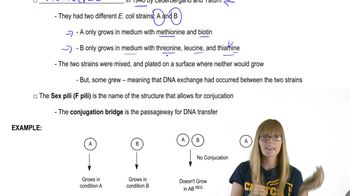
With respect to F⁺ and F⁻ bacterial matings, answer the following questions: How was it established that physical contact between cells was necessary?
Verified step by step guidance1
Understand the biological context: F⁺ bacteria contain the F plasmid and can donate genetic material to F⁻ bacteria, which lack the plasmid, through a process called conjugation.
Recognize that the question asks about the experimental evidence showing that physical contact between F⁺ and F⁻ cells is necessary for conjugation to occur.
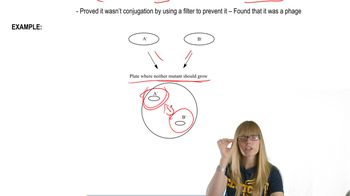
Recall the classic experiment where researchers used a U-tube apparatus with a filter that allowed the passage of liquid and small molecules but prevented direct cell-to-cell contact between F⁺ and F⁻ bacteria.
Note that when F⁺ and F⁻ cells were separated by this filter, no genetic transfer occurred, indicating that soluble factors alone were insufficient for conjugation.
Conclude that the necessity of physical contact was established because genetic transfer only happened when F⁺ and F⁻ cells were allowed to touch directly, demonstrating that conjugation requires cell-to-cell contact.
Verified video answer for a similar problem:This video solution was recommended by our tutors as helpful for the problem above
Video duration:
1mPlay a video:
Was this helpful?
Key Concepts
Here are the essential concepts you must grasp in order to answer the question correctly.
F⁺ and F⁻ Bacterial Mating
F⁺ bacteria contain the fertility (F) plasmid, enabling them to form a pilus and transfer genetic material to F⁻ bacteria, which lack the plasmid. This conjugation process results in the transfer of the F plasmid, converting F⁻ cells into F⁺ cells.
Recommended video:
Guided course
F Factor and Hfr
Role of Physical Contact in Conjugation
Physical contact between F⁺ and F⁻ cells is essential for conjugation because the F pilus connects the two cells, allowing DNA transfer. Experiments using filters that prevent cell contact but allow molecular diffusion showed no gene transfer, proving contact is necessary.
Recommended video:
Guided course
Conjugation Overview
Experimental Evidence Using Membrane Filters
Researchers used membrane filters with pores small enough to block bacteria but allow molecules to pass. When F⁺ and F⁻ cells were separated by such filters, no conjugation occurred, demonstrating that direct cell-to-cell contact, not just chemical signals, is required for DNA transfer.
Recommended video:
Guided course
Transduction
Related Videos
Related Practice
Textbook Question
583
views
