How do we know whether or not genetic recombination between bacteria involves cell-to-cell contact?
Table of contents
- 1. Introduction to Genetics51m
- 2. Mendel's Laws of Inheritance3h 37m
- 3. Extensions to Mendelian Inheritance2h 41m
- 4. Genetic Mapping and Linkage2h 28m
- 5. Genetics of Bacteria and Viruses1h 21m
- 6. Chromosomal Variation1h 48m
- 7. DNA and Chromosome Structure56m
- 8. DNA Replication1h 10m
- 9. Mitosis and Meiosis1h 34m
- 10. Transcription1h 0m
- 11. Translation58m
- 12. Gene Regulation in Prokaryotes1h 19m
- 13. Gene Regulation in Eukaryotes44m
- 14. Genetic Control of Development44m
- 15. Genomes and Genomics1h 50m
- 16. Transposable Elements47m
- 17. Mutation, Repair, and Recombination1h 6m
- 18. Molecular Genetic Tools19m
- 19. Cancer Genetics29m
- 20. Quantitative Genetics1h 26m
- 21. Population Genetics50m
- 22. Evolutionary Genetics29m
5. Genetics of Bacteria and Viruses
Bacterial Conjugation
Problem 3b
Textbook Question
With respect to F⁺ and F⁻ bacterial matings, answer the following questions: How was it established that chromosome transfer was unidirectional?
Verified step by step guidance1
Understand the biological context: In bacterial conjugation between F⁺ (donor) and F⁻ (recipient) cells, genetic material is transferred from one cell to another. The question focuses on how it was shown that this transfer occurs in one direction only—from the F⁺ donor to the F⁻ recipient.
Review the experimental design: Scientists mixed F⁺ and F⁻ bacteria and then separated the two populations after conjugation. They used genetic markers unique to each strain to track the movement of DNA.
Analyze the results: By checking which markers appeared in the recipient cells after mating, researchers observed that only donor markers were transferred to the recipient, and no recipient markers were found in the donor cells.
Interpret the findings: The absence of recipient markers in donor cells indicated that DNA transfer did not occur from F⁻ to F⁺ cells, establishing the unidirectional nature of chromosome transfer during conjugation.
Summarize the conclusion: The unidirectionality was confirmed by the selective presence of donor genetic material in recipients and the lack of reciprocal transfer, demonstrating that chromosome transfer proceeds only from F⁺ to F⁻ cells.
Verified video answer for a similar problem:This video solution was recommended by our tutors as helpful for the problem above
Video duration:
2mPlay a video:
Was this helpful?
Key Concepts
Here are the essential concepts you must grasp in order to answer the question correctly.
F⁺ and F⁻ Bacterial Mating
F⁺ bacteria contain the fertility factor (F plasmid) and can initiate conjugation by forming a pilus to connect with F⁻ bacteria, which lack the F plasmid. This mating allows genetic material transfer from F⁺ to F⁻ cells, enabling the study of gene transfer mechanisms.
Recommended video:
Guided course
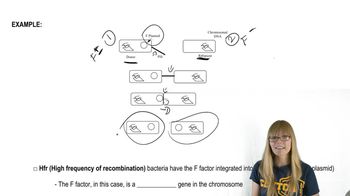
F Factor and Hfr
Unidirectional Chromosome Transfer
In bacterial conjugation, DNA transfer occurs only from the F⁺ donor to the F⁻ recipient, not in reverse. This unidirectionality was demonstrated by tracking genetic markers and observing that only the recipient acquired donor genes, confirming the direction of transfer.
Recommended video:
Guided course
Chromosome Structure
Use of Genetic Markers to Trace DNA Transfer
Researchers used specific genetic markers on donor and recipient chromosomes to monitor gene movement during conjugation. By analyzing which markers appeared in the recipient after mating, they established the direction and extent of chromosome transfer.
Recommended video:
Guided course
Mapping with Markers
Related Videos
Related Practice
Textbook Question
465
views