Textbook Question
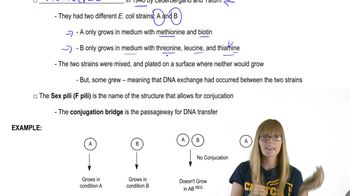
With respect to F⁺ and F⁻ bacterial matings, answer the following questions: How was it established that physical contact between cells was necessary?
419
views

 Klug 12th EditionCh. 6 - Genetic Analysis and Mapping in Bacteria and BacteriophagesProblem 3c
 Verified step by step guidance
 08:52
08:52
 04:06
04:06 07:39
07:39With respect to F⁺ and F⁻ bacterial matings, answer the following questions: How was it established that physical contact between cells was necessary?
Write a short summary that contrasts how recombination occurs in bacteria and bacteriophages.
Describe the basis for chromosome mapping in the Hfr x F⁻ crosses.
List all major differences between:
(a) The F⁺ x F⁻ and the Hfr x F⁻ bacterial crosses
(b) The F⁺, F⁻, Hfr, and F' bacteria.
With respect to F⁺ and F⁻ bacterial matings, answer the following questions: How was it established that chromosome transfer was unidirectional?