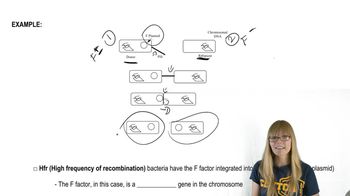
Conjugation between an Hfr cell and an F⁻ cell does not usually result in conversion of exconjugants to the donor state. Occasionally, however, the result of this conjugation is two Hfr cells. Explain how this occurs.
Table of contents
- 1. Introduction to Genetics51m
- 2. Mendel's Laws of Inheritance3h 37m
- 3. Extensions to Mendelian Inheritance2h 41m
- 4. Genetic Mapping and Linkage2h 28m
- 5. Genetics of Bacteria and Viruses1h 21m
- 6. Chromosomal Variation1h 48m
- 7. DNA and Chromosome Structure56m
- 8. DNA Replication1h 10m
- 9. Mitosis and Meiosis1h 34m
- 10. Transcription1h 0m
- 11. Translation58m
- 12. Gene Regulation in Prokaryotes1h 19m
- 13. Gene Regulation in Eukaryotes44m
- 14. Genetic Control of Development44m
- 15. Genomes and Genomics1h 50m
- 16. Transposable Elements47m
- 17. Mutation, Repair, and Recombination1h 6m
- 18. Molecular Genetic Tools19m
- 19. Cancer Genetics29m
- 20. Quantitative Genetics1h 26m
- 21. Population Genetics50m
- 22. Evolutionary Genetics29m
5. Genetics of Bacteria and Viruses
Bacterial Conjugation
Problem 4
Textbook Question
List all major differences between:
(a) The F⁺ x F⁻ and the Hfr x F⁻ bacterial crosses
(b) The F⁺, F⁻, Hfr, and F' bacteria.
Verified step by step guidance1
Step 1: Understand the nature of the F factor in bacterial conjugation. The F factor (fertility factor) is a plasmid that enables bacteria to transfer genetic material through conjugation. F⁺ bacteria carry the F plasmid, while F⁻ bacteria do not.
Step 2: Compare the F⁺ x F⁻ and Hfr x F⁻ crosses by focusing on the type of donor cell and the genetic material transferred. In an F⁺ x F⁻ cross, the donor is an F⁺ cell with the F plasmid separate from the chromosome, transferring mainly the plasmid. In an Hfr x F⁻ cross, the donor is an Hfr cell where the F factor is integrated into the bacterial chromosome, transferring chromosomal genes along with the F factor.
Step 3: List the major differences between F⁺, F⁻, Hfr, and F' bacteria by defining each: F⁺ bacteria have the F plasmid as an independent element; F⁻ bacteria lack the F plasmid; Hfr bacteria have the F factor integrated into their chromosome, enabling transfer of chromosomal genes; F' bacteria carry an F plasmid that has excised from the chromosome but includes some chromosomal genes.
Step 4: Highlight the consequences of these differences in terms of gene transfer: F⁺ cells transfer only the F plasmid, converting F⁻ recipients to F⁺; Hfr cells transfer part of their chromosome starting from the integrated F factor, often not converting F⁻ to Hfr due to incomplete transfer; F' cells transfer the F plasmid plus some chromosomal genes, potentially introducing new traits to recipients.
Step 5: Summarize the key distinctions focusing on the genetic material transferred, the integration status of the F factor, and the resulting phenotypes of recipient cells after conjugation.
Verified video answer for a similar problem:This video solution was recommended by our tutors as helpful for the problem above
Video duration:
1mPlay a video:
Was this helpful?
Key Concepts
Here are the essential concepts you must grasp in order to answer the question correctly.
F⁺ x F⁻ and Hfr x F⁻ Bacterial Crosses
F⁺ bacteria carry the F plasmid as an independent element and can transfer it to F⁻ cells via conjugation, converting them into F⁺. Hfr bacteria have the F factor integrated into their chromosome, allowing transfer of chromosomal genes to F⁻ cells during conjugation, often resulting in genetic recombination but rarely converting F⁻ to Hfr.
Recommended video:
Guided course
F Factor and Hfr
F⁺, F⁻, Hfr, and F' Bacteria
F⁺ cells contain the F plasmid as an episome; F⁻ cells lack the F factor entirely. Hfr cells have the F factor integrated into their chromosome, enabling high-frequency recombination. F' bacteria carry an F plasmid that has excised imprecisely, including some chromosomal genes, which can be transferred to recipients, facilitating gene mapping and variation.
Recommended video:
Guided course
F Factor and Hfr
Bacterial Conjugation and Gene Transfer Mechanisms
Conjugation is the process where genetic material is transferred between bacteria via direct contact, typically through a pilus. The nature of the F factor (plasmid or integrated) determines the type and extent of DNA transferred. Understanding these mechanisms is essential to distinguish how different bacterial crosses affect gene transfer and recombination.
Recommended video:
Guided course
F Factor and Hfr
Related Videos
Related Practice
Textbook Question
1866
views