Go to the website http://www.ncbi.nlm.nih.gov/omim and enter 'Lynch syndrome' in the Search box at the top of the page. From the list of options given, select '#120435—Lynch Syndrome.' Use the information you retrieve to answer the following questions. What genes are most commonly mutated in Lynch syndrome?
Table of contents
- 1. Introduction to Genetics51m
- 2. Mendel's Laws of Inheritance3h 37m
- 3. Extensions to Mendelian Inheritance2h 41m
- 4. Genetic Mapping and Linkage2h 28m
- 5. Genetics of Bacteria and Viruses1h 21m
- 6. Chromosomal Variation1h 48m
- 7. DNA and Chromosome Structure56m
- 8. DNA Replication1h 10m
- 9. Mitosis and Meiosis1h 34m
- 10. Transcription1h 0m
- 11. Translation58m
- 12. Gene Regulation in Prokaryotes1h 19m
- 13. Gene Regulation in Eukaryotes44m
- 14. Genetic Control of Development44m
- 15. Genomes and Genomics1h 50m
- 16. Transposable Elements47m
- 17. Mutation, Repair, and Recombination1h 6m
- 18. Molecular Genetic Tools19m
- 19. Cancer Genetics29m
- 20. Quantitative Genetics1h 26m
- 21. Population Genetics50m
- 22. Evolutionary Genetics29m
19. Cancer Genetics
Overview of Cancer
Problem 15
Textbook Question
How do translocations such as the Philadelphia chromosome contribute to cancer?
Verified step by step guidance1
Understand that a translocation is a chromosomal abnormality where a segment of one chromosome breaks off and attaches to another chromosome, potentially disrupting normal gene function.
Recognize that the Philadelphia chromosome is a specific translocation between chromosomes 9 and 22, denoted as t(9;22)(q34;q11), which fuses parts of two genes: BCR from chromosome 22 and ABL from chromosome 9.
Learn that this fusion creates a novel BCR-ABL gene that encodes a constitutively active tyrosine kinase enzyme, which means it is always 'on' and continuously signals cells to divide.
Understand that this uncontrolled signaling leads to increased cell proliferation and reduced apoptosis (programmed cell death), contributing to the development of cancer, specifically chronic myelogenous leukemia (CML).
Summarize that translocations like the Philadelphia chromosome contribute to cancer by creating abnormal fusion genes that produce proteins disrupting normal cell cycle regulation and promoting malignant transformation.
Verified video answer for a similar problem:This video solution was recommended by our tutors as helpful for the problem above
Video duration:
1mPlay a video:
Was this helpful?
Key Concepts
Here are the essential concepts you must grasp in order to answer the question correctly.
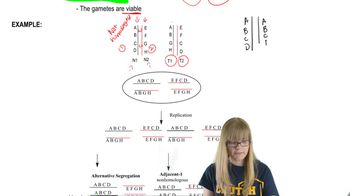
Chromosomal Translocations
Chromosomal translocations occur when segments from two different chromosomes break and reattach to each other. This rearrangement can disrupt normal gene function or create novel gene fusions, which may alter cellular behavior. Translocations are a common genetic abnormality in various cancers.
Recommended video:
Guided course
Reciprocal Translocation
Philadelphia Chromosome
The Philadelphia chromosome is a specific translocation between chromosomes 9 and 22, producing the BCR-ABL fusion gene. This abnormal gene encodes a constitutively active tyrosine kinase that drives uncontrolled cell division, primarily associated with chronic myeloid leukemia (CML).
Recommended video:
Guided course
Chromosome Structure
Oncogene Activation and Cancer Development
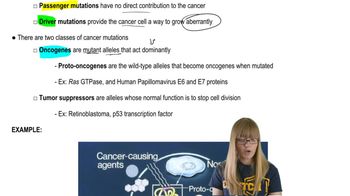
Oncogenes are mutated or abnormally expressed genes that promote cancer. Translocations can activate oncogenes by creating fusion proteins or misregulating gene expression, leading to increased cell proliferation and survival. This process is a key mechanism by which genetic changes contribute to cancer.
Recommended video:
Guided course
Cancer Mutations
Watch next
Master Cancer Characteristics with a bite sized video explanation from Kylia
Start learningRelated Videos
Related Practice
Textbook Question
474
views
