Go to the website http://www.ncbi.nlm.nih.gov/omim and enter 'Lynch syndrome' in the Search box at the top of the page. From the list of options given, select '#120435—Lynch Syndrome.' Use the information you retrieve to answer the following questions. Provide a brief summary of the normal functions of the protein products of these genes.
Table of contents
- 1. Introduction to Genetics51m
- 2. Mendel's Laws of Inheritance3h 37m
- 3. Extensions to Mendelian Inheritance2h 41m
- 4. Genetic Mapping and Linkage2h 28m
- 5. Genetics of Bacteria and Viruses1h 21m
- 6. Chromosomal Variation1h 48m
- 7. DNA and Chromosome Structure56m
- 8. DNA Replication1h 10m
- 9. Mitosis and Meiosis1h 34m
- 10. Transcription1h 0m
- 11. Translation58m
- 12. Gene Regulation in Prokaryotes1h 19m
- 13. Gene Regulation in Eukaryotes44m
- 14. Genetic Control of Development44m
- 15. Genomes and Genomics1h 50m
- 16. Transposable Elements47m
- 17. Mutation, Repair, and Recombination1h 6m
- 18. Molecular Genetic Tools19m
- 19. Cancer Genetics29m
- 20. Quantitative Genetics1h 26m
- 21. Population Genetics50m
- 22. Evolutionary Genetics29m
19. Cancer Genetics
Overview of Cancer
Problem 12
Textbook Question
If a cell suffers damage to its DNA while in S phase, how can this damage be repaired before the cell enters mitosis?
Verified step by step guidance1
Understand that the S phase is the part of the cell cycle where DNA replication occurs, so the DNA is being copied and is more vulnerable to damage.
Recognize that cells have specific DNA damage repair mechanisms active during S phase, such as the homologous recombination repair pathway, which uses the sister chromatid as a template for accurate repair.
Identify that the cell cycle has checkpoints, particularly the G2/M checkpoint, which monitors DNA integrity after replication and before mitosis to prevent progression if damage is detected.
Explain that if DNA damage is detected during S phase or G2, the cell cycle can be temporarily halted to allow repair mechanisms to fix the damage before mitosis begins.
Summarize that the combination of DNA repair pathways (like homologous recombination) and cell cycle checkpoints ensures that DNA damage incurred during S phase is repaired before the cell enters mitosis, maintaining genomic stability.
Verified video answer for a similar problem:This video solution was recommended by our tutors as helpful for the problem above
Video duration:
27sPlay a video:
Was this helpful?
Key Concepts
Here are the essential concepts you must grasp in order to answer the question correctly.
DNA Damage and Repair Mechanisms
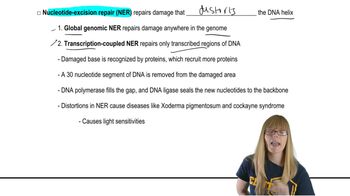
Cells have specialized pathways to detect and repair DNA damage, such as base excision repair, nucleotide excision repair, and homologous recombination. These mechanisms ensure genomic integrity by correcting errors before cell division.
Recommended video:
Guided course
Repair Pathways
S Phase and DNA Replication
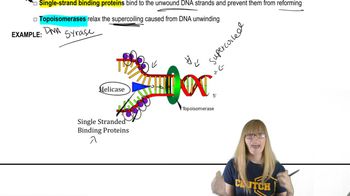
The S phase is the part of the cell cycle where DNA is replicated. During this phase, the cell is particularly vulnerable to DNA damage, but also has active repair systems to fix errors before replication completes and the cell progresses to mitosis.
Recommended video:
Guided course
Steps to DNA Replication
Cell Cycle Checkpoints
Checkpoints are control mechanisms that monitor and regulate the progression of the cell cycle. The G2/M checkpoint ensures that DNA damage is repaired after S phase and before mitosis, preventing the division of cells with damaged DNA.
Recommended video:
Guided course
Bacteriophage Life Cycle
Watch next
Master Cancer Characteristics with a bite sized video explanation from Kylia
Start learningRelated Videos
Related Practice
Textbook Question
365
views