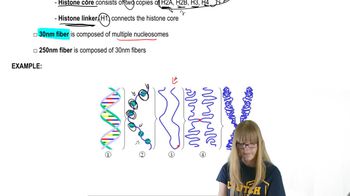
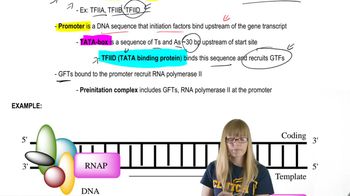
In eukaryotic DNA, where are you most likely to find histone protein H1?
Table of contents
- 1. Introduction to Genetics51m
- 2. Mendel's Laws of Inheritance3h 37m
- 3. Extensions to Mendelian Inheritance2h 41m
- 4. Genetic Mapping and Linkage2h 28m
- 5. Genetics of Bacteria and Viruses1h 21m
- 6. Chromosomal Variation1h 48m
- 7. DNA and Chromosome Structure56m
- 8. DNA Replication1h 10m
- 9. Mitosis and Meiosis1h 34m
- 10. Transcription1h 0m
- 11. Translation58m
- 12. Gene Regulation in Prokaryotes1h 19m
- 13. Gene Regulation in Eukaryotes44m
- 14. Genetic Control of Development44m
- 15. Genomes and Genomics1h 50m
- 16. Transposable Elements47m
- 17. Mutation, Repair, and Recombination1h 6m
- 18. Molecular Genetic Tools19m
- 19. Cancer Genetics29m
- 20. Quantitative Genetics1h 26m
- 21. Population Genetics50m
- 22. Evolutionary Genetics29m
7. DNA and Chromosome Structure
Eukaryotic Chromosome Structure
Problem 5
Textbook Question
What genetic process is occurring in a puff of a polytene chromosome? How do we know this experimentally?
Verified step by step guidance1
Understand that a puff in a polytene chromosome represents a region where the chromatin has decondensed, indicating active gene expression.
Recognize that the genetic process occurring in a puff is transcription, where RNA polymerase synthesizes RNA from the DNA template.
Recall that polytene chromosomes are large, banded chromosomes found in certain tissues (like salivary glands of Drosophila), allowing visualization of chromosomal activity under a microscope.
Know that experimental evidence for transcription in puffs comes from autoradiography experiments where radioactive RNA precursors (like 3H-uridine) are incorporated into newly synthesized RNA localized at the puff regions.
Conclude that the presence of newly synthesized RNA at the puff sites confirms that transcription is actively occurring in these regions of the polytene chromosome.
Verified video answer for a similar problem:This video solution was recommended by our tutors as helpful for the problem above
Video duration:
2mPlay a video:
Was this helpful?
Key Concepts
Here are the essential concepts you must grasp in order to answer the question correctly.
Polytene Chromosomes
Polytene chromosomes are oversized chromosomes found in certain tissues like the salivary glands of Drosophila. They result from repeated rounds of DNA replication without cell division, producing many aligned chromatids. Their distinctive banding patterns and puffs allow visualization of gene activity at the chromosomal level.
Recommended video:
Guided course
Chromosome Structure
Chromosomal Puffs and Gene Transcription
Chromosomal puffs are regions where the chromatin decondenses, indicating active gene transcription. These puffs represent sites where RNA polymerase and transcription factors are engaged in synthesizing RNA, making them visible markers of gene expression in polytene chromosomes.
Recommended video:
Guided course
Eukaryotic Transcription
Experimental Evidence for Transcription in Puffs
Experimental methods such as autoradiography with radioactive RNA precursors and in situ hybridization have shown that puffs correspond to sites of active RNA synthesis. Incorporation of labeled nucleotides into RNA at puff sites confirms that transcription is occurring there.
Recommended video:
Guided course
Eukaryotic Transcription
Related Videos
Related Practice
Textbook Question
442
views