Describe the importance of light and dark G bands that appear along chromosomes.
Table of contents
- 1. Introduction to Genetics51m
- 2. Mendel's Laws of Inheritance3h 37m
- 3. Extensions to Mendelian Inheritance2h 41m
- 4. Genetic Mapping and Linkage2h 28m
- 5. Genetics of Bacteria and Viruses1h 21m
- 6. Chromosomal Variation1h 48m
- 7. DNA and Chromosome Structure56m
- 8. DNA Replication1h 10m
- 9. Mitosis and Meiosis1h 34m
- 10. Transcription1h 0m
- 11. Translation58m
- 12. Gene Regulation in Prokaryotes1h 19m
- 13. Gene Regulation in Eukaryotes44m
- 14. Genetic Control of Development44m
- 15. Genomes and Genomics1h 50m
- 16. Transposable Elements47m
- 17. Mutation, Repair, and Recombination1h 6m
- 18. Molecular Genetic Tools19m
- 19. Cancer Genetics29m
- 20. Quantitative Genetics1h 26m
- 21. Population Genetics50m
- 22. Evolutionary Genetics29m
7. DNA and Chromosome Structure
Eukaryotic Chromosome Structure
Problem 7
Textbook Question
Why might we predict that the organization of eukaryotic genetic material will be more complex than that of viruses or bacteria?
Verified step by step guidance1
Step 1: Understand the basic differences in genetic material between eukaryotes, bacteria, and viruses. Eukaryotic cells have a nucleus and multiple linear chromosomes, while bacteria typically have a single circular chromosome, and viruses have much smaller genomes that can be DNA or RNA, often single or double-stranded.
Step 2: Consider the size and amount of genetic material. Eukaryotic genomes are generally much larger and contain more genes than bacterial or viral genomes, which requires more complex packaging and regulation.
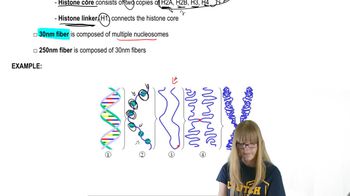
Step 3: Recognize the role of chromatin structure in eukaryotes. Eukaryotic DNA is wrapped around histone proteins forming nucleosomes, which further fold into higher-order structures, adding layers of complexity to DNA organization and accessibility.
Step 4: Think about gene regulation complexity. Eukaryotic genes often have introns and exons, and their expression is controlled by multiple regulatory elements and epigenetic modifications, unlike the simpler gene organization in bacteria and viruses.
Step 5: Summarize that the combination of larger genome size, linear chromosomes, chromatin packaging, and sophisticated gene regulation mechanisms leads to a more complex organization of eukaryotic genetic material compared to viruses or bacteria.
Verified video answer for a similar problem:This video solution was recommended by our tutors as helpful for the problem above
Video duration:
2mPlay a video:
Was this helpful?
Key Concepts
Here are the essential concepts you must grasp in order to answer the question correctly.
Eukaryotic Genome Structure
Eukaryotic genomes are organized into multiple linear chromosomes contained within a nucleus, unlike the typically single circular chromosome in bacteria or the compact genomes of viruses. This complexity allows for more genes and regulatory elements, contributing to intricate cellular functions.
Recommended video:
Guided course
Chromosome Structure
Chromatin and DNA Packaging
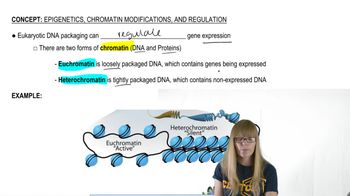
Eukaryotic DNA is wrapped around histone proteins forming chromatin, which further folds into higher-order structures. This packaging regulates gene expression and protects DNA, adding layers of complexity absent in most viral and bacterial genomes.
Recommended video:
Guided course
Chromatin
Gene Regulation and Non-coding DNA
Eukaryotic genomes contain extensive non-coding regions and complex regulatory sequences that control gene expression in time and space. Viruses and bacteria have simpler regulatory mechanisms, making eukaryotic genetic organization more intricate.
Recommended video:
Guided course
Non-Epistatic Genes
Related Videos
Related Practice
Textbook Question
486
views