Which of the following elements is a transposable element in Drosophila?
Table of contents
- 1. Introduction to Genetics51m
- 2. Mendel's Laws of Inheritance3h 37m
- 3. Extensions to Mendelian Inheritance2h 41m
- 4. Genetic Mapping and Linkage2h 28m
- 5. Genetics of Bacteria and Viruses1h 21m
- 6. Chromosomal Variation1h 48m
- 7. DNA and Chromosome Structure56m
- 8. DNA Replication1h 10m
- 9. Mitosis and Meiosis1h 34m
- 10. Transcription1h 0m
- 11. Translation58m
- 12. Gene Regulation in Prokaryotes1h 19m
- 13. Gene Regulation in Eukaryotes44m
- 14. Genetic Control of Development44m
- 15. Genomes and Genomics1h 50m
- 16. Transposable Elements47m
- 17. Mutation, Repair, and Recombination1h 6m
- 18. Molecular Genetic Tools19m
- 19. Cancer Genetics29m
- 20. Quantitative Genetics1h 26m
- 21. Population Genetics50m
- 22. Evolutionary Genetics29m
16. Transposable Elements
Transposable Elements in Eukaryotes
Problem 16
Textbook Question
Contrast the structure of SINE and LINE DNA sequences. Why are LINEs referred to as retrotransposons?
Verified step by step guidance1
Begin by defining SINEs (Short Interspersed Nuclear Elements) and LINEs (Long Interspersed Nuclear Elements) as two types of transposable elements found in the genome, emphasizing their role in genome structure and evolution.
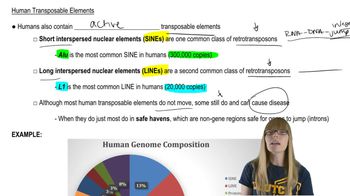
Explain the structural differences: SINEs are short sequences, typically around 100-300 base pairs, and do not encode proteins, whereas LINEs are much longer, often several thousand base pairs, and contain open reading frames that encode proteins necessary for their own mobilization.
Describe how LINEs have the machinery (such as reverse transcriptase and endonuclease) that allows them to copy and insert themselves into new locations in the genome, which is a key feature of retrotransposons.
Clarify that SINEs lack this machinery and rely on the proteins produced by LINEs to transpose, making them non-autonomous elements.
Conclude by explaining that LINEs are called retrotransposons because they transpose through an RNA intermediate that is reverse transcribed back into DNA before insertion, a process similar to retroviral replication.
Verified video answer for a similar problem:This video solution was recommended by our tutors as helpful for the problem above
Video duration:
1mPlay a video:
Was this helpful?
Key Concepts
Here are the essential concepts you must grasp in order to answer the question correctly.
Structure of SINEs (Short Interspersed Nuclear Elements)
SINEs are short DNA sequences, typically 100-300 base pairs long, that do not encode proteins. They rely on other elements for their mobility and are derived from small RNA genes like tRNA. SINEs are non-autonomous, meaning they cannot transpose by themselves.
Recommended video:
Guided course
Human Transposable Elements
Structure of LINEs (Long Interspersed Nuclear Elements)
LINEs are longer DNA sequences, usually 6,000 base pairs, that encode proteins necessary for their own retrotransposition, such as reverse transcriptase. They are autonomous elements capable of copying and inserting themselves into new genomic locations.
Recommended video:
Guided course
Human Transposable Elements
Retrotransposons and Their Mechanism
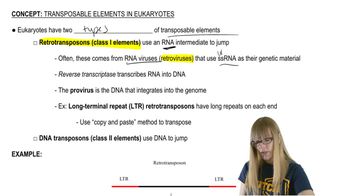
Retrotransposons are genetic elements that move within the genome via an RNA intermediate, which is reverse-transcribed back into DNA before insertion. LINEs are called retrotransposons because they encode enzymes enabling this copy-and-paste mechanism, unlike SINEs which depend on LINE machinery.
Recommended video:
Guided course
Eukaryotic Transposable Elements
Watch next
Master Eukaryotic Transposable Elements with a bite sized video explanation from Kylia
Start learningRelated Videos
Related Practice
Multiple Choice
387
views
1
rank