Which of the following is an example of a safe haven for transposon movement?
Table of contents
- 1. Introduction to Genetics51m
- 2. Mendel's Laws of Inheritance3h 37m
- 3. Extensions to Mendelian Inheritance2h 41m
- 4. Genetic Mapping and Linkage2h 28m
- 5. Genetics of Bacteria and Viruses1h 21m
- 6. Chromosomal Variation1h 48m
- 7. DNA and Chromosome Structure56m
- 8. DNA Replication1h 10m
- 9. Mitosis and Meiosis1h 34m
- 10. Transcription1h 0m
- 11. Translation58m
- 12. Gene Regulation in Prokaryotes1h 19m
- 13. Gene Regulation in Eukaryotes44m
- 14. Genetic Control of Development44m
- 15. Genomes and Genomics1h 50m
- 16. Transposable Elements47m
- 17. Mutation, Repair, and Recombination1h 6m
- 18. Molecular Genetic Tools19m
- 19. Cancer Genetics29m
- 20. Quantitative Genetics1h 26m
- 21. Population Genetics50m
- 22. Evolutionary Genetics29m
16. Transposable Elements
Transposable Elements in Eukaryotes
Problem 19
Textbook Question
Compare DNA transposons and retrotransposons. What properties do they share?
Verified step by step guidance1
Start by defining DNA transposons and retrotransposons to understand their basic nature: DNA transposons move via a 'cut-and-paste' mechanism using DNA intermediates, while retrotransposons move via a 'copy-and-paste' mechanism using an RNA intermediate.
Identify the key mechanism of transposition for each: DNA transposons use a transposase enzyme to excise and insert themselves directly as DNA, whereas retrotransposons use reverse transcriptase to convert RNA back into DNA before insertion.
List the shared properties by focusing on their common roles and features, such as both being mobile genetic elements capable of moving within the genome and both contributing to genome plasticity and evolution.
Highlight that both types can cause mutations or genomic rearrangements when they insert into new locations, affecting gene function or regulation.
Summarize by noting that despite differences in their transposition mechanisms, DNA transposons and retrotransposons share the fundamental property of being transposable elements that can move within the genome and impact genetic diversity.
Verified video answer for a similar problem:This video solution was recommended by our tutors as helpful for the problem above
Video duration:
2mPlay a video:
Was this helpful?
Key Concepts
Here are the essential concepts you must grasp in order to answer the question correctly.
DNA Transposons
DNA transposons are mobile genetic elements that move within the genome via a 'cut-and-paste' mechanism. They excise themselves from one location and insert into another without an RNA intermediate, often using a transposase enzyme. This movement can cause mutations or genome rearrangements.
Recommended video:
Guided course
DNA Proofreading
Retrotransposons
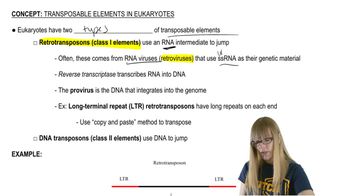
Retrotransposons move through a 'copy-and-paste' mechanism involving an RNA intermediate. They are transcribed into RNA, then reverse-transcribed back into DNA, which integrates at a new genomic site. This process increases their copy number and can impact genome size and function.
Recommended video:
Guided course
Eukaryotic Transposable Elements
Shared Properties of Transposons
Both DNA transposons and retrotransposons are types of transposable elements that can move within the genome, contributing to genetic diversity and evolution. They can disrupt gene function or regulation and often carry sequences that facilitate their mobility, such as terminal repeats or coding for enzymes like transposase or reverse transcriptase.
Recommended video:
Guided course
Prokaryotic Transposable Elements
Watch next
Master Eukaryotic Transposable Elements with a bite sized video explanation from Kylia
Start learningRelated Videos
Related Practice
Multiple Choice
478
views
1
rank
