Which of the following would occur if an Alu element jumped into the AG splice site of a human gene?
Table of contents
- 1. Introduction to Genetics51m
- 2. Mendel's Laws of Inheritance3h 37m
- 3. Extensions to Mendelian Inheritance2h 41m
- 4. Genetic Mapping and Linkage2h 28m
- 5. Genetics of Bacteria and Viruses1h 21m
- 6. Chromosomal Variation1h 48m
- 7. DNA and Chromosome Structure56m
- 8. DNA Replication1h 10m
- 9. Mitosis and Meiosis1h 34m
- 10. Transcription1h 0m
- 11. Translation58m
- 12. Gene Regulation in Prokaryotes1h 19m
- 13. Gene Regulation in Eukaryotes44m
- 14. Genetic Control of Development44m
- 15. Genomes and Genomics1h 50m
- 16. Transposable Elements47m
- 17. Mutation, Repair, and Recombination1h 6m
- 18. Molecular Genetic Tools19m
- 19. Cancer Genetics29m
- 20. Quantitative Genetics1h 26m
- 21. Population Genetics50m
- 22. Evolutionary Genetics29m
16. Transposable Elements
Transposable Elements in Eukaryotes
Problem 21
Textbook Question
In maize, a Ds or Ac transposon can alter the function of genes at or near the site of transposon insertion. It is possible for these elements to transpose away from their original insertion site, causing a reversion of the mutant phenotype. In some cases, however, even more severe phenotypes appear, due to events at or near the mutant allele. What might be happening to the transposon or the nearby gene to create more severe mutations?
Verified step by step guidance1
Understand that transposons like Ds (Dissociation) and Ac (Activator) can move within the genome, which can disrupt gene function when they insert into or near genes.
Recognize that when a transposon excises (moves out) from its original site, it can sometimes restore the gene's function, leading to a reversion of the mutant phenotype.
Consider that during the excision process, the transposon may not leave the DNA cleanly; it can cause small insertions or deletions (indels) at the excision site, which can further disrupt the gene.
Realize that these imprecise excision events can create more severe mutations if they alter the coding sequence or regulatory regions of the gene, potentially causing frameshifts or loss of important gene elements.
Also, transposon movement can cause chromosomal rearrangements or affect nearby genes, which might contribute to the appearance of more severe phenotypes.
Verified video answer for a similar problem:This video solution was recommended by our tutors as helpful for the problem above
Video duration:
51sPlay a video:
Was this helpful?
Key Concepts
Here are the essential concepts you must grasp in order to answer the question correctly.
Transposons and Their Mechanism of Transposition
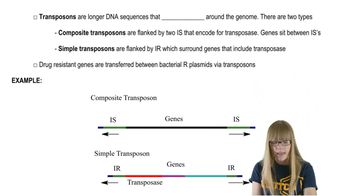
Transposons, such as Ds and Ac elements in maize, are DNA sequences that can move within the genome. They insert into genes or regulatory regions, disrupting normal gene function. Their movement can be cut-and-paste or replicative, causing mutations or reversions depending on insertion or excision events.
Recommended video:
Guided course
Prokaryotic Transposable Elements
Effects of Transposon Excision and Footprint Mutations
When a transposon excises from a gene, it may leave behind small insertions or deletions called footprints. These residual changes can alter the gene's coding sequence or regulatory elements, sometimes causing more severe mutations than the original insertion by disrupting gene function more extensively.
Recommended video:
Guided course
Maternal Effect
Local Genomic Instability Induced by Transposons
Transposon activity can induce genomic instability near the insertion site, including chromosomal rearrangements, duplications, or deletions. Such events can exacerbate mutant phenotypes by affecting multiple genes or regulatory regions, leading to more severe or novel mutations beyond simple insertional disruption.
Recommended video:
Guided course
Induced Mutations
Watch next
Master Eukaryotic Transposable Elements with a bite sized video explanation from Kylia
Start learningRelated Videos
Related Practice
Multiple Choice
404
views
5
rank
2
comments