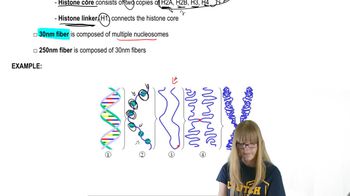
Describe the sequence of research findings that led to the development of the model of chromatin structure.
Table of contents
- 1. Introduction to Genetics51m
- 2. Mendel's Laws of Inheritance3h 37m
- 3. Extensions to Mendelian Inheritance2h 41m
- 4. Genetic Mapping and Linkage2h 28m
- 5. Genetics of Bacteria and Viruses1h 21m
- 6. Chromosomal Variation1h 48m
- 7. DNA and Chromosome Structure56m
- 8. DNA Replication1h 10m
- 9. Mitosis and Meiosis1h 34m
- 10. Transcription1h 0m
- 11. Translation58m
- 12. Gene Regulation in Prokaryotes1h 19m
- 13. Gene Regulation in Eukaryotes44m
- 14. Genetic Control of Development44m
- 15. Genomes and Genomics1h 50m
- 16. Transposable Elements47m
- 17. Mutation, Repair, and Recombination1h 6m
- 18. Molecular Genetic Tools19m
- 19. Cancer Genetics29m
- 20. Quantitative Genetics1h 26m
- 21. Population Genetics50m
- 22. Evolutionary Genetics29m
7. DNA and Chromosome Structure
Eukaryotic Chromosome Structure
Problem 12
Textbook Question
Mammals contain a diploid genome consisting of at least 10⁹ bp. If this amount of DNA is present as chromatin fibers, where each group of 200 bp of DNA is combined with 9 histones into a nucleosome and each group of 6 nucleosomes is combined into a solenoid, achieving a final packing ratio of 50, determine:
(a) the total number of nucleosomes in all fibers,
(b) the total number of histone molecules combined with DNA in the diploid genome, and
(c) the combined length of all fibers.
Verified step by step guidance1
Identify the total amount of DNA base pairs (bp) given, which is at least 10⁹ bp for the diploid genome.
Calculate the total number of nucleosomes by dividing the total base pairs by the number of base pairs per nucleosome. Since each nucleosome contains 200 bp, use the formula: \(\text{Number of nucleosomes} = \frac{10^{9} \text{ bp}}{200 \text{ bp/nucleosome}}\).
Determine the total number of histone molecules by multiplying the number of nucleosomes by the number of histones per nucleosome. Given that each nucleosome has 9 histones, use: \(\text{Total histones} = \text{Number of nucleosomes} \times 9\).
Calculate the combined length of all chromatin fibers before packing. First, find the length of DNA per base pair (approximately 0.34 nm per bp), then multiply by the total number of base pairs: \(\text{DNA length} = 10^{9} \text{ bp} \times 0.34 \text{ nm/bp}\).
Adjust the length of the fibers to account for the packing ratio of 50, which means the chromatin fiber length is reduced by a factor of 50 compared to the extended DNA length. Use: \(\text{Fiber length} = \frac{\text{DNA length}}{50}\).
Verified video answer for a similar problem:This video solution was recommended by our tutors as helpful for the problem above
Video duration:
1mPlay a video:
Was this helpful?
Key Concepts
Here are the essential concepts you must grasp in order to answer the question correctly.
Nucleosome Structure and Composition
A nucleosome is the fundamental unit of chromatin, consisting of approximately 200 base pairs of DNA wrapped around a histone octamer made up of 8 histone proteins. The question states 9 histones per nucleosome, which may include an additional linker histone. Understanding nucleosome composition is essential to calculate the total number of nucleosomes and histones in the genome.
Recommended video:
Guided course
Chromosome Structure
Chromatin Fiber Organization and Solenoid Model
Chromatin fibers are formed by nucleosomes arranged into higher-order structures. Six nucleosomes fold into a solenoid fiber, which compacts DNA further. This hierarchical organization affects the overall length and packing ratio of DNA, crucial for determining the combined length of chromatin fibers.
Recommended video:
Guided course
Histone Protein Modifications
DNA Packing Ratio and Genome Size
The packing ratio describes how much the DNA length is reduced by chromatin folding. Given a diploid genome size of 10⁹ base pairs and a packing ratio of 50, this ratio helps convert the total DNA length into the length of compacted chromatin fibers, enabling calculations of fiber length and nucleosome numbers.
Recommended video:
Guided course
Sequencing Difficulties
Related Videos
Related Practice
Textbook Question
495
views