What genetic process is occurring in a puff of a polytene chromosome? How do we know this experimentally?
Table of contents
- 1. Introduction to Genetics51m
- 2. Mendel's Laws of Inheritance3h 37m
- 3. Extensions to Mendelian Inheritance2h 41m
- 4. Genetic Mapping and Linkage2h 28m
- 5. Genetics of Bacteria and Viruses1h 21m
- 6. Chromosomal Variation1h 48m
- 7. DNA and Chromosome Structure56m
- 8. DNA Replication1h 10m
- 9. Mitosis and Meiosis1h 34m
- 10. Transcription1h 0m
- 11. Translation58m
- 12. Gene Regulation in Prokaryotes1h 19m
- 13. Gene Regulation in Eukaryotes44m
- 14. Genetic Control of Development44m
- 15. Genomes and Genomics1h 50m
- 16. Transposable Elements47m
- 17. Mutation, Repair, and Recombination1h 6m
- 18. Molecular Genetic Tools19m
- 19. Cancer Genetics29m
- 20. Quantitative Genetics1h 26m
- 21. Population Genetics50m
- 22. Evolutionary Genetics29m
7. DNA and Chromosome Structure
Eukaryotic Chromosome Structure
Problem 9
Textbook Question
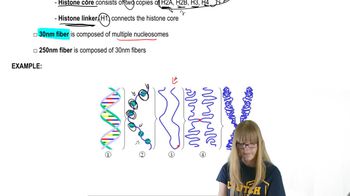
Describe the molecular composition and arrangement of the components in the nucleosome.
Verified step by step guidance1
Begin by identifying the core components of a nucleosome, which include DNA and histone proteins.
Explain that the nucleosome consists of approximately 147 base pairs of DNA wrapped around a histone octamer.
Describe the histone octamer as being composed of two copies each of four different histone proteins: H2A, H2B, H3, and H4.
Clarify that the DNA wraps around the histone octamer in about 1.65 left-handed superhelical turns, which helps compact the DNA.
Mention the role of the linker histone H1, which binds to the DNA between nucleosomes and helps stabilize the higher-order chromatin structure.
Verified video answer for a similar problem:This video solution was recommended by our tutors as helpful for the problem above
Video duration:
1mPlay a video:
Was this helpful?
Key Concepts
Here are the essential concepts you must grasp in order to answer the question correctly.
Nucleosome Structure
A nucleosome is the fundamental unit of chromatin, consisting of DNA wrapped around a histone protein core. It compacts DNA and regulates its accessibility, playing a key role in gene expression and DNA packaging.
Recommended video:
Guided course
Chromosome Structure
Histone Proteins
Histones are positively charged proteins (H2A, H2B, H3, and H4) that form an octamer core around which DNA wraps. Their interaction with DNA helps neutralize negative charges and facilitates tight DNA packaging.
Recommended video:
Guided course
Proteins
DNA-Histone Interaction
Approximately 147 base pairs of DNA wrap around the histone octamer in about 1.65 turns. This interaction is stabilized by electrostatic forces and hydrogen bonds, enabling efficient DNA compaction while allowing dynamic access for cellular processes.
Recommended video:
Guided course
Interacting Genes Overview
Related Videos
Related Practice
Textbook Question
752
views