During what genetic process are lampbrush chromosomes present in vertebrates?
Table of contents
- 1. Introduction to Genetics51m
- 2. Mendel's Laws of Inheritance3h 37m
- 3. Extensions to Mendelian Inheritance2h 41m
- 4. Genetic Mapping and Linkage2h 28m
- 5. Genetics of Bacteria and Viruses1h 21m
- 6. Chromosomal Variation1h 48m
- 7. DNA and Chromosome Structure56m
- 8. DNA Replication1h 10m
- 9. Mitosis and Meiosis1h 34m
- 10. Transcription1h 0m
- 11. Translation58m
- 12. Gene Regulation in Prokaryotes1h 19m
- 13. Gene Regulation in Eukaryotes44m
- 14. Genetic Control of Development44m
- 15. Genomes and Genomics1h 50m
- 16. Transposable Elements47m
- 17. Mutation, Repair, and Recombination1h 6m
- 18. Molecular Genetic Tools19m
- 19. Cancer Genetics29m
- 20. Quantitative Genetics1h 26m
- 21. Population Genetics50m
- 22. Evolutionary Genetics29m
7. DNA and Chromosome Structure
Eukaryotic Chromosome Structure
Problem 10
Textbook Question
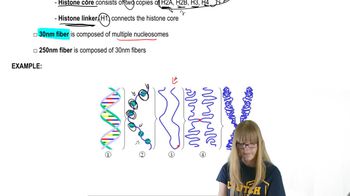
Describe the transitions that occur as nucleosomes are coiled and folded, ultimately forming a chromatid.
Verified step by step guidance1
Begin by understanding that DNA is initially wrapped around histone proteins to form nucleosomes, which resemble 'beads on a string.' This is the first level of chromatin organization.
Next, recognize that these nucleosomes coil further into a 30 nm fiber, often described as a solenoid or zigzag structure, which compacts the DNA more tightly.
Then, the 30 nm fiber forms looped domains by attaching to a protein scaffold, creating loops that further condense the chromatin.
Following this, the looped domains themselves coil and fold into even higher-order structures, increasing the level of compaction necessary for chromosome formation.
Finally, these highly condensed and folded chromatin fibers form the visible chromatid, which is one half of a duplicated chromosome, ready for cell division.
Verified video answer for a similar problem:This video solution was recommended by our tutors as helpful for the problem above
Video duration:
2mPlay a video:
Was this helpful?
Key Concepts
Here are the essential concepts you must grasp in order to answer the question correctly.
Nucleosome Structure
Nucleosomes are the fundamental units of chromatin, consisting of DNA wrapped around histone protein octamers. This structure compacts DNA and regulates its accessibility, serving as the first level of DNA packaging in the nucleus.
Recommended video:
Guided course
Chromosome Structure
Chromatin Fiber Formation
Nucleosomes coil into a 30-nanometer chromatin fiber through interactions between histone tails and linker DNA. This secondary structure further compacts DNA and organizes it into a more condensed form, preparing it for higher-order folding.
Recommended video:
Guided course
Chromatin
Higher-Order Chromatin Folding into Chromatids
The 30-nanometer fiber loops and folds into larger loops attached to a protein scaffold, forming the highly condensed chromatid structure seen during mitosis. This hierarchical folding ensures efficient DNA segregation during cell division.
Recommended video:
Guided course
Chromatin
Related Videos
Related Practice
Textbook Question
776
views