In selective breeding experiments, it is frequently observed that the strains respond to artificial selection for many generations, with the selected phenotype changing in the desired direction. Often, however, the response to artificial selection reaches a plateau after many generations, and the phenotype no longer changes as it did in past generations. Once a plateau has been reached, is the heritability of the trait very high or is it very low? Explain.
Table of contents
- 1. Introduction to Genetics51m
- 2. Mendel's Laws of Inheritance3h 37m
- 3. Extensions to Mendelian Inheritance2h 41m
- 4. Genetic Mapping and Linkage2h 28m
- 5. Genetics of Bacteria and Viruses1h 21m
- 6. Chromosomal Variation1h 48m
- 7. DNA and Chromosome Structure56m
- 8. DNA Replication1h 10m
- 9. Mitosis and Meiosis1h 34m
- 10. Transcription1h 0m
- 11. Translation58m
- 12. Gene Regulation in Prokaryotes1h 19m
- 13. Gene Regulation in Eukaryotes44m
- 14. Genetic Control of Development44m
- 15. Genomes and Genomics1h 50m
- 16. Transposable Elements47m
- 17. Mutation, Repair, and Recombination1h 6m
- 18. Molecular Genetic Tools19m
- 19. Cancer Genetics29m
- 20. Quantitative Genetics1h 26m
- 21. Population Genetics50m
- 22. Evolutionary Genetics29m
20. Quantitative Genetics
Heritability
Problem 14b
Textbook Question
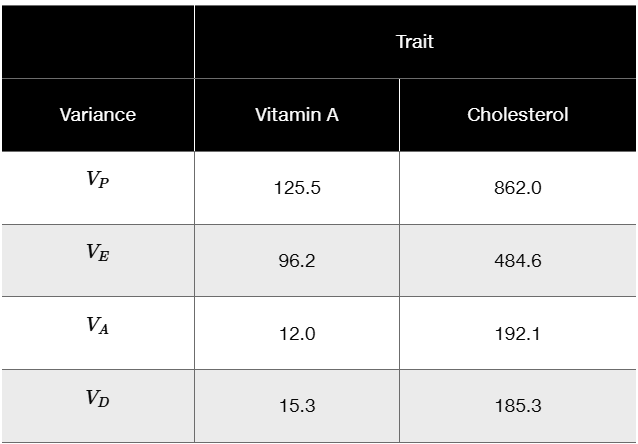
A hypothetical study investigated the vitamin A content and the cholesterol content of eggs from a large population of chickens. The following variances (V) were calculated.

Which trait, if either, is likely to respond to selection?
Verified step by step guidance1
Step 1: Understand the variances given in the table. \(V_P\) is the phenotypic variance, which is the total observed variance in the trait. \(V_E\) is the environmental variance, representing variation due to environmental factors. \(V_A\) is the additive genetic variance, which is the portion of genetic variance that contributes to resemblance between parents and offspring. \(V_D\) is the dominance genetic variance, which arises from interactions between alleles at the same locus.
Step 2: Recall that the response to selection depends primarily on the additive genetic variance (\(V_A\)) because only additive effects are reliably passed from parents to offspring and thus contribute to heritability.
Step 3: Calculate the narrow-sense heritability (\(h^2\)) for each trait using the formula:
\[h^2 = \frac{V_A}{V_P}\]
This ratio tells us the proportion of phenotypic variance that is due to additive genetic variance.
Step 4: Compare the \(h^2\) values for Vitamin A and Cholesterol. The trait with the higher \(h^2\) is more likely to respond to selection because it has a greater proportion of additive genetic variance relative to total phenotypic variance.
Step 5: Conclude which trait is likely to respond to selection based on the calculated heritabilities, keeping in mind that traits with low additive genetic variance or low heritability will respond less effectively to selection.
Verified video answer for a similar problem:This video solution was recommended by our tutors as helpful for the problem above
Video duration:
1mPlay a video:
Was this helpful?
Key Concepts
Here are the essential concepts you must grasp in order to answer the question correctly.
Phenotypic Variance (V_P)
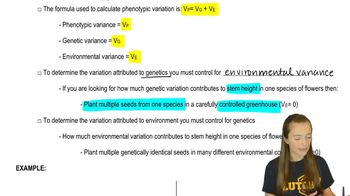
Phenotypic variance represents the total observed variation in a trait within a population. It includes genetic variance (both additive and dominance) and environmental variance. Understanding V_P is essential to partition the sources of variation affecting the trait.
Recommended video:
Guided course
Analyzing Trait Variance
Additive Genetic Variance (V_A)
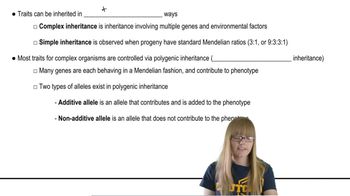
Additive genetic variance is the portion of genetic variance attributed to the additive effects of alleles. It is crucial for predicting response to selection because only additive effects are reliably passed from parents to offspring, influencing trait heritability.
Recommended video:
Guided course
Traits and Variance
Heritability and Response to Selection
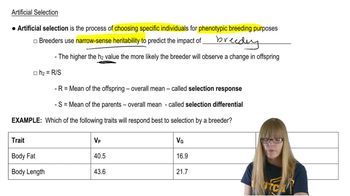
Heritability in the narrow sense is the ratio of additive genetic variance to phenotypic variance (h² = V_A / V_P). Traits with higher heritability are more likely to respond to selection because additive genetic effects drive evolutionary change.
Recommended video:
Guided course
Artificial Selection
Watch next
Master Calculating Heritability with a bite sized video explanation from Kylia
Start learningRelated Videos
Related Practice
Textbook Question
519
views
