What kind of heritability estimates (broad sense or narrow sense) are obtained from human twin studies?
Table of contents
- 1. Introduction to Genetics51m
- 2. Mendel's Laws of Inheritance3h 37m
- 3. Extensions to Mendelian Inheritance2h 41m
- 4. Genetic Mapping and Linkage2h 28m
- 5. Genetics of Bacteria and Viruses1h 21m
- 6. Chromosomal Variation1h 48m
- 7. DNA and Chromosome Structure56m
- 8. DNA Replication1h 10m
- 9. Mitosis and Meiosis1h 34m
- 10. Transcription1h 0m
- 11. Translation58m
- 12. Gene Regulation in Prokaryotes1h 19m
- 13. Gene Regulation in Eukaryotes44m
- 14. Genetic Control of Development44m
- 15. Genomes and Genomics1h 50m
- 16. Transposable Elements47m
- 17. Mutation, Repair, and Recombination1h 6m
- 18. Molecular Genetic Tools19m
- 19. Cancer Genetics29m
- 20. Quantitative Genetics1h 26m
- 21. Population Genetics50m
- 22. Evolutionary Genetics29m
20. Quantitative Genetics
Heritability
Problem 12b
Textbook Question
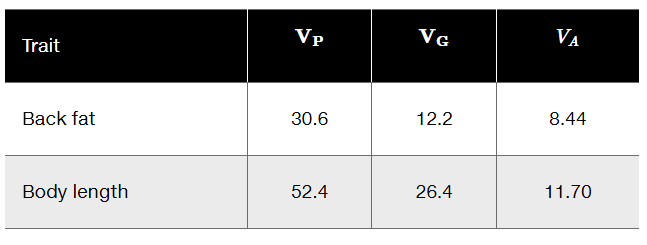
The following variances were calculated for two traits in a herd of hogs.

Which of the two traits will respond best to selection by a breeder? Why?
Verified step by step guidance1
Step 1: Understand the key variances given in the table: \(V_P\) (phenotypic variance), \(V_G\) (genetic variance), and \(V_A\) (additive genetic variance) for each trait. These variances help us understand the genetic contribution to the traits and their potential response to selection.
Step 2: Recall that the response to selection depends primarily on the narrow-sense heritability (\(h^2\)), which is the proportion of phenotypic variance due to additive genetic variance. It is calculated as:
\[h^2 = \frac{V_A}{V_P}\]
Step 3: Calculate the narrow-sense heritability for each trait using the formula above. This will give you a measure of how much of the trait's variation is heritable and can be passed on to the next generation.
Step 4: Compare the heritability values for back fat and body length. The trait with the higher \(h^2\) value will respond better to selection because a greater proportion of its variation is due to additive genetic factors.
Step 5: Conclude which trait will respond best to selection based on the higher heritability value, and explain that this is because selection acts on additive genetic variance, which directly influences the trait's improvement in the population.
Verified video answer for a similar problem:This video solution was recommended by our tutors as helpful for the problem above
Video duration:
2mPlay a video:
Was this helpful?
Key Concepts
Here are the essential concepts you must grasp in order to answer the question correctly.
Phenotypic Variance (VP)
Phenotypic variance (VP) represents the total variation observed in a trait within a population. It includes both genetic variance and environmental variance, reflecting all factors that contribute to differences in the trait among individuals.
Recommended video:
Guided course
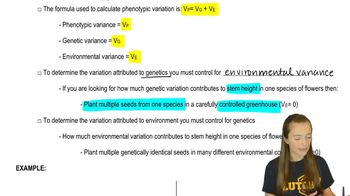
Analyzing Trait Variance
Additive Genetic Variance (VA)
Additive genetic variance (VA) is the portion of genetic variance that contributes to the resemblance between parents and offspring. It represents the cumulative effect of individual alleles and is crucial for predicting the response to selection in breeding programs.
Recommended video:
Guided course
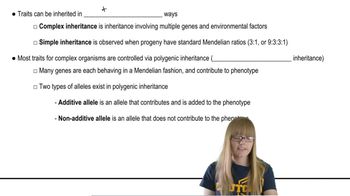
Traits and Variance
Heritability and Response to Selection
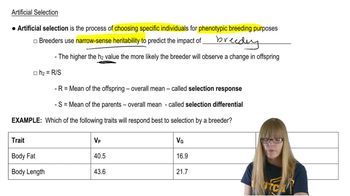
Heritability in the narrow sense (h²) is the ratio of additive genetic variance to phenotypic variance (VA/VP). It indicates the proportion of trait variation due to additive genetics and predicts how effectively a trait will respond to selection by breeders.
Recommended video:
Guided course
Artificial Selection
Watch next
Master Calculating Heritability with a bite sized video explanation from Kylia
Start learningRelated Videos
Related Practice
Textbook Question
1087
views
