New allopolyploid plant species can arise by hybridization between two species. If hybridization occurs between a diploid plant species with 2n = 14 and a second diploid species with 2n = 22, the new allopolyploid would have 36 chromosomes. What pattern of speciation is illustrated by the development of the allopolyploid species?
Verified step by step guidance
1
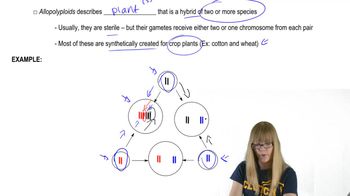
Understand the concept of allopolyploidy: Allopolyploidy occurs when two different species hybridize, and the resulting hybrid undergoes chromosome doubling, leading to a new species with a combination of chromosomes from both parent species.
Identify the chromosome numbers of the parent species: The first diploid species has 2n = 14 chromosomes, and the second diploid species has 2n = 22 chromosomes. These represent the total chromosome counts for each species.
Determine the chromosome count in the hybrid: When hybridization occurs, the hybrid initially inherits one set of chromosomes from each parent species. This results in a hybrid with n = 7 (from the first species) + n = 11 (from the second species), giving a total of 18 chromosomes.
Explain chromosome doubling in allopolyploidy: In allopolyploidy, the hybrid undergoes chromosome doubling, which duplicates the chromosome count. Doubling the 18 chromosomes results in 36 chromosomes in the new allopolyploid species.
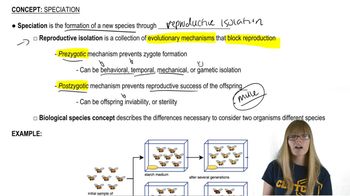
Conclude the pattern of speciation: The development of the allopolyploid species illustrates a form of sympatric speciation, where a new species arises without geographic isolation, through hybridization and chromosome doubling.
Verified video answer for a similar problem:
This video solution was recommended by our tutors as helpful for the problem above
Video duration:
1m
Play a video:
Was this helpful?
Key Concepts
Here are the essential concepts you must grasp in order to answer the question correctly.
Allopolyploidy
Allopolyploidy is a form of polyploidy that occurs when two different species hybridize, resulting in a new species with multiple sets of chromosomes from both parent species. In the case of the new plant species described, the combination of the diploid chromosome sets from both parent species leads to a total of 36 chromosomes, illustrating how genetic material from different species can combine to create viable offspring.
Hybridization is the process where two distinct species interbreed to produce hybrid offspring. This can occur naturally or through human intervention. In the context of the question, hybridization between the two diploid species results in a hybrid that possesses genetic material from both parents, which is crucial for the subsequent formation of the allopolyploid species.
Speciation is the evolutionary process by which populations evolve to become distinct species. The development of an allopolyploid species through hybridization exemplifies a specific pattern of speciation known as sympatric speciation, where new species arise from a common ancestor while inhabiting the same geographic area, often facilitated by genetic changes such as polyploidy.