New allopolyploid plant species can arise by hybridization between two species. If hybridization occurs between a diploid plant species with 2n = 14 and a second diploid species with 2n = 22, the new allopolyploid would have 36 chromosomes. What type of isolation mechanism is most likely to prevent hybridization between the allopolyploid and the diploid species?
Verified step by step guidance
1
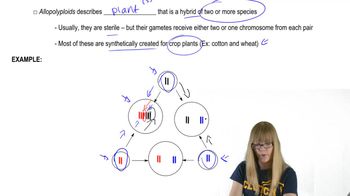
Step 1: Understand the concept of allopolyploidy. Allopolyploidy occurs when two different species hybridize, and their chromosomes combine to form a new species with a unique chromosome number. In this case, the hybridization involves two diploid species with chromosome numbers 2n = 14 and 2n = 22, resulting in an allopolyploid with 36 chromosomes.
Step 2: Recognize that the new allopolyploid species has a different chromosome number compared to the original diploid species. This difference in chromosome number can lead to reproductive isolation because the chromosomes may not pair correctly during meiosis, preventing viable offspring.
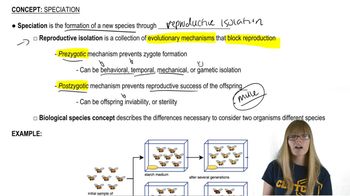
Step 3: Identify the type of isolation mechanism. The most likely mechanism preventing hybridization between the allopolyploid and the diploid species is postzygotic isolation. This occurs when hybrid offspring are inviable or sterile due to mismatched chromosome sets.
Step 4: Consider the role of genetic incompatibility. The inability of the chromosomes from the diploid species to pair correctly with the chromosomes of the allopolyploid during meiosis is a form of genetic incompatibility, which reinforces reproductive isolation.
Step 5: Conclude that the isolation mechanism is primarily postzygotic, as it prevents the formation of fertile hybrids between the allopolyploid and the diploid species, ensuring the genetic distinctiveness of the new allopolyploid species.
Verified video answer for a similar problem:
This video solution was recommended by our tutors as helpful for the problem above
Video duration:
1m
Play a video:
Was this helpful?
Key Concepts
Here are the essential concepts you must grasp in order to answer the question correctly.
Allopolyploidy
Allopolyploidy is a form of polyploidy that occurs when two different species hybridize and the resulting offspring have multiple sets of chromosomes from both parent species. In this case, the new allopolyploid plant species has a chromosome number that is the sum of the two parent species' chromosome counts, leading to increased genetic diversity and potential for adaptation.
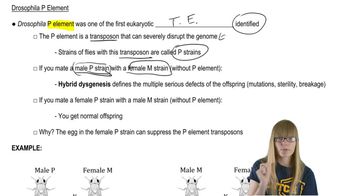
Hybridization is the process where two different species interbreed to produce hybrid offspring. This can occur between closely related species and can lead to the formation of new species, such as allopolyploids, which can have unique traits and adaptations. However, hybridization is often limited by various reproductive barriers.
Reproductive isolation mechanisms are biological features that prevent species from interbreeding and producing viable offspring. These mechanisms can be prezygotic, such as temporal or ecological isolation, or postzygotic, such as hybrid inviability. In the context of the question, these mechanisms are crucial for understanding how the new allopolyploid might be prevented from hybridizing with the original diploid species.