Indicate the expected number of Barr bodies in interphase cells of individuals with Klinefelter syndrome, Turner syndrome, and karyotypes 47, XYY, 47, XXX, and 48, XXXX.
Table of contents
- 1. Introduction to Genetics51m
- 2. Mendel's Laws of Inheritance3h 37m
- 3. Extensions to Mendelian Inheritance2h 41m
- 4. Genetic Mapping and Linkage2h 28m
- 5. Genetics of Bacteria and Viruses1h 21m
- 6. Chromosomal Variation1h 48m
- 7. DNA and Chromosome Structure56m
- 8. DNA Replication1h 10m
- 9. Mitosis and Meiosis1h 34m
- 10. Transcription1h 0m
- 11. Translation58m
- 12. Gene Regulation in Prokaryotes1h 19m
- 13. Gene Regulation in Eukaryotes44m
- 14. Genetic Control of Development44m
- 15. Genomes and Genomics1h 50m
- 16. Transposable Elements47m
- 17. Mutation, Repair, and Recombination1h 6m
- 18. Molecular Genetic Tools19m
- 19. Cancer Genetics29m
- 20. Quantitative Genetics1h 26m
- 21. Population Genetics50m
- 22. Evolutionary Genetics29m
6. Chromosomal Variation
Chromosomal Mutations: Aneuploidy
Problem 18
Textbook Question
Mendelian ratios are modified in crosses involving autotetraploids. Assume that one plant expresses the dominant trait green seeds and is homozygous (WWWW). This plant is crossed to one with white seeds that is also homozygous (wwww). If only one dominant allele is sufficient to produce green seeds, predict the F₁ and F₂ results of such a cross. Assume that synapsis between chromosome pairs is random during meiosis.
Verified step by step guidance1
Step 1: Understand the genetic setup. We have an autotetraploid organism with four copies of each gene. The green seed trait is dominant (W), and white seed is recessive (w). The homozygous green parent genotype is WWWW, and the homozygous white parent genotype is wwww.
Step 2: Determine the genotype of the F₁ generation. Since the green parent (WWWW) is crossed with the white parent (wwww), all F₁ offspring will inherit two W alleles from the green parent and two w alleles from the white parent, resulting in the genotype WWww.
Step 3: Understand allele segregation in autotetraploids. During meiosis, chromosome pairing (synapsis) is random, so gametes can have different combinations of W and w alleles. The possible gametes from a WWww individual can be calculated using the binomial distribution for allele segregation.
Step 4: Calculate the gamete genotype frequencies from the F₁ (WWww). The possible gametes are WW, Ww, and ww, with probabilities given by the formula for combinations of alleles in autotetraploid meiosis: \(P(k) = \frac{\binom{2}{k} \binom{2}{2-k}}{\binom{4}{2}}\), where \(k\) is the number of W alleles in the gamete.
Step 5: Predict the F₂ generation genotypes and phenotypes by crossing the gametes from the F₁ generation. Use the gamete frequencies to set up a Punnett square or probability matrix, then determine the genotype frequencies of the F₂. Since only one dominant allele is needed for green seeds, calculate the proportion of green (at least one W) and white (all w) phenotypes.
Verified video answer for a similar problem:This video solution was recommended by our tutors as helpful for the problem above
Video duration:
3mPlay a video:
Was this helpful?
Key Concepts
Here are the essential concepts you must grasp in order to answer the question correctly.
Autotetraploidy and Chromosome Pairing
Autotetraploids have four copies of each chromosome, originating from genome duplication within a species. During meiosis, chromosomes can pair randomly as bivalents or multivalents, affecting segregation patterns. This random synapsis alters expected Mendelian ratios compared to diploids, influencing genotype and phenotype frequencies in offspring.
Recommended video:
Guided course
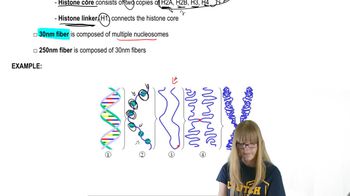
Chromosome Structure
Dominance and Allelic Interaction in Polyploids
In polyploids, a single dominant allele can mask the effect of multiple recessive alleles, producing the dominant phenotype. For a trait controlled by one dominant allele (e.g., green seeds), any genotype with at least one 'W' allele will show green seeds, while only the homozygous recessive (wwww) shows white seeds. This affects phenotypic ratios in progeny.
Recommended video:
Guided course
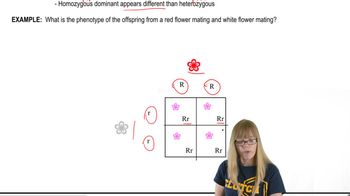
Variations on Dominance
Segregation and Phenotypic Ratios in Polyploid Crosses
Segregation in autotetraploids follows more complex patterns due to multiple chromosome copies and random pairing. The F₁ generation from a homozygous dominant (WWWW) crossed with homozygous recessive (wwww) will be all heterozygous (Wwww) and green. The F₂ generation shows modified ratios, with a higher proportion of dominant phenotypes than diploid Mendelian ratios due to multiple allele combinations.
Recommended video:
Guided course
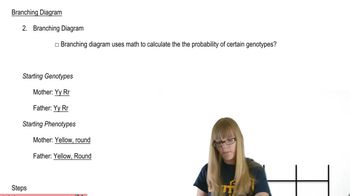
Branch Diagram
Related Videos
Related Practice
Textbook Question
885
views
